

Editor’s note (June 12th): This article was lightly updated when trading closed.
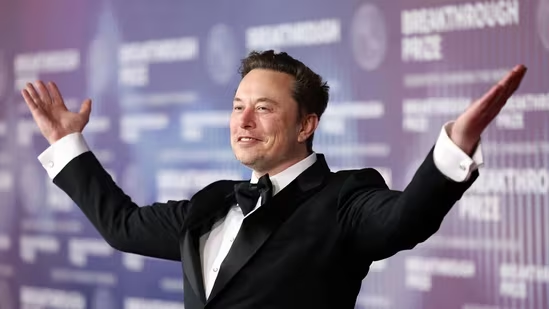
IT WAS THE IPO that was never supposed to happen. On June 12th Elon Musk rang the Nasdaq’s opening bell from the Texas headquarters of SpaceX, his rocketry firm, as it made its public debut. At $135 each, the sale of 5% of the company’s shares raised $75bn, making it comfortably the biggest initial public offering of all time (see chart) and Mr Musk the world’s first trillionaire.
Mr Musk had long resisted listing SpaceX, arguing that public ownership would impose too many short-term constraints on his grand vision of dozens of rocket launches a day, a sky crowded with satellites and cities on the Moon and Mars. But he will be pleased with the opening spell of trading. SpaceX’s shares were reportedly nearly four times oversubscribed, perhaps fuelled by an uncommonly high proportion being reserved for retail investors rather than big institutions. On the first day of trading shares closed at $161, gaining 19% and taking the firm’s value to around $2.1trn—an eye-popping number for a company with revenue last year of $18.7bn and a net loss of $4.9bn.
What exactly are investors buying? A bet on SpaceX is a bet on three things: that there is a great deal of money to be made in space; that a lot of it will be made in AI specifically; and that Mr Musk—who has structured things so that he retains complete control of the company—is the man to deliver it.
The road to space already runs through Mr Musk’s launchpads. SpaceX’s cheap, partly reusable Falcon 9 rockets, which first flew in 2010, have made it the world’s dominant space power. Last year SpaceX launched more than twice as much mass into orbit as every other company and country on Earth combined. The firm hopes to cement that dominance with its Starship mega-rocket, which is designed to be entirely reusable and therefore much cheaper, per tonne of payload, than even the Falcon 9.
SpaceX has already found at least one seam of gold on the final frontier. Its cheap rockets have allowed it to launch more than 10,000 Starlink satellites. These beam internet access to more than 12m individual customers, as well as airlines, shipping firms and (via its Starshield subsidiary) various arms of America’s government. Starlink is growing fast, and is, at least for now, the only profitable part of the company. Last year it made an operating profit of $4.4bn, up from $2bn the year before.
But much of SpaceX’s lofty valuation depends on a plan to fly a second, much bigger and more profitable constellation of satellites. America’s hyperscalers are forecast to spend some $800bn this year building data centres to power their AI models. Mr Musk thinks that in future they would do better to spend their money putting their servers in space instead.
The pitch is that terrestrial data centres are already hard to build, and likely to get harder. Electricity and machinery are in short supply. Locals are often bitterly opposed. A number of American states have banned new construction or are pondering doing so. None of those constraints applies in orbit. Solar power is plentiful (and more intense than on Earth). And there are no neighbours to annoy. If Starship can be made to work, then the economics are also more plausible than they might seem at first glance. SpaceX would make money either from its own AI products (the firm bought xAI, Mr Musk’s heavily loss-making AI lab, in February), or by selling computing capacity to other AI firms. The firm has already signed multi-billion-dollar deals with both Anthropic and Google to rent capacity at its existing Colossus data centre on Earth.
A few days before the IPO, SpaceX offered more details about how exactly all this might work. Its first AI satellite is designed to contain about as much computing power as a single rack at a conventional data centre. Electricity comes from two sets of solar panels with a combined wingspan of 70 metres, and cooling from two sets of radiators, each about ten metres long. “A lot of this is technology we’ve already made” for Starlink’s satellites, said Mr Musk. “We don’t think this is a super-hard problem.”
The firm is planning an enormous expansion of its Starlink satellite factory, with production of AI satellites due to start next year. At first the actual computing would be done by the sort of off-the-shelf parts found in any Earthly data centre—although SpaceX hopes eventually to make its own AI chips in another gigantic, yet-to-be-built factory Mr Musk has dubbed the “Terafab”.
Sceptics note that orbital data centres have never been tried. The whole plan depends on Starship, which is already late. And markets are already jittery: in the days before SpaceX’s IPO the share prices of several big firms riding on AI fell sharply on worries about how sustainable the boom really is.
Yet the story of SpaceX is that of a company repeatedly doing things that most observers thought were impossible. In the early 2000s it was considered unlikely that any private company could get a liquid-fuelled rocket into orbit; SpaceX managed it in 2008. Landing rockets for re-use was seen as the stuff of science fiction. These days Mr Musk’s firm does it more than twice a week. Several other companies tried beaming internet access from low orbit during the dotcom boom. They all went bust.
Whether Mr Musk’s believers or his naysayers are eventually proved right, many people will end up taking a punt on SpaceX automatically. Several big indices have changed their rules to enable early inclusion of SpaceX’s stock. That means that cheap, popular funds that track those indices will end up buying the shares automatically. Fever dreams or a blueprint for the future: whatever you think of Mr Musk’s plans, some of your retirement income probably now depends on them.