
The Man Staging the Biggest World Cup in History—for an Audience of One

The world’s top soccer executives were preparing for a World Cup kickoff event last year in Washington, D.C., when FIFA president Gianni Infantino had a flash of inspiration.
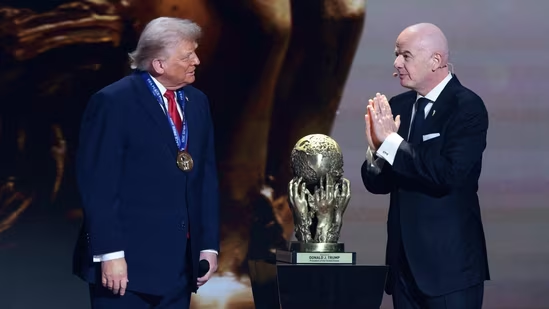
What if the December meeting, normally of interest only to soccer fans, could be turned into a geopolitical news event? Infantino, the Swiss lawyer who had ruled over the world’s most popular sport for nearly a decade, would present a new award that had nothing to do with kicking a ball.
He called it the FIFA Peace Prize—and the first recipient would be President Trump.
When Infantino presented his idea to the organization’s top committee, according to two FIFA sources, few in the room had any clue it was coming. The FIFA Council, the sport’s international governing body, wasn’t entirely sure what to make of it. It had never done anything like this.
Yet weeks later, on stage at the Kennedy Center, the whole scene played out exactly as Infantino had dreamed. He handed Trump a trophy and looped a medal around his neck, pledging “the support of the entire football community,” he said, “to help you make peace.”
All Infantino hoped for in return was for the leader of the free world to help make his $11 billion soccer tournament a success. He was up against shifting policy, U.S. travel bans, and, in one case, an ongoing war with a country in the World Cup.
A senior administration official said there were laughs and some knowing eye rolls about the presentation behind the scenes, knowing how obsessed Trump was with the Nobel Prize. But, they added, “It was honestly a smart idea on their part.”
Infantino, 56, whose World Cup kicks off Thursday in Mexico City, has made it a specialty of his to court the planet’s most influential power brokers. A little more than a decade ago, he had been a relatively obscure character outside of soccer circles. Now, he rubbed elbows with world leaders and cozied up to Trump.
“Without his engagement and his involvement, it would have been impossible to organize a World Cup in the United States,” Infantino said ahead of the opening game.
Over the past year, Infantino has cropped up at the president’s side at least a dozen times, from the Oval Office to the Gaza peace summit in Egypt. If Infantino had gleaned one thing, it was that he needed to keep Trump happy for the World Cup to stay on track.
“President Trump and Gianni Infantino share a genuine friendship built on a common vision,” said Andrew Giuliani, the executive director of the White House’s task force on the World Cup. “President Trump is the most charismatic leader I’ve ever known, and Gianni isn’t far behind.”
Organizing a World Cup is a colossal undertaking no matter where the tournament is held, which is why FIFA has often appreciated the cooperation of centralized governments that could clear away obstacles and keep the tournament running smoothly. (The past two editions were held in Russia and Qatar.) But the challenge of coordinating a World Cup co-hosted by the U.S., Mexico, and Canada exceeds anything ever attempted in the 96-year history of the tournament.
An unprecedented 48 teams are participating including four—Haiti, Iran, Ivory Coast and Senegal—under a full or partial travel ban. Outside of a few scattered delays, all 1,248 players have received visas. That doesn’t include every team official or all of the tournament support staff. On Monday, FIFA confirmed that a Somali referee had been denied entry to the U.S., but didn’t disclose a reason.
“FIFA is not involved in host country immigration processes, including visa adjudications,” the organization said.
That tension between parachuting in the world’s biggest sporting event and the bureaucratic operations of a country is what makes this enterprise so complex. That is why FIFA sees Infantino’s relationship with Trump as essential, according to a person familiar with Infantino’s thinking.
“Gianni has no access issues with the president,” the administration official said. “Anytime he wants to see him or talk to him, he can see him.”
Infantino’s courtship of Trump has earned him plenty of criticism, particularly in Europe, where he is seen to be lending the popularity of the World Cup to an unpopular American leader. After the awarding of the FIFA Peace Prize, the human-rights nonprofit FairSquare lodged a formal ethics complaint with FIFA alleging that Infantino had violated its statutory commitment to neutrality.
“This complaint is about a lot more than Infantino’s support for President Donald Trump’s political agenda,” the FairSquare wrote. “More broadly, this is about how FIFA’s absurd governance structure has allowed Gianni Infantino to openly flout the organization’s rules.”
Trump isn’t even much of a soccer fan—though he played for a season in high school at the New York Military Academy. But he knows the global spotlight will shine. The tournament will feature what Infantino describes as “104 Super Bowls” over five weeks, and 11 of the 16 venues for the World Cup are in the U.S.
For Infantino, this tournament holds a special place. He may have inherited Russia and Qatar from his predecessor, but he has overseen this North American World Cup from the beginning. And Infantino realizes more clearly than anyone just how much he owes to U.S. intervention.
“Together we will make not only America great again but also the entire world,” Infantino said in a video during Trump’s second inauguration.
Infantino rose to power after a sprawling investigation, led by the Justice Department, exposed widespread corruption at FIFA and took down former president Sepp Blatter in 2015. Infantino was elected to the top job by promising to tap in to FIFA’s vast cash reserves to spread millions of dollars in development money to soccer associations around worldwide.
And through it all, Infantino had the support of U.S. soccer officials, who helped him campaign for the job and secure key votes in North America, Central America, and the Caribbean region. On the day of the election, the former president of U.S. Soccer guided Infantino around the Zurich Hallenstadion to glad hand with delegations from FIFA’s then-207 member associations.
Until that point, Infantino’s most public role in soccer had been hosting tournament draws for UEFA, the governing body of European soccer. Born in the Valais canton of Switzerland, near the Italian border, he was a lawyer by training and joined UEFA in 2000. Later, he would stand on stage in Nyon, delighting in the matchups for the Champions League knockout rounds, and then return to his quiet job as UEFA’s general secretary.
In the space of a single whirlwind year, Infantino was thrust into the role of FIFA candidate for reform transparency. After he assumed the job, he insisted on replacing the marble floors of the FIFA Council room with green carpeting to mimic a soccer pitch. He also discovered a safe that had been kept in Blatter’s office that Infantino said had once contained cash and files on Blatter’s enemies. Infantino refused to touch it.
“Money used to change hands under the table,” reads an official biography of Infantino published by FIFA this year. “Since February 2016, it has moved in the open for all to see.”
It was also plain to see that Infantino had developed a taste for attention. He moved easily among heads of state, knowing how and when to pay his respect. His social media feed is one long string of public appearances and birthday wishes.
At the opening game of the 2018 World Cup, he positioned himself between Vladimir Putin and Saudi Crown Prince Mohammed bin Salman. Several years later, Saudi Arabia would win the right to host the 2034 World Cup as the only candidate in the running.
Around that time, Infantino was cultivating the friendships that opened the door to the Oval Office. One was the president’s son-in-law, Jared Kushner. And the other was a former Goldman Sachs partner turned president of U.S. Soccer named Carlos Cordeiro—who happened to maintain a relationship with New England Patriots owner Robert Kraft. That crowd pulled him into Trump’s orbit—and Infantino never left.
“I have never known them to have a disagreement,” the administration official said.
Relations weren’t quite as close with the Biden White House, the person added. So when Trump was re-elected, Infantino rushed to Washington. Mentioned by name in Trump’s victory rally, he attended the inauguration in person, announcing that “this is FIFA at the maximum of its respect.”
Since then, Infantino has attended all kinds of events that don’t explicitly require the president of soccer’s governing body to be there. He has joined Trump at a UFC fight, at the unveiling of his Board of Peace, and at regular intervals in the Oval Office, where a replica of the World Cup sits behind the Resolute Desk.
Infantino’s ability to push the right buttons of world leaders isn’t reserved for the president. In New York, he recently met with mayor Zohran Mamdani in the middle of a public fight over the price of World Cup match tickets and transportation. Knowing that Mamdani was a huge fan of Arsenal in the English Premier League, Infantino set up a FaceTime call for him with the club’s legendary former manager—and current FIFA executive—Arsène Wenger.
The result for Infantino has been an obsequious presence around American officials while navigating thorny questions of U.S. foreign policy. And none has taken up more oxygen than what to do about Iran, a squad with direct ties to the regime. Never before has a national team traveled to the World Cup while actively at war against its host—or a winner of the FIFA Peace prize.
As Iran threatened to boycott the tournament, Infantino and Cordeiro worked behind the scenes to move the team’s base camp from California to Tijuana in Mexico, even though all three of Iran’s matches will take place in the U.S. And although Trump said he didn’t care whether or not it participated, Iran is now set to take the field in Los Angeles on June 15.
“Gianni’s fantastic, he’s a friend of mine,” Trump said recently. “I said, ‘You do whatever you want. You can have them, you don’t have to have them.’”
But this was never in question for Infantino. FIFA isn’t accustomed to having teams pull out of its global showcase—at least not since Egypt missed the boat to Uruguay in 1930. Fielding 48 teams for the first time in World Cup history is a particular point of pride for the FIFA president. It helps, too, that he is doing it while driving record revenues in the world’s richest sports market.
“For the first time in 250 years of history of the United States of America, well, you will not just be invaded but you will be conquered,” he told the U.S. Conference of Mayors last December, only to be met with awkward silence.
“You will be conquered by soccer.”
Write to Joshua Robinson at [email protected] and Josh Dawsey at [email protected]