

The demonstration was organised by far-left radical groups including Students for Justice in Palestine and No Tech for Apartheid, reported The New York Post.
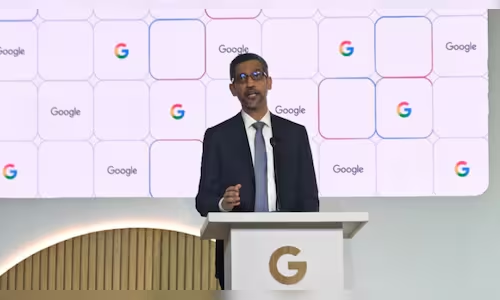
The protest, centered on pro-Palestinian activism and opposition to Google’s ties with the Israeli government, briefly disrupted the event. Videos shared on social media showed over 100 graduates participating in a walkout at Stanford Stadium, chanting “Free, free Palestine.”
Over 100 Stanford graduates walked out once Google CEO Sundar Pichai took the stage as commencement speaker, chanting, “Free, free Palestine!” pic.twitter.com/rp0pI09BJb
— Ben Swann (@BenSwann_) June 15, 2026
In the video shared on X, a BBC reporter asked Pichai, who was walking and waving at student, to share this thoughts on the walk out. He didn’t answer the question and kept walking.
WATCH: We asked Google CEO Sundar Pichai for his reaction to 100+ Stanford grads walking out of his speech today. @BBCWorld pic.twitter.com/MqJOO9faWn
— Lily Jamali (@lilyjamali) June 14, 2026
A Stanford alumnus with a master’s degree in materials science and engineering, earned in 1995, Pichai was invited to serve as the keynote speaker for the university’s 135th commencement ceremony.
His appearance, however, became a focal point for protesters seeking to draw attention to Google’s involvement in Project Nimbus. Signed in 2021, Project Nimbus is a $1.2 billion cloud computing agreement jointly held by Google and Amazon to provide cloud and AI services to the Israeli government.
Some employees and pro-Palestinian activists have raised concerns that the technology could support activities carried out by Israel’s military and security forces that may harm Palestinians.
Meanwhile, Google has consistently maintained that the contract is intended for government cloud services and has defended its participation in the project.
The controversy has previously sparked unrest within the company. Earlier in 2024, Google fired several employees following sit-ins and demonstrations at its offices in California and New York that protested the company’s involvement in Project Nimbus and its relationship with Israel.
The latest demonstration at Stanford occurred amid a wider wave of student activism and growing criticism of Big Tech companies at commencement ceremonies this year.
Earlier this year, former Google CEO Eric Schmidt faced boos during a commencement speech at the University of Arizona, where some students expressed concerns about artificial intelligence and its impact on employment opportunities.
Despite the protest, Pichai continued with his address, focusing on themes of optimism and adapting to change in a rapidly changing world.
“People thought it would be really difficult for me; it is the last two letters of my last name, after all,” he said, referring to the ‘AI’ in Pichai. Pichai also encouraged students to “choose optimism, work on hard things, and do what excites you.”
Students for Justice in Palestine has previously posted statements calling for the “death of all collaborators”, echoing Hamas’ justification for carrying out executions of Palestinians accused of cooperating with Israel.
The group also shared a tribute to Gaza-based influencer Saleh al-Jafarawi following reports of his death. Al-Jafarawi had openly celebrated the October 7 attack on Israel, and SJP described him as a martyr in its tribute.
The student walkout also drew reactions from prominent Indian-Americans. Venture capitalist and technology executive Vinod Khosla criticised the students for walking out during Pichai’s address.
On X, he wrote, “The stupidity of these @Stanford students to take the greatest opportunity for equality in humanity ever and to really free humanity and go walk out on @google and @sundarpichai that’s pioneered that.”
The stupidity of these @Stanford students to take the greatest opportunity for equality in humanity ever and to really free humanity and go walk out on @google and @sundarpichai that’s pioneered that. Biased, idiotic, short-sighted and very selfish. Selfish because they ignored… https://t.co/z7Ql8bLqOh
— Vinod Khosla (@vkhosla) June 14, 2026
Lawmaker Ro Khanna, however, said the protest was directed at Google’s reported links to the IDF and stressed the importance of protecting free speech and peaceful dissent on university campuses.
Vinod, my understanding is these students walked out to protest Google’s contract with IDF given Israel’s genocide in Gaza.
Wherever one stands on those contracts, I believe you would support their right of free expression and challenging authority. https://t.co/uOYIrty0IO
— Ro Khanna (@RoKhanna) June 14, 2026
In response to Khosla’s post, he shared, “Vinod, my understanding is these students walked out to protest Google’s contract with IDF, given Israel’s genocide in Gaza. Wherever one stands on those contracts, I believe you would support their right of free expression and challenging authority.”