
Washington, D.C., May Get a Mamdani Moment

The nation’s capital is in the throes of a mayoral election, and buckle up. The apparent front-runner in Washington, D.C.’s June 16 Democratic primary is a Zohran Mamdani lite, setting up what could become a confrontation with the Trump Administration.

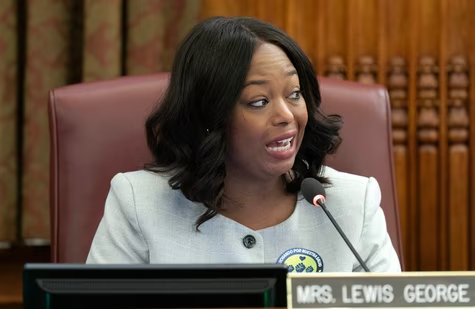
D.C. Council member Janeese Lewis George speaks during the D.C. Council hearing on the Fiscal Year 2027 budget at the Wilson Building, City Hall, Tuesday, June 9, 2026, in Washington (AP)

The seat is open after Muriel Bowser, who counts as sane and effective by Washington standards, decided not to run for a fourth term. The front-runner in the polls to replace her is Janeese Lewis George, proudly affiliated with the Democratic Socialists of America. Kenyan McDuffie, a more conventional Democrat for better and worse, is in second. The winner of the Democratic primary is all but a shoo-in come the general election in November.

This sets the stage for the district’s Mamdani moment. Ms. Lewis George isn’t promising government-run supermarkets as the New York mayor is. But she does want to build 72,000 new housing units within five years, while expanding rent control. A centerpiece of this program is a pledge to ramp up government-owned housing construction. She promises a universal childcare subsidy.

She’d try to pay for this with a new tax on the incomes of people who own businesses in the district but live in Virginia or Maryland. In theory she says this would raise $500 million. In practice it would chase lobbyists and law firms into offices across the city line.

Ms. Lewis George also sounds determined to unlearn the lessons of recent years on urban crime and policing. While nodding to the need for more police on the streets, she’s opposed policies such as a youth curfew intended to thwart violent mob swarms of teens organized by social media. Her record as a prosecutor was marked by her enthusiasm for pretty much any policy other than throwing criminals into jail.

Mr. McDuffie is normal by comparison. He talks a good game about the need to attract more investment to the district by avoiding punishing tax increases. He may even understand how the property-development industry works, as demonstrated by his more modest home-building target (12,000).

Yet neither candidate seems fully alert to the district’s dire demographic, economic and fiscal straits. Washington never recovered from the pandemic, and the Trump Administration’s federal job cuts have worsened the problem. Office vacancies are up, population growth is slowing, and government tax revenue is flat.

This may explain why both candidates are falling back on running against President Trump, who has meddled in district governance to a greater extent than any President in decades. But the dirty secret around town is that his efforts to beautify city parks, get fountains working again and deploy the National Guard to deter crime are popular even in this deep blue city.

That will make Washington a flash point in the conflict between far-left urban governance and a more conservative national electorate. If no one else can govern Washington, Mr. Trump might. Primary voters are on notice.