
Reform UK reform’s English punctuation

Corporal Bradley Clyde is a very manly man. You can tell this from his height (a manly 6ft 3inches, or 1.9 metres); his speech (full of manly phrases like “Open fire”) and from his job (he became a soldier because office work “just wasn’t manly enough”).

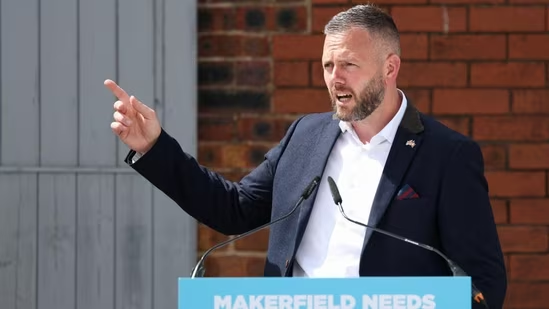
Reform UK candidate Rob Kenyon attends a press conference ahead of the June 18 Makerfield by-election, in Ashton-in-Makerfield, on June 10 (REUTERS)

Very little would be manly enough for Clyde. Within a few swift pages of “The Blood Waltz” he has killed one Nazi with his bare hands, dispatched another with a gun, fed their bodies to pigs and bedded a beautiful blonde “passionately”. The German foe looks at him with “fear”.

The people of Makerfield might eye him with similar anxiety. For “The Blood Waltz” is a historical novel written by Rob Kenyon, who is standing for election there on June 18th. This, to readers of this self-published book, might come as a surprise, for in its pages politicians are alluded to as people who “hardly worked” yet “you couldn’t fire”. Despite this (or perhaps because of it) Mr Kenyon is standing for Reform UK, a party which has said children should learn a more “patriotic” version of “Britain’s great and proud history”.

“The Blood Waltz”, his time-travelling military-sci-fi semi-erotic novel, offers not merely hyphens but history, almost all of it proudly patriotic. In its 301 pacy pages, Corporal Clyde is zapped through a portal to 1940s France where he battles evil Nazis, insurmountable odds and the ever-present perils of anachronism and historical error. At one point Adolf Hitler (not a man much remembered by history for his manners) signs off a telegram with the words “Yours gratefully, Adolf”.

Subtlety is not this book’s strong suit. British soldiers tend to have tattoos and hearts of gold; Nazis have eyepatches and villainous souls; women are blonde temptresses with lovely breasts. The dialogue is not easily mistaken for that of Vasily Grossman. When soldiers are in peril they tend to simply say: “Argh.”

However, Clyde’s greatest battles are not with Nazis but with the English language itself. Reform has said that it does not wish children to be “indoctrinated” at school. Happily Mr Kenyon has not been. He has no truck with the dully doctrinaire idea that if you do not know a word you should look it up in a dictionary (“disinterested” befuddles him), or with the tedious convention that apostrophes show possession, or that sentences should start with a capital letter and end with a full stop

which can give this books page’s an unsettling, uneasy feel

Which is surely nothing to what some of the people of Makerfield might be feeling. For Mr Kenyon has not merely put his ideas in a novel but also on social media, where he has offered sexual innuendo and scepticism on vaccines. As the manly Clyde might say: “Argh”. Or perhaps: “argh