

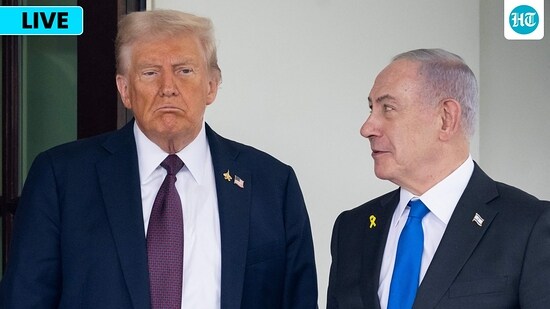
Iran war news LIVE: Donald Trump also said Israeli Prime Minister Benjamin Netanyahu agreed to pull back any troops preparing to attack Beirut.
Iran war news LIVE: Lebanon announced a partial ceasefire between Hezbollah and Israel on Monday in what would amount to a limited de-escalation of a conflict that has killed thousands of people and inflamed the broader US-Israeli war with Iran. According to Lebanon’s embassy in Washington, the agreement would not end the conflict in the country, but it calls for Israel to refrain from strikes on Beirut and its suburbs controlled by Hezbollah, while the Iran-aligned group would halt its attacks on Israel.
Iran’s Tasnim news agency reported that Tehran had suspended dialogue with mediators over Israel’s expanding offensive in Lebanon, where the US ally again threatened strikes on Beirut’s southern suburbs.
Hostilities in southern Lebanon, which Israel invaded in March, continued on Monday evening. Early on Tuesday, the Israeli military said that it intercepted two projectiles that crossed from Lebanon into northern Israel, and that no injuries were reported.
US President Donald Trump, who first announced the agreement, said Hezbollah, through intermediaries, had pledged not to attack Israel. No US president has ever spoken with Hezbollah, with or without intermediaries. The US has designated the group as a terrorist organisation.
The United States has backed Israel’s operations against Hezbollah, while pursuing a deal with Iran to end the war, reopen Hormuz and impose controls on Iran’s nuclear programme.
But Iran again said Monday it had not entered nuclear negotiations and insisted Israel must halt its Lebanon offensive before any wider deal could be agreed.
Trump also said Israeli Prime Minister Benjamin Netanyahu agreed to pull back any troops preparing to attack Beirut.
After Trump’s announcement, Netanyahu said Israel would continue military operations in southern Lebanon, where ground forces are pushing toward the Zaharani River, their deepest incursion in Lebanon in 25 years.
Trump lashes out at Netanyahu
Trump lashed out at one of his staunchest allies Israeli Prime Minister Benjamin Netanyahu in a heated phone call on Monday over Israel’s continuous bombardment of Lebanon, reported Axios citing US officials and a source briefed on the call.
During the call, Trump referred to Netanyahu as “crazy” and accused him of being ungrateful, the report said.
Summarising his remarks, a US official told Axios: “You’re f**king crazy. You’d be in prison if it weren’t for me. I’m saving your a*s. Everybody hates you now. Everybody hates Israel because of this.”
Earlier the same day, Iran had warned it could pull out of negotiations with the US in response to Israel’s actions in Lebanon.
A second source said Trump also shouted at Netanyahu: “What the f**k are you doing?”
The US-Iran peace talks
Donald Trump expressed optimism about a breakthrough in the Middle East, noting that he anticipates securing an agreement with Iran to extend the truce and restore transit through the strategic maritime chokepoint, the Strait of Hormuz, “over the next week”.
He told ABC News he has thus far withheld final approval on a Memorandum of Understanding (MoU) aimed at unblocking the vital shipping lane, explaining, “I still have to get a few more points.”
This optimistic outlook builds on a statement he had made just a few hours earlier on Monday, when the US President announced that negotiations with Tehran are progressing “at a rapid pace”, despite a recent exchange of fire that has severely tested the fragile truce between the two nations.
Elaborating during that earlier window on Monday via social media, the US President posted on Truth Social, “Talks are continuing, at a rapid pace, with the Islamic Republic of Iran.”
However, this diplomatic momentum is moving against a volatile backdrop, as the ceasefire, which was established nearly two months ago following weeks of intense conflict, faces renewed friction after American and Iranian forces engaged in retaliatory strikes over the weekend and into Monday. These latest hostilities have triggered widespread concern that the truce might break down and disrupt ongoing diplomatic channels entirely.
Iran’s chief negotiator, Mohammad Bagher Ghalibaf, said the US naval blockade and Lebanon escalation were “clear evidence of US non-compliance with the ceasefire”.
Late Monday, Tasnim reported that Iran was suspending “dialogues and exchange of texts through mediators” over Israel’s actions in Lebanon.
In a message carried by state TV, the Revolutionary Guards intelligence body said “crossing the red lines in Lebanon and Gaza” would mean “direct war”.
It said Iran was determined to preserve what it called the “Strait of Hormuz equation” and to take “meaningful actions” by opening other fronts.
Trump told NBC that he did not mean Washington would “start dropping bombs all over there”, but insisted the US naval blockade would remain.
Tasnim reported that Iran would keep Hormuz blocked and, with its allies, “activate other fronts”, including the Bab al-Mandab Strait at the entrance of the Red Sea.
Tehran’s Houthi allies in Yemen have previously attacked shipping near Bab al-Mandab, whose closure could disrupt millions more barrels of oil exported daily by Saudi Arabia through its Red Sea port of Yanbu.
In another sign of danger to Gulf shipping, the UKMTO maritime agency reported a “large explosion” on a cargo vessel off Iraq “following a hit from an unknown projectile”.
Iran’s Tasnim news agency reported that Tehran had suspended dialogue with mediators over Israel’s expanding offensive in Lebanon, where the US ally again threatened strikes on Beirut’s southern suburbs.
Hostilities in southern Lebanon, which Israel invaded in March, continued on Monday evening. Early on Tuesday, the Israeli military said that it intercepted two projectiles that crossed from Lebanon into northern Israel, and that no injuries were reported.
US President Donald Trump, who first announced the agreement, said Hezbollah, through intermediaries, had pledged not to attack Israel. No US president has ever spoken with Hezbollah, with or without intermediaries. The US has designated the group as a terrorist organisation.
The United States has backed Israel’s operations against Hezbollah, while pursuing a deal with Iran to end the war, reopen Hormuz and impose controls on Iran’s nuclear programme.
But Iran again said Monday it had not entered nuclear negotiations and insisted Israel must halt its Lebanon offensive before any wider deal could be agreed.
Trump also said Israeli Prime Minister Benjamin Netanyahu agreed to pull back any troops preparing to attack Beirut.
After Trump’s announcement, Netanyahu said Israel would continue military operations in southern Lebanon, where ground forces are pushing toward the Zaharani River, their deepest incursion in Lebanon in 25 years.
Trump lashes out at Netanyahu
Trump lashed out at one of his staunchest allies Israeli Prime Minister Benjamin Netanyahu in a heated phone call on Monday over Israel’s continuous bombardment of Lebanon, reported Axios citing US officials and a source briefed on the call.
During the call, Trump referred to Netanyahu as “crazy” and accused him of being ungrateful, the report said.
Summarising his remarks, a US official told Axios: “You’re f**king crazy. You’d be in prison if it weren’t for me. I’m saving your a*s. Everybody hates you now. Everybody hates Israel because of this.”
Earlier the same day, Iran had warned it could pull out of negotiations with the US in response to Israel’s actions in Lebanon.
A second source said Trump also shouted at Netanyahu: “What the f**k are you doing?”
The US-Iran peace talks
Donald Trump expressed optimism about a breakthrough in the Middle East, noting that he anticipates securing an agreement with Iran to extend the truce and restore transit through the strategic maritime chokepoint, the Strait of Hormuz, “over the next week”.
He told ABC News he has thus far withheld final approval on a Memorandum of Understanding (MoU) aimed at unblocking the vital shipping lane, explaining, “I still have to get a few more points.”
This optimistic outlook builds on a statement he had made just a few hours earlier on Monday, when the US President announced that negotiations with Tehran are progressing “at a rapid pace”, despite a recent exchange of fire that has severely tested the fragile truce between the two nations.
Elaborating during that earlier window on Monday via social media, the US President posted on Truth Social, “Talks are continuing, at a rapid pace, with the Islamic Republic of Iran.”
However, this diplomatic momentum is moving against a volatile backdrop, as the ceasefire, which was established nearly two months ago following weeks of intense conflict, faces renewed friction after American and Iranian forces engaged in retaliatory strikes over the weekend and into Monday. These latest hostilities have triggered widespread concern that the truce might break down and disrupt ongoing diplomatic channels entirely.
Iran’s chief negotiator, Mohammad Bagher Ghalibaf, said the US naval blockade and Lebanon escalation were “clear evidence of US non-compliance with the ceasefire”.
Late Monday, Tasnim reported that Iran was suspending “dialogues and exchange of texts through mediators” over Israel’s actions in Lebanon.
In a message carried by state TV, the Revolutionary Guards intelligence body said “crossing the red lines in Lebanon and Gaza” would mean “direct war”.
It said Iran was determined to preserve what it called the “Strait of Hormuz equation” and to take “meaningful actions” by opening other fronts.
Trump told NBC that he did not mean Washington would “start dropping bombs all over there”, but insisted the US naval blockade would remain.
Tasnim reported that Iran would keep Hormuz blocked and, with its allies, “activate other fronts”, including the Bab al-Mandab Strait at the entrance of the Red Sea.
Tehran’s Houthi allies in Yemen have previously attacked shipping near Bab al-Mandab, whose closure could disrupt millions more barrels of oil exported daily by Saudi Arabia through its Red Sea port of Yanbu.
In another sign of danger to Gulf shipping, the UKMTO maritime agency reported a “large explosion” on a cargo vessel off Iraq “following a hit from an unknown projectile”.
Follow all the updates here:
Jun 02, 2026 7:23:20 AM IST
Iran war news LIVE: New Zealand bans three ‘extremist Israeli settlers’
New Zealand has placed travel bans on three “extremist Israeli settlers”, the country’s Foreign Minister Winston Peters said.
The three individuals now banned from travelling to New Zealand – Itamar Yehuda Levi; Harel David Libi; and Eliav Libi – “actively worked to expand illegal settlements in the West Bank, including through violence”, Peters said in a statement on X announcing the ban.
“The actions of these individuals threaten peace and security for Israelis and Palestinians and drive the region further into crisis,” he said, adding that New Zealand’s policy is to support a two-state solution for Palestinians.
Jun 02, 2026 7:09:29 AM IST
Iran war news LIVE: A US soldier and a British soldier die during training in Iraq
One American soldier and one British soldier died during a training exercise in Iraq, US and UK officials said Monday without releasing further details.
The deaths occurred Sunday at an air base in Irbil in the semi-autonomous Kurdish region of northern Iraq, where the US has retained a presence, the US Army said in a post on X. The statement said the soldier’s identity is being withheld until 24 hours after his or her family has been notified.
The UK’s Ministry of Defence said in a separate post that the family of the British soldier has been notified and requested a “period of grace” before more details are released.
Jun 02, 2026 7:07:25 AM IST
Iran war news LIVE: Australia projects lower wheat harvest amid Iran war fertiliser price spike, dry conditions
Australia’s upcoming wheat harvest will be the country’s smallest in three years, amid high fertiliser costs and dry conditions, the Australian government has said.
Australia, one of the world’s largest exporters of wheat, is expected to reap 26.7 million metric tonnes of wheat later this year, about 9 million tonnes less than last season, the Australian Bureau of Agricultural and Resource Economics and Sciences (ABARES) said in a quarterly crop report.
Skyrocketing fertiliser costs, amid the war on Iran, as well as low rainfall in Australia’s east, are contributing to the reduced yield, ABARES said.
“It will be crucial that adequate and timely supply of fertiliser is available and adequate rainfall is received to meet current yield projections,” ABARES said.
Prior to the US-Israel war on Iran, Australia imported much of its diesel fuel and fertiliser supplies through the now-blockaded Strait of Hormuz.
Jun 02, 2026 6:50:16 AM IST
Iran war news LIVE: Iran’s parliament speaker warns dialogue with US will halt if Israeli attacks on Lebanon continue
Iran’s chief negotiator with the US and parliamentary speaker Mohammad Bagher Ghalibaf spoke on Monday with his Lebanese counterpart, Nabih Berri, regarding Israel’s invasion of the country.
In a post on X, Ghalibaf said: “In my conversation with my brother, Mr. Nabih Berri, the Speaker of the Lebanese Parliament, I emphasised that if the crimes of the Zionist regime in Lebanon continue, we will not only halt the dialogue process but also stand firmly against them.”
He concluded his message by declaring: “Long live the resistance! Long live the defence of the motherland! Long live the brotherhood of the Iranian and Lebanese peoples!”