

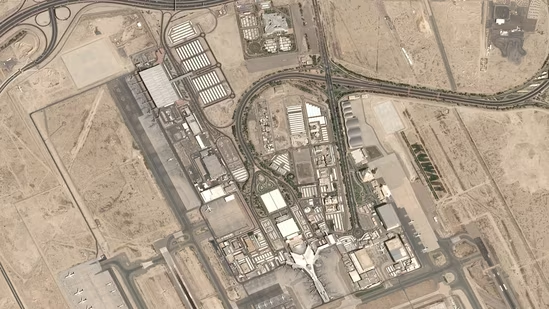
In a televised broadcast on Wednesday, Iranian Air Force personnel recounted the harrowing details of a precision airstrike carried out by the country to target an American military base in Kuwait. The attack was carried out in early March at the peak of US and Israel’s offensive against the country.
Known as Camp Buehring, the operation was implemented by a commander and two crew member using Iranian F-5 fighter jets. All three were present during the televised interview.
Low altitude, high risk
As per the commander, the need for an immediate and direct response arose following renewed aggression by the US. “We immediately wanted to carry out a retaliatory operation,” he stated, calling Camp Buehring as “a highly strategic base with one of the highest troop concentrations and capacities.”
The tightly coordinated and high-risk penetration strike was executed at extremely low altitude within roughly 50 minutes, Iran’s state news agency Press TV reveals.
Three pilots in two F-5 jets flew in formation into Kuwaiti airspace at exceptionally low altitude in order to avoid radar detection. “We were practically skimming the ground… We would even pass beneath power lines,” the commander added. “The training standard is about 500 feet, but we were flying below 50 feet.”
Also Read I Sanctions relief, frozen funds, $300 billion plan: What Iran stands to gain under Trump’s deal | In numbers
“We passed between two vessels so low that their decks were higher than us… The sailors had to come down and look over the railings just to see us pass beneath them.”
Despite the presence of layered air defenses, including Patriot missile systems, AWACS surveillance, and scrambled fighter jets, the entire mission was carried out in complete radio silence.
Once the personnel had successfully entered the Kuwaiti airspace, the jets switched to direct overflight since the targets were to be attacked using free-fall bombs. “We had to fly directly over the target… As soon as we reached the base, we carried out a heavy bombing,” the commander revealed.
The commander claimed widespread destruction at the site along with damaging several airborne assets and enemy helicopters were seen taking flight during the explosion. “Three [enemy] F-15 aircraft… were mistakenly engaged and destroyed simultaneously,” the commander said.
Elaborating on their exit strategy, the commander revealed, “After the bombing, we carried out a deception maneuver… They were unable to track or intercept us.” Following this, all three members safely returned to the Iranian airspace and proceeded to a designation follow-on base.
Also Read I Iran targets Bahrain and Kuwait after new US strikes
Proxy attacks
Kuwait, Iraq, Bahrain and Erbil have time and again been used as proxies for the West Asia conflict. As per the Islamic Revolutionary Guard Corps’ (IRGC) statement in early June, the “precise and concentrated missile attacks” were carried out on US military facilities in Kuwait “in response to the provocation and blatant aggression of American terrorist forces targeting the national sovereignty of the Islamic Republic of Iran in the beloved island of Qeshm”.
“The Islamic Revolutionary Guard Corps, by announcing this initial response for retaliation, issues a firm and decisive warning to the government of the United States, the leader of global arrogance, and all those who allow the use of their soil or airspace to violate Iran,” the official IRGC statement read.
“The era of “hit and run” has ended, and the aggressor forces must bear the dire consequences of their ignorance and reckless adventures.”
Kuwait’s military issued public guidelines at the time of the attacks, stating that any sounds of explosions heard were a result of air defense systems intercepting “hostile” missiles and drones.
Also Read I Iran attacks US bases in Kuwait, warns ‘era of hit and run is over’; explosions heard in Iraq and Bahrain
Around the same time, a fresh barrage of missiles was targeted towards Bahrain and Kuwait. The US Central Command (CENTCOM) claimed that its forces struck down four Iranian attack drones launched towards the strait and then struck Iranian coastal surveillance radar sites soon after. In retaliation, the CENTCOM launched seven ballistic missiles towards Iran, six of which were intercepted and one fell short, news agency AFP revealed.
The US and Iran have currently agreed to sign a memorandum of understanding, laying out terms for both parties, before discussions on a final agreement to end the war are initiated.