
Court replays Arise TV interview as Deji Adeyanju testifies in El-Rufai’s alleged phone-tapping trial

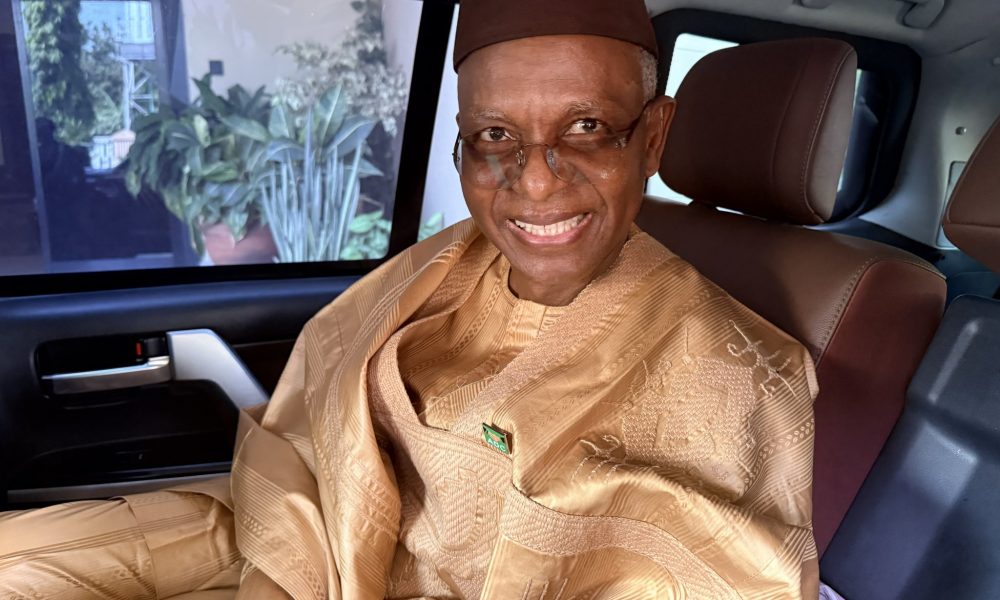
Proceedings in the trial of former Kaduna State Governor, Mallam Nasir El-Rufai, over alleged illegal interception of communications and national security breaches continued at the Federal High Court in Abuja on Monday, with the prosecution replaying a television interview that forms a key part of its case.
The interview, aired on Arise Television on February 13, was played before Justice Joyce Abdulmalik as the prosecution sought to establish the basis of the allegations against the former governor.
Human rights lawyer and activist, Deji Adeyanju, appeared as the second prosecution witness (PW-2) and told the court that the video accurately reflected statements made by El-Rufai during the broadcast concerning an alleged intercepted telephone conversation involving the National Security Adviser (NSA), Malam Nuhu Ribadu.
According to the prosecution, the State Security Service (SSS) instituted a five-count charge against El-Rufai after comments he made during the television programme, where he allegedly claimed to have obtained information from an intercepted conversation involving the NSA. The former governor had reportedly alleged that security agencies were instructed to arrest him upon his return to Nigeria from Cairo, Egypt.
During the hearing, prosecution counsel, Oluwole Aladedoye (SAN), applied for the replay of the interview, which had earlier been tendered as evidence through the first prosecution witness.
The court also admitted several exhibits, including a subpoena served on Adeyanju, his written statement to investigators, and a flash drive containing his subsequent appearance on the same television programme, along with the accompanying certificate of compliance. The exhibits were admitted without objection from defence counsel, Paul Erokoro (SAN).
While giving evidence, Adeyanju said he participated in the same Arise Television programme shortly after El-Rufai’s interview.
“I was invited to the programme and my segment came after that of Mallam El-Rufai,” Adeyanju told the court. “I listened to his comments and responded to some of the issues he raised because I believed some of them were either inaccurate or incomplete.”
The witness further stated that he was later invited by SSS operatives to make a statement regarding the broadcast. He said he informed investigators that El-Rufai had suggested that information concerning the alleged directive against him came from an intercepted communication.
During cross-examination, Erokoro questioned whether El-Rufai had specifically admitted to personally tapping any telephone conversation. In response, Adeyanju maintained that the former governor’s statement during the interview was that “we listened to their calls.”
The defence also argued that hearing a conversation through an open speakerphone could not automatically be classified as illegal wiretapping, while questioning whether there was evidence that the NSA’s communications had been unlawfully intercepted.
Adeyanju, however, maintained that any claim suggesting that a high-level government official’s communication had been intercepted warranted investigation by the relevant authorities. He added that he had no personal knowledge of how the NSA conducted his telephone conversations.
El-Rufai was arraigned on April 23 and pleaded not guilty to all five counts bordering on alleged illegal interception of communications and related national security offences. He was granted bail in the sum of ₦100 million and remains on bail pending the conclusion of the trial.
Following Monday’s proceedings, Justice Abdulmalik adjourned the matter to a later date for continuation of hearing. The prosecution is expected to continue presenting evidence centred on the television broadcast and related digital records.