

By Maryanne Awuya
Billions of naira lost annually to corruption, money laundering, and tax evasion will continue to cripple Nigeria’s development, according to the Africa Network for Environment and Economic Justice (ANEEJ).
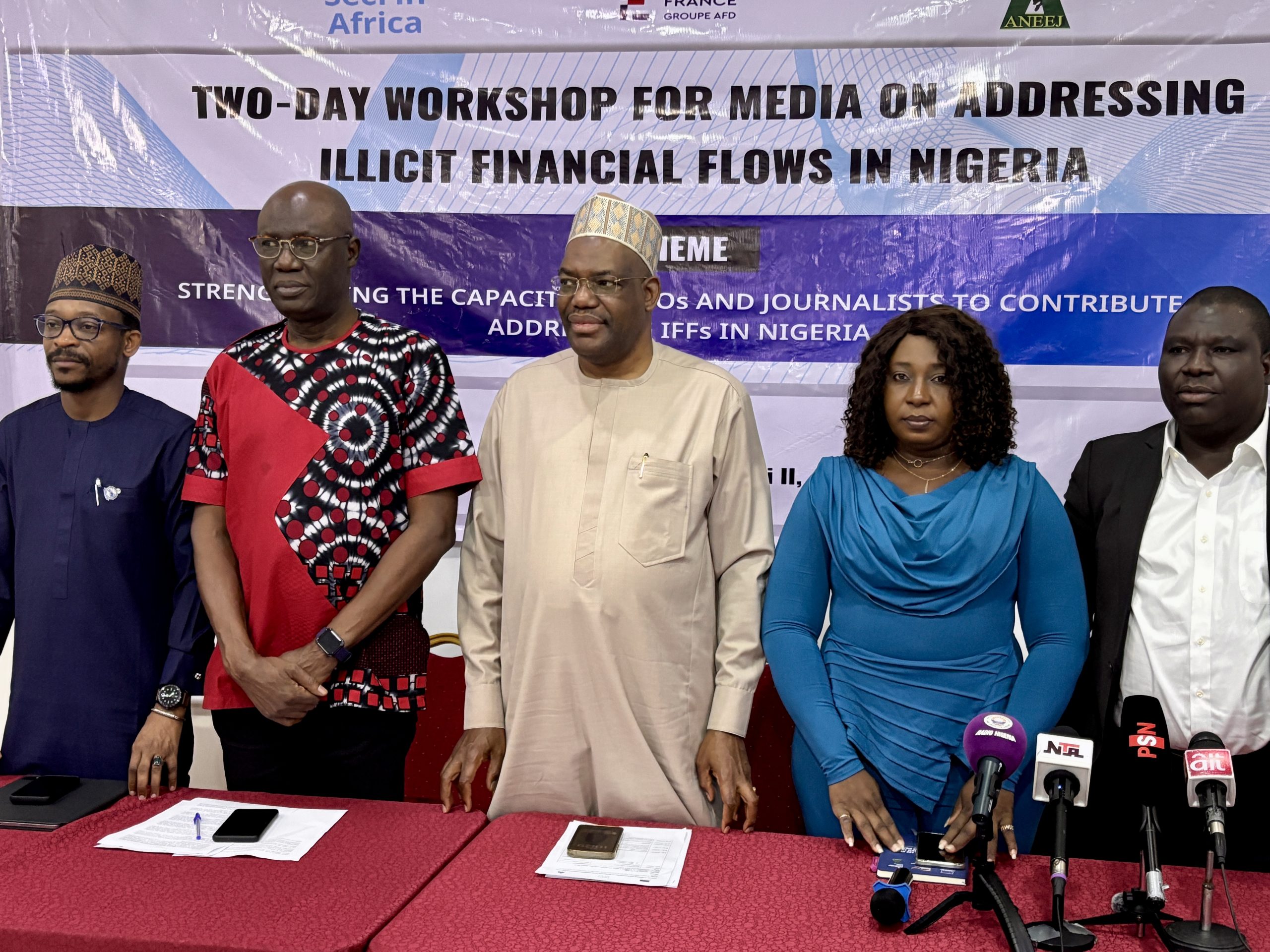
Speaking on Thursday at a two-day media capacity-building workshop in Abuja, the civil society group urged journalists to step up as critical partners in exposing illicit financial flows (IFFs), promoting transparency, and enforcing public accountability.
Persecondnews correspondent at the event reports that the workshop, organized with support from the European Union through the SecFin Africa Programme, focused on strengthening media capacity to investigate and report on illicit financial flows and related financial crimes.
Representing ANEEJ’s Executive Director, the Deputy Executive Director of the organization, Mr. Leo Atakpu, said illicit financial flows remain one of the greatest threats to economic development, democratic governance, and social justice in Nigeria.
He noted that practices such as corruption, tax evasion, trade misinvoicing, money laundering, and procurement fraud continue to divert resources that should otherwise be used to provide critical infrastructure, healthcare, education, and other essential services.
According to him, journalists occupy a strategic position in the fight against IFFs through investigative reporting, public-interest journalism, and evidence-based storytelling.
“The media can uncover hidden financial crimes, expose procurement abuses, follow suspicious money trails, and amplify citizens’ concerns while holding public and private institutions accountable,” Atakpu said.
He explained that the workshop was designed to deepen participants’ understanding of the drivers and impacts of illicit financial flows while equipping them with practical investigative skills, including the effective use of the Freedom of Information (FOI) Act, data analysis, and beneficial ownership reporting.
Atakpu urged participants to use the knowledge gained from the training to produce impactful investigative reports capable of promoting institutional transparency.
SecFin Africa Programme Representative, Prof. Abdullahi Shehu, said the initiative was conceived following a proposal by ANEEJ to study the legal and institutional frameworks for combating illicit financial flows in Nigeria.
According to him, one of the programme’s primary objectives is to strengthen the capacity of civil society organizations (CSOs) and the media to contribute meaningfully to efforts aimed at curbing financial crimes.
He added that IFFs have serious implications for public resource management, infrastructure development, and social service delivery.
“We must collectively work to prevent illicit financial flows and ensure proper monitoring of public resources so citizens can demand accountability from government,” Shehu said.
In his remarks, the Chief Governance, Risk and Compliance Officer of the Nigerian Financial Intelligence Unit (NFIU), Ibrahim Baba Mohammed, described the media as one of society’s most powerful accountability institutions.
Mohammed, who represented the Chief Executive Officer of NFIU, said responsible, factual, and balanced reporting plays a crucial role in informing the public, promoting transparency, and supporting financial crime investigations.
He disclosed that intelligence and reports generated from media investigations have frequently contributed to financial crime probes and subsequent prosecutions.
Mohammed urged journalists to remain committed to factual reporting and actively engage in national efforts to combat money laundering, terrorism financing, corruption, and other illicit financial activities.
Also speaking at the event, a representative of the Special Control Unit Against Money Laundering (SCUML), Mohammed Isah, noted that illicit financial flows continue to deprive African countries of resources needed for development, stressing the need for stronger compliance and transparency measures.
To effectively combat financial crimes, he stressed the need for synergy between key regulatory bodies—including the EFCC, ICPC, NFIU, and Nigeria Customs Service—and civil society groups.
He also noted that journalists are strategic allies whose reporting boosts these enforcement efforts through public awareness.
Persecondnews reports that the event drew journalists, editors, CSOs, and accountability agency representatives to strengthen joint efforts against illicit financial flows nationwide.