

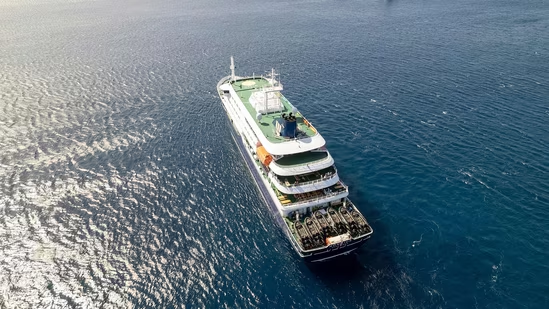
A health emergency aboard the MV Hondius has caused panic after multiple passengers developed a severe respiratory illness during a voyage across the Atlantic Ocean. The World Health Organization (WHO) on Sunday said that at least three people have died following a suspected hantavirus outbreak. The ship had been sailing from Ushuaia toward Cape Verde.
What did WHO say about the hantavirus cases?
The WHO confirmed that one patient tested positive for hantavirus, while several additional infections remain under investigation. “To date, one case of hantavirus infection has been laboratory confirmed, and there are five additional suspected cases,” the international health organization told AFP.
“Of the six affected individuals, three have died and one is currently in intensive care in South Africa.”
South African health authorities first described the incident as an outbreak of a “severe acute respiratory illness” after critically ill passengers were medically evacuated to Johannesburg for treatment.
About the hantavirus cases
Among the first victims was a 70-year-old passenger who became ill while still aboard the ship. He later died onboard, with his body remaining on Saint Helena, according to South African health spokesperson Foster Mohale. His wife, a 69-year-old woman who also fell sick during the voyage, was airlifted to Johannesburg but later died in hospital.
A third patient, identified as a 69-year-old British passenger, remains in intensive care in South Africa.
Authorities have not publicly confirmed the nationalities of all victims, although a source familiar with the situation told AFP that a Dutch couple were believed to be among the dead.
What is hantavirus?
The WHO stressed that hantavirus infections are generally linked to rodent exposure rather than cruise-related transmission. “Hantavirus infections are typically linked to environmental exposure (exposure to infected rodents’ urine or faeces).
“While rare, hantavirus may spread between people, and can lead to severe respiratory illness and requires careful patient monitoring, support and response.”
The organization also confirmed it is working alongside government officials and the ship’s operators to coordinate additional medical evacuations.
“The WHO said it was “facilitating coordination” between national authorities and the ship’s operators to organise the medical evacuation of two passengers with symptoms.”
The MV Hondius, operated by Dutch travel company Oceanwide Expeditions, is marketed as a polar expedition cruise vessel capable of carrying roughly 170 passengers alongside approximately 70 crew members. Its itineraries typically include stops at remote Atlantic locations such as South Georgia and Saint Helena.
Ship-tracking data on Sunday placed the vessel near Praia, the capital city of Cape Verde, while authorities continued assessing the outbreak.
All about hantavirus
Hantavirus Pulmonary Syndrome (HPS) – A severe respiratory illness (most common in North and South America).
Hemorrhagic Fever with Renal Syndrome (HFRS) – A disease that affects the kidneys and causes bleeding.
How it spreads
Hantavirus does not spread from person to person generally.
Humans typically get infected through contact with infected rodents (especially deer mice in the US) via:
Breathing in tiny airborne particles of the virus from rodent urine, droppings, or saliva (most common route).
Touching surfaces contaminated with rodent waste and then touching your mouth, nose, or eyes.
Being bitten by an infected rodent (less common).
Rarely, through ingestion of contaminated food or water.
The virus becomes airborne when dried rodent droppings or urine are disturbed
Key facts
There is no vaccine or specific antiviral treatment.
Early symptoms (1–8 weeks after exposure) include fever, muscle aches, fatigue, and headaches.
HPS can rapidly progress to severe breathing difficulty and can be fatal in some cases.