

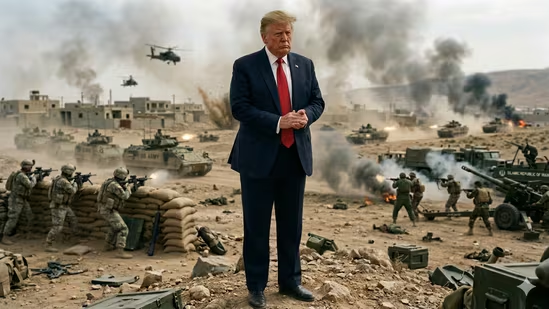
Iran sharpened its attack against the United States, warning of strong retaliation if confronted with force and demanding reparations for recent military strikes. Iran also as tensions continue to simmer despite a tenuous ceasefire following weeks of conflict in West Asia.
Seyyed Mehdi Tabatabaei, deputy for communications in the Iranian president’s office, accused Washington of engaging in “low-value psychological games” and urged US officials to “climb out of the pit that the child-killer has dug for them.”
The ‘child killer’ jibe at Trump comes in response to the bombing of a Minab school where an alleged US missile killed 165 girls.
He added that the US should “pay reparations for the assault” and “return to their own land.”
“Iran claims to be a proponent of peace and friendship in the world, but if anyone speaks to this nation in the language of force, they will receive a harsh slap,” Tabatabaei said, signalling Tehran’s continued readiness to escalate if provoked.
US-Iran War
The conflict began on February 28 following coordinated strikes by the US and Israel against Tehran and other regional targets. Iran responded by striking US bases and Israeli positions, alongside disrupting maritime traffic in the Strait of Hormuz, which caused a sharp spike in global oil prices.
The exchange of fire quickly raised fears of a wider regional war, drawing in multiple actors and pushing global markets into turmoil.
While a ceasefire agreement brokered through backchannel diplomacy in early April has largely halted direct large-scale strikes, both sides have stopped short of declaring a formal end to hostilities. Instead, the situation has settled into a tense standoff marked by aggressive rhetoric, military posturing, and sporadic incidents that threaten to unravel the fragile calm.
US naval forces continue to maintain a significant presence in and around the Strait of Hormuz, a vital chokepoint through which nearly a fifth of the world’s oil supply passes. American officials have described the deployment as necessary to ensure freedom of navigation and prevent disruptions to global energy flows. Iran, however, has criticised the move as an act of coercion and a violation of its regional sovereignty, warning that continued pressure could trigger a renewed confrontation.
Global impact of the war
The economic consequences of the conflict have been substantial. Global oil prices surged sharply during the peak of the hostilities, briefly crossing $120 per barrel amid fears of supply disruptions.
Although prices have since moderated following the ceasefire, volatility remains high, with markets sensitive to any sign of renewed escalation. Shipping costs in the region have also risen, and insurers have increased premiums for vessels operating in the Gulf, reflecting the persistent risk.
Beyond energy markets, the war has had broader geopolitical ramifications. The conflict has intensified existing rivalries in West Asia, with regional powers recalibrating their positions in response to the shifting balance.
It has also complicated diplomatic efforts aimed at reviving negotiations over Iran’s nuclear programme, which had already stalled prior to the outbreak of hostilities.
In Washington, the conflict has triggered a debate over the scope and duration of US military engagement.
The administration has maintained that active hostilities have effectively ceased following the April ceasefire, arguing that its objectives were achieved without the need for prolonged warfare.
Critics, however, contend that the absence of a formal agreement and the continued military presence in the region leave the door open for further escalation.
Pentagon officials have acknowledged the financial cost of the conflict, estimating that US operations have already run into tens of billions of dollars. The human toll, while not fully disclosed, includes casualties among military personnel and civilians across multiple countries in the region, as well as displacement in areas affected by strikes.
Tehran, for its part, has framed the conflict as an act of aggression and has sought to position itself as both a victim and a resilient regional power. Iranian officials have repeatedly emphasised their country’s capacity and willingness to respond to threats.