

The small drone hovered over the heads of Israeli soldiers gathered near a tank in the hills of southern Lebanon. Then it dived into the crowd and detonated an explosive, killing one and injuring five others. A military rescue helicopter landed at the chaotic scene, while soldiers hurriedly carried the injured off the battlefield.
But the attack from Hezbollah this past Sunday wasn’t done. A second drone filmed the scene from above before diving in and exploding. It missed the helicopter by a few yards.
“Wow, wow! Another drone! Wow! I can’t believe it!” shouted a soldier filming the scene.
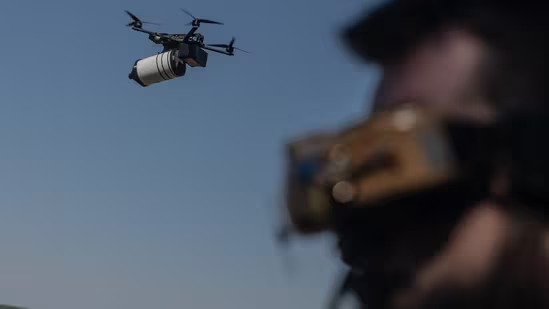
Hezbollah, the Lebanese militant group, has increasingly used first-person-view, or FPV, drones to attack Israeli troops, posing a major threat to the Israeli military that it hasn’t encountered in earlier rounds of fighting in Gaza and Lebanon, according to military officials and soldiers. The devices are a type of small, cheap drone that has wreaked havoc in Russia and Ukraine and was used more recently by Iranian-backed militias in Iraq to attack U.S. troops. They are difficult to detect, highly accurate and cost hundreds of dollars a piece.
Their deployment by Hezbollah has become widespread in recent weeks. On Thursday, the Israeli military said another soldier had been killed by an explosive drone in southern Lebanon, and on Tuesday, an Israeli man was killed after an FPV drone struck him and his son as they were operating excavators for the military there.
The Israeli government and the military have faced mounting criticism at home for being unprepared for the drone attacks despite the Ukrainian precedent. They are now searching for techniques to neutralize the threat as Israel and Hezbollah continue to attack each other more than two weeks after the U.S. announced a cease-fire in southern Lebanon.
“I gave instructions a few weeks ago for a special project to destroy the drone threat,” Israeli Prime Minister Benjamin Netanyahu said in a video statement released Tuesday. “It will take time—but we will blow this up too.”
Hezbollah has recently released dozens of videos of FPVs hitting tanks, armored vehicles and excavators. The videos are set to upbeat music and show targets circled in red. Drone experts and military analysts said the videos showed Hezbollah’s drone operators were skillful and had likely been taught.
In particular, videos of Sunday’s drone attack taken by Hezbollah and Israeli soldiers have been widely shared in Israel, shown on national networks and cited as evidence the military was unprepared for the threat.
Ukraine’s former defense minister said the government had repeatedly offered to exchange knowledge with Israel to counter the Iranian drone threat, but was ignored.
“Unfortunately, our warnings were not taken into account,” Oleksiy Reznikov, Ukraine’s defense minister from 2021 to 2023, said in an interview. “Since Oct. 7, 2023, and continuing to this day, Israel has been facing the aggressive application of Russian-derived combat experience through Iranian proxies.”
The Israeli military said it was monitoring the drone threat and developing methods to confront and adapt to it.
FPVs are typically flown by pilots wearing goggles that allow them to see the view from the drone’s camera. Ukrainian soldiers in 2022 were among the first to use them in battle when they strapped explosives to off-the-shelf drones and launched them toward Russian positions. The drones have since become one of the most common types used in Ukraine, accounting for most battlefield casualties. FPVs have an average range of 15 kilometers or longer if a signal repeater or optic fiber wires are used, allowing operators to sit far from the front lines.
Drones in Ukraine now rapidly detect and target vehicles and troops’ movement in a vast “kill-zone.” Border cities and roads are covered with nets to intercept drones before they hit their targets.
Innovation has moved at a fast pace in both the Russian and Ukrainian ranks, with new types of drones constantly being introduced, including fiber-optic drones impervious to electronic warfare and AI-powered drone swarms that can hit targets on their own.
“We shouldn’t be surprised after four plus years of Ukraine that this technology would be spreading,” said Samuel Bendett, an adviser with the Russia Studies Program at CNA, a Washington-based think tank. “We know that Iran has been monitoring the use of drones in the Ukraine war. We know that Iran has military to military cooperation with Russia.”
Hezbollah began experimenting with FPVs as early as June 2024, releasing footage showing FPVs hitting Israeli military hardware. But its use of the drones appeared to stop after Israel’s exploding pager operations and its Lebanon land invasion in October 2024, before making a recent comeback.
Israel’s defense industry over the years focused on the more traditional threats of rockets and ballistic missiles, with drones largely overlooked up until recently, The Wall Street Journal previously reported.
Ukraine has become a leader in cost-effective solutions such as portable jammers and acoustic sensors, as well as unmanned robots for evacuating troops.
Most concerning for Israel is Hezbollah’s use of FPVs tethered to fiber-optic cables, which are trickier to pilot but can’t be stopped with existing electronic countermeasures. This technology was pioneered by Russia to devastating effect in late 2024. Israel’s defense ministry and its research arm known as MAFAT recently issued a call for proposals to “identify additional capabilities to address the threat of fiber-optic-controlled FPV drones.”
“Optic fiber is the worst. There is actually no efficient way to countermeasure this threat,” said Iaroslav Kalinin, a former army officer in the Ukrainian military and chief executive of Infozahyst, one of Ukraine’s biggest electronic warfare contractors.
Ukraine now relies on acoustic sensors and nets to counter optic fiber drones, while more sophisticated solutions are still in testing, he said. Optic fiber is not available off the shelf and likely had to be brought in from abroad, analysts and security officials said.
Iran and its proxies have demonstrated use of FPVs in recent years, with Iraqi militias using them to hit U.S. targets including bases in Iraq during the Iran war. The Israeli military has also been using FPVs against Hezbollah militants and publishing videos of its hits.
“If Israel doesn’t kill the operators they will improve. They are gaining experience. Even when their drone fails, this is also experience,” said Yigal Levin, an independent military analyst who focuses on the Russia-Ukraine war and the Middle East. Levin, who runs a Telegram channel focused on military analysis, said that in recent weeks multiple Israeli reservists and officers had reached out to him for help with FPVs.
Israeli soldiers in Lebanon said that units were scrambling and were now improvising solutions such as covering military equipment and outposts with nets to trap the drones, a method Ukraine has long relied on.
An Israeli reservist currently operating in Lebanon said that Hezbollah was constantly flying FPVs toward troops in his area, an average of at least 10 alerts a day. In one case he heard a loud boom and learned that an FPV had hit a nearby military vehicle. He said the use of FPVs had increased as he and his unit ventured deeper into Lebanon.
He is now 10 kilometers into Lebanon and when he and other soldiers receive an alert about incoming FPVs, almost always during the day, they are told to immediately go indoors and wait. Taking down the drone can sometimes take an hour, the reservist said. He said he didn’t think the issue was taken seriously in Israel until recent deaths.
Some Ukrainian experts said that watching videos from Lebanon felt like looking back in time at their own war.
“FPVs are the new reality,” said Kalinin. “It’s easy to pick up the technology. It’s easy to produce, even homemade…it’s only the beginning of this process. Unfortunately, world safety won’t be the same.”
Write to Anat Peled at anat.peled@wsj.com