

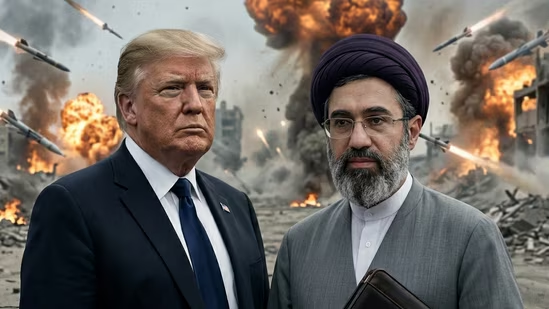
Iran has put forward a 14-point peace proposal to the United States through Pakistan. This is in response to Washington’s earlier nine-point plan to end the war which began after the US and Israel bombed the Islamic State on February 28.
Tehran has linked any deal to guarantees against future military strikes and financial compensation, Iran’s semi-official Tasnim news agency reported. While the US has suggested a two-month ceasefire, Iran insists the matter should be resolved within 30 days and that negotiations must focus on ending the war altogether, as per the outlet.
Inside Iran’s 14-point plan for the US
The proposal outlines a settlement plan that includes ending military actions across the region, including Lebanon, lifting the naval blockade, and withdrawing foreign forces, according to Iranian media. It also calls for a new arrangement to govern the Strait of Hormuz, a major global energy route.
Iran has also demanded lifting of sanctions, release of frozen Iranian assets, and compensation for damages. It has proposed resolving all issues within 30 days, instead of the two-month ceasefire timeline suggested by the US.
Iran’s deputy foreign minister Kazem Gharibabadi said, “Now the ball is in the United States’ court to choose the path of diplomacy or the continuation of a confrontational approach,” as quoted by state broadcaster IRIB during a briefing with diplomats in Tehran.
What the US and Iran want
- The US suggested a two-month ceasefire; Iran wants a complete settlement within 30 days.
- US calls for dismantling enrichment facilities and ending uranium enrichment; Iran has previously insisted on its right to enrichment, with detailed changes deferred to a later stage.
- The US wants unrestricted access; Iran calls for a revised regional framework and removal of blockade conditions.
- The US seeks an end to Iranian support for armed groups; Iran calls for an end to regional fighting while maintaining its alliances.
- The US proposes phased relief; Iran demands the complete removal of sanctions and the release of assets.
- Tehran has also linked a possible deal to firm guarantees on no future attacks.
‘Up to the US’, says Iran
Gharibabadi said Iran remains open to both diplomacy and confrontation depending on Washington’s response. “It is up to the US whether to pursue a negotiated settlement or to return to open war,” he said.
US President Donald Trump said he will review the Iranian proposal but questioned whether it would be acceptable. “I will soon be reviewing the plan that Iran has just sent to us, but can’t imagine that it would be acceptable in that they have not yet paid a big enough price for what they have done to Humanity, and the World, over the last 47 years,” Trump said on Truth Social.
He also said earlier that he was not satisfied with Iran’s position. “They want to make a deal, I’m not satisfied with it, so we’ll see what happens,” he said.
Violence continues in the region. Fresh Israeli strikes in Lebanon on Saturday reportedly killed three people in Sammaiyeh in the Tyre district, despite a fragile ceasefire that has been in place since April 17.