

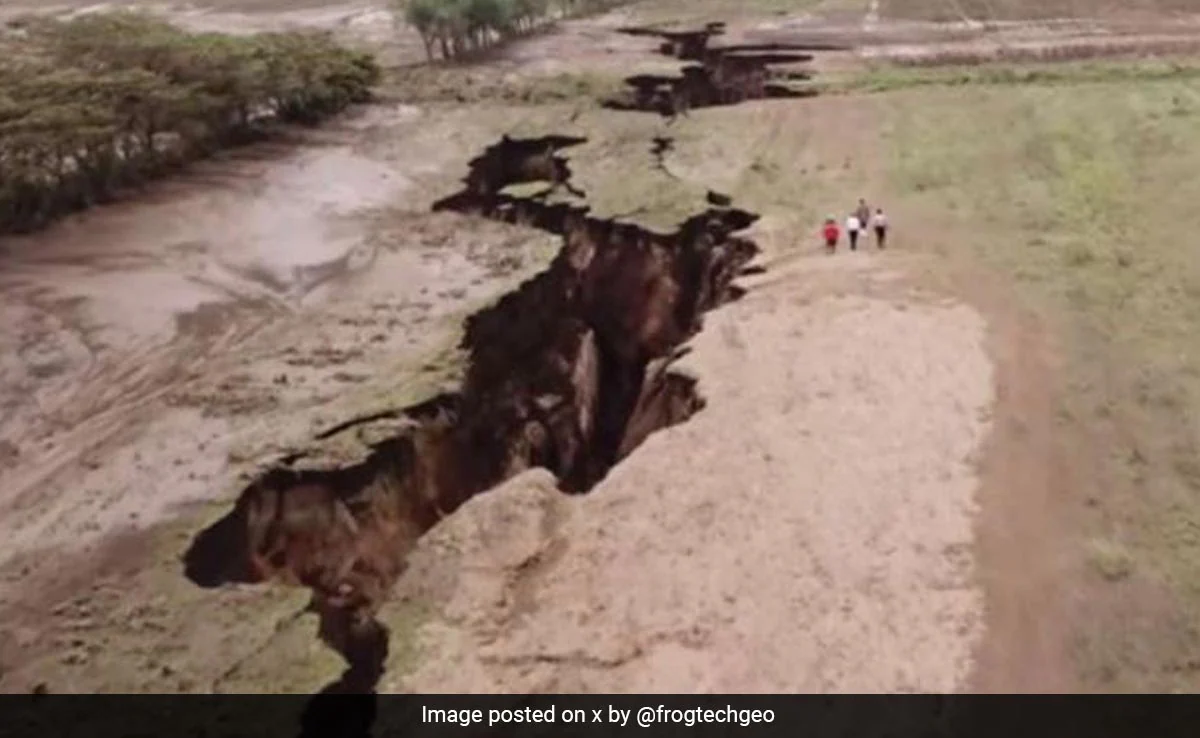
The continent of Africa may be splitting into two faster than expected, new research has revealed. The spot in question is the Turkana Rift in the eastern part of the landmass, spanning 500 kilometers across Kenya and Ethiopia, a paper published last month in Nature Communications stated.
A part of the East African Rift System, the rift is where three tectonic plates meet- the Arabian, African and Somali plates. Two of these plates are slowly drifting apart at a rate of about 4.7 millimeters annually, a process that will divide the continent into two, creating an ocean between the lands.
Turkana is the only known active rift on Earth that is presently showing “necking,” a key phase before a new ocean basin forms, a statement by researchers at Columbia University explained.
The study found that the thinned crust beneath the Turkana Rift indicates the region is further along in continental rifting than previously believed and is nearing a critical stage.
Christian Rowan, a PhD student in Earth and Environmental Sciences and a researcher at Columbia Climate School’s Lamont-Doherty Earth Observatory, said that the research “can be fed into tectonic models that are coupled with climate to really explore how shifting tectonics and climates influenced our evolution.” Rowan was also the lead author of the study.,
Before you panic, the split will play out in geological time, meaning it’s at least a few million years till the next stage or oceanisation, when magma will surge through the cracks in the crust and create a new seafloor for water from the Indian Ocean in the north.
The Turkana Rift started pulling apart around 45 million years ago. Researchers also found that an earlier period of rifting did not culminate in continental breakup but made the crust weaker and thinner, contributing to the present rifting phase.
Impact Of The Research
The research holds importance in the area of human evolution, indicating how Turkana became an important site for hominin or early human fossils.
Over 1,200 hominin fossils from the last 4 million years, one-third of all such fossils found in Africa, have been found in the Turkana Rift. Seen as a scientific ‘Garden of Eden’ by many, researchers now believe that following widespread volcanism around 4 million years ago, fine-grained sediments favourable for fossil preservation rapidly gathered in the region, making it easier to preserve fossils.
For now, the continent is millions of years away from splitting up and creating a new landmass.