

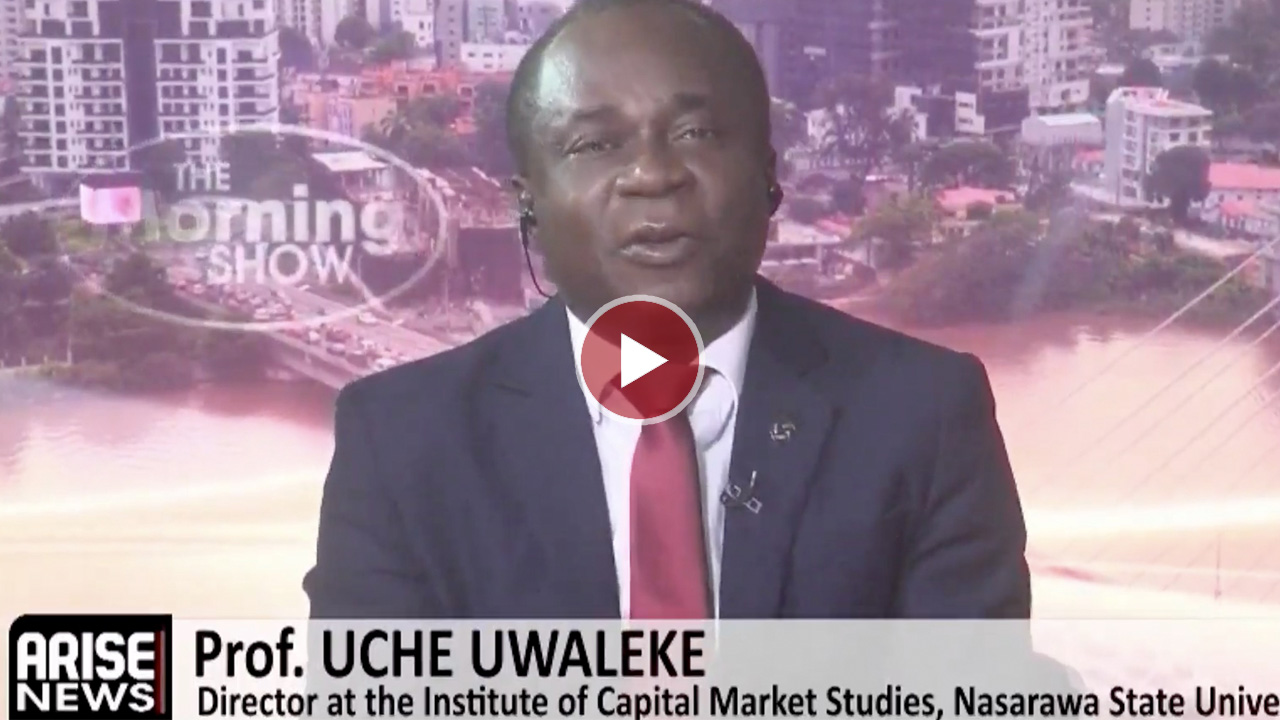
Director of the Institute of Capital Market Research at Nasarawa State College, Professor Uche Uwaleke has stated that Nigeria’s fiscal challenges stem extra from poor income administration and systemic leakages than from low income technology, calling for pressing reforms to enhance transparency, lower assortment prices, and strengthen public {financial} programs.
Talking in an interview with ARISE Information on Thursday, Uwaleke stated latest issues raised by the World {Bank} about Nigeria’s fiscal place are “legitimate” and mirror long-standing structural weaknesses.
“The World {Bank}’s issues are legitimate,” he stated. “However what strikes me is that Nigeria’s drawback is not only a income drawback — it’s a income administration drawback. We now have important leakages throughout the system.”
He famous that regardless of producing almost ₦90 trillion in income between 2023 and 2026, the affect on improvement has remained restricted resulting from inefficiencies and poor coordination amongst key authorities companies.
“There are gaps in coordination. The Funds Workplace, the Workplace of the Accountant-Common, and the Debt Administration Workplace usually are not correctly aligned. That creates confusion and weakens fiscal outcomes,” he stated.
Uwaleke recognized the excessive value of income assortment as a serious drain on public funds, revealing that key companies retain between 4 and seven p.c of revenues as assortment prices — far above international requirements.
“At present, companies just like the Federal Inland Income Service, the Nigerian Customs Service, and the Nigerian Upstream Petroleum Regulatory Fee retain between 4 and seven p.c as value of assortment. That may be very excessive by any normal,” he stated.
“In international greatest apply, the price of income assortment ranges between 0.5 and 1 p.c. Within the UK, for instance, it’s about 0.51 p.c, whereas in lots of OECD nations it’s even decrease.”
He warned that the present mannequin encourages inefficiency reasonably than efficiency.
“It creates a perverse incentive — rewarding quantity as a substitute of effectivity. One key precept of public finance is that the price of assortment ought to be low relative to income. That’s not the case in Nigeria.”
Uwaleke advisable a shift away from percentage-based deductions to a budget-based funding mannequin.
“These companies ought to be funded by way of the finances based mostly on their precise wants, not as a proportion of income. That can enhance effectivity and transparency.”
On issues about over 5,000 sub-accounts exterior the Treasury Single Account (TSA), Uwaleke blamed the failure to periodically evaluation the system.
“The TSA was launched to enhance transparency, however over time, it has not been correctly reviewed. When reforms usually are not monitored, individuals discover methods to avoid them,” he stated.
He known as for a complete audit of Nigeria’s public {financial} administration programs.
“We want a forensic evaluation of the TSA, in addition to programs like GIFMIS and IPPIS. With out common evaluation, loopholes will proceed to emerge.”
Uwaleke acknowledged that some progress has been made in addressing leakages within the oil sector, significantly by way of latest coverage measures.
“The President took a step in the precise course with Government Order 9, which addressed a few of the deductions beforehand made by NNPC Restricted. That has helped scale back leakages, however extra must be finished throughout different companies.”
He additionally criticised the present funding construction for revenue-generating companies, noting that their earnings generally exceed allocations to whole areas.
“In January 2024, three companies — FIRS, NUPRC, and Customs — obtained about ₦78 billion by way of first-line prices. That was greater than what your complete North-East states obtained, which was about ₦56 billion,” he stated.
“If you examine that to funding for important sectors like well being and training, the chance value is just too excessive.”
On fiscal federalism, Uwaleke stated Nigeria’s present revenue-sharing system broadly displays its construction however ought to evolve as duties shift to states.
“The federal authorities presently takes about 48.5 p.c, states 26.72 p.c, and native governments 20.7 p.c. That aligns with current duties,” he stated.
“However as extra duties are devolved to states — for instance in electrical energy and correctional companies — they need to obtain a bigger share of income.”
Uwaleke confused that addressing Nigeria’s fiscal challenges requires a holistic reform method targeted on effectivity, transparency, and accountability.
“We should block leakages, scale back the price of income assortment, and strengthen oversight of public {financial} programs. With out these reforms, elevated income alone won’t translate into significant improvement,” he stated.
Boluwatife Enome
Times Nigeria