

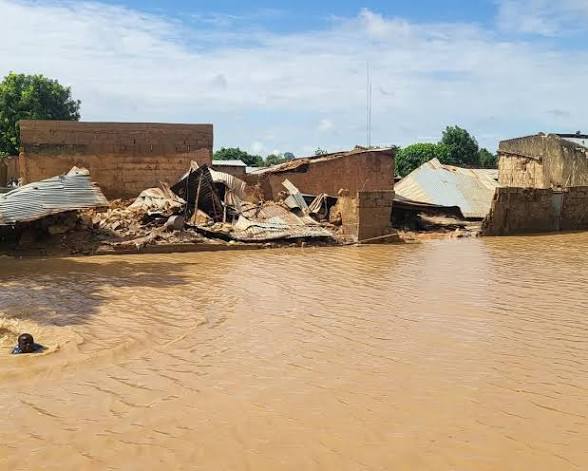
As Nigeria edges nearer to the height of the 2026 wet season, a well-recognized however troubling query resurfaces: will the nation as soon as once more be caught between early warnings and late responses? With contemporary projections pointing to widespread vulnerability throughout hundreds of communities nationwide, the stakes have by no means been larger. The problem is now not in regards to the absence of forecasts, however in regards to the nation’s readiness to translate these warnings into well timed, coordinated motion. On this unfolding actuality, the function of the Nationwide Emergency Administration Company (NEMA) turns into not simply necessary, however central to figuring out whether or not preparedness will lastly take priority over panic.
The 2026 Annual Flood Outlook has as soon as once more sounded a stark warning. Over 30,000 communities are in danger nationwide, with 14,118 categorised as high-risk throughout 33 states and the Federal Capital Territory. An additional 15,597 fall inside moderate-risk zones, whereas 923 communities are thought-about low threat. These will not be simply statistics; they symbolize houses, livelihoods, and full native economies that could possibly be disrupted in a matter of days if proactive measures will not be taken.
Flooding in Nigeria has developed into a posh and recurring disaster, pushed by a mixture of local weather variability and human components. Elevated rainfall depth, rising water ranges in main rivers, and the affect of local weather change proceed to intensify vulnerability. On the identical time, fast urbanisation, poor drainage techniques, encroachment on waterways, and indiscriminate waste disposal worsen the scenario. The result’s a harmful cycle the place pure triggers meet human negligence, amplifying the dimensions of destruction.
Towards this backdrop, the federal authorities has signalled a renewed dedication to strengthening emergency response techniques. President Bola Ahmed Tinubu, represented by the Minister of Surroundings, Balarabe Lawal, has acknowledged present challenges whereas reaffirming efforts to enhance coordination amongst related ministries and businesses. The emphasis on sooner, more practical response mechanisms displays a rising recognition that catastrophe administration should evolve alongside rising dangers.
On the centre of this evolving response is NEMA, which continues to play a pivotal function in coordinating preparedness and mitigation efforts. In recent times, the company has shifted its focus from largely reactive interventions to a extra proactive technique anchored on early warning and early motion. This strategy recognises a vital actuality: disasters might not at all times be prevented, however their affect might be considerably diminished with the fitting stage of preparedness.
One of the crucial notable elements of NEMA’s present technique is the strengthening of early warning techniques. Working intently with technical businesses such because the Nigerian Meteorological Company (NiMet) and the Nigerian Hydrological Companies Company (NIHSA), NEMA ensures that flood forecasts are disseminated properly forward of peak rainfall durations. Nevertheless, the true problem lies not simply in issuing warnings, however in guaranteeing that they translate into well timed and efficient motion on the group stage.
To bridge this hole, the company has intensified its grassroots sensitisation campaigns. Throughout flood-prone states, communities are being educated on evacuation procedures, the risks of ignoring flood alerts, and the significance of sustaining clear drainage techniques. These engagements, typically carried out in collaboration with state emergency administration businesses and native authorities, are steadily fostering a tradition of preparedness that has lengthy been missing.
Equally important is the growing emphasis on simulation workout routines and inter-agency coordination. Current flood response drills performed in weak areas have introduced collectively safety businesses, emergency responders, and group volunteers to rehearse real-life eventualities. These workout routines will not be merely symbolic; they function sensible assessments of response capability, serving to to establish gaps and enhance coordination earlier than catastrophe strikes.
But, regardless of these efforts, persistent challenges stay. Early warning info doesn’t at all times attain distant or underserved communities. In some circumstances, residents underestimate the dangers or delay evacuation till it’s too late. There may be additionally the difficulty of uneven dedication on the sub-national stage, the place some state governments have but to completely prioritise native preparedness measures. These gaps spotlight the necessity for a extra built-in strategy that goes past federal interventions to incorporate stronger state and group possession.
Mitigation, within the broader sense, should additionally deal with structural and environmental components. The desilting of drainage techniques, enforcement of city planning rules, and prevention of building on floodplains are vital steps that require sustained political will. Lengthy-term options akin to afforestation, improved land administration, and climate-resilient infrastructure should even be prioritised if Nigeria is to scale back its vulnerability to recurring floods.
Know-how is one other space with important potential. Actual-time knowledge monitoring, predictive analytics, and digital communication platforms can improve each preparedness and response. When successfully deployed, these instruments can be certain that warnings will not be solely well timed however actionable, reaching folks in codecs they perceive and belief.
In the end, the story of flooding in Nigeria is not only about rising water ranges; it’s in regards to the intersection of atmosphere, governance, and public behaviour. Whereas businesses like NEMA proceed to strengthen institutional response, the function of residents can’t be neglected. Easy actions akin to correct waste disposal, adherence to constructing rules, and responsiveness to evacuation directives can collectively make a big distinction.
Because the 2026 flood season unfolds, Nigeria stands at a vital crossroads. The warnings are clear, the dangers are properly documented, and the institutional frameworks led by NEMA are steadily bettering. But, the true check lies past projections and coverage statements; it rests on collective motion. Preparedness should transfer from paper to apply, from authorities desks to weak communities. If the teachings of earlier floods are taken severely and early actions are sustained, this 12 months may mark a turning level in Nigeria’s catastrophe administration story. But when complacency prevails, the implications will as soon as once more be measured in avoidable losses. The selection, finally, shouldn’t be within the arms of nature, however within the resolve of a nation decided to behave earlier than the waters rise.