

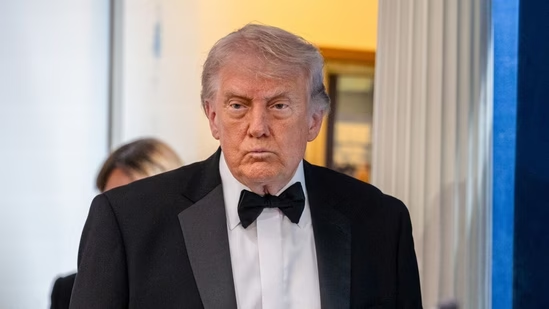
US President Donald Trump met oil company and trading house executives at the White House on Tuesday to discuss sustaining the naval blockade of Iranian ports for an extended period, as Brent crude climbed to $119 a barrel on Wednesday and US military commanders separately prepared a strike plan to increase pressure on Tehran.
The spike in oil prices came after Trump told news outlet Axios on Wednesday he would not lift the blockade until Iran agreed to a nuclear deal — “they are choking like a stuffed pig and it is going to be worse for them.”
Later, the US president stated that the two sides are talking on the phone and that “Iran has come a long way, the question is whether they will go far enough… Now, Iran just has to say we give up”.
The Wall Street Journal on Tuesday reported he had reached that conclusion at a Monday Situation Room meeting, where he weighed resuming bombing or walking away and judged both riskier than continuing to squeeze Tehran’s oil revenues — a high-stakes bid for a nuclear capitulation Iran has long refused.
Oil price rise
Brent oil rose to its highest since June 2022, gaining more than 7% on the day. Prices have now erased all losses since the US and Iran agreed to a temporary ceasefire, with investors bracing for a longer conflict.
Tuesday’s meeting, described by a White House official, included representatives of Chevron Corp. as well as trading houses Trafigura Group, Vitol Group and Mercuria Energy Group Ltd. A Chevron spokesperson confirmed that the company’s chief executive officer, Mike Wirth, attended. Treasury secretary Scott Bessent, who has led the administration’s efforts to impose economic pressure on Iran, hosted the meeting. Other participants included Vice President JD Vance and White House Chief of Staff Susie Wiles.
It came roughly three weeks into a ceasefire that has halted bombing but hasn’t led to a major breakthrough on a nuclear deal.
Participants discussed ways the Trump administration could keep up its blockade of Iranian ports, if needed, while minimising impact on American consumers. The officials and executives also spoke about efforts the administration has already taken to address the oil market, domestic production, oil futures, natural gas and shipping, as well as progress in Venezuela following the US capture of its former leader Nicolás Maduro.
How the Hormuz is affecting supply
The near-closure of the Strait of Hormuz has blocked the flow of about 13 million barrels of crude a day. The world has been draining pre-war oil inventories — and tapping emergency stockpiles — that have provided a buffer in the short term.
The US squeeze of Iran’s crude flows is central to the Trump administration’s strategy in the region. Bessent has described the blockade as blocking crude sales to deprive Tehran of revenue, while pushing more oil into storage and forcing the closure of some wells. “Iran’s creaking oil industry is starting to shut in production” thanks to the blockade, Bessent posted on X on Monday.
The administration has issued — and extended — a temporary waiver allowing foreign vessels to ship crude and other commodities between US ports and eased sanctions allowing purchases of some waterborne cargoes of Russian crude, among other steps.
While Trump said he’d stick with the blockade, US military commanders have prepared a plan for a short and powerful wave of strikes on Iran to raise pressure on the regime, Axios said, citing people with knowledge of the preparations.
Iranian officials showed no sign of backing down. Parliament Speaker Mohammad Bagher Ghalibaf on Wednesday accused Trump of seeking to force Iran to surrender through economic pressure and internal divisions, the semi-official Tasnim news agency reported.
“Trump explicitly divides the country into hardliners and moderates and then immediately talks about a naval blockade to force Iran to surrender through economic pressure and internal divisions,” Ghalibaf said in an audio message addressed to Iranians. The only solution to “counter the enemy” is national unity, he added.
Trump has claimed that divisions within the Iranian regime have slowed decisionmaking. US and Israeli attacks have killed many of the country’s top leaders.
It’s unclear how much storage and time Iran has left before it would need to close down wells, which may damage them permanently. Analytics firm Kpler estimates it has another 12 to 22 days.
Trump administration officials have repeatedly said oil and gasoline prices will fall after the war ends. But climbing commodities prices weigh heavily on the administration ahead of the November midterm elections that will determine whether Trump’s Republican Party maintains control of Congress.
US fed leaves rates unchanged
Federal Reserve officials left interest rates unchanged, but revealed a deepening division over the outlook for policy amid increased uncertainty caused by the conflict in the Middle East.
Four officials voted against the decision, including three who objected to language in their post-meeting statement that suggested the central bank would eventually resume cutting rates.
Cleveland Fed President Beth Hammack, Minneapolis Fed President Neel Kashkari and Dallas Fed President Lorie Logan “supported maintaining the target range for the federal funds rate but did not support inclusion of an easing bias in the statement at this time,” the committee said.
Governor Stephen Miran dissented in favour of a quarter-point reduction in rates.
The 8-4 vote marked the first time since October 1992 that four officials dissented against a Federal Open Market Committee decision. The committee left their benchmark federal funds rate in a range of 3.5% to 3.75%.
The S&P 500 and Treasuries remained lower after the decision.
Heading into the meeting, investors and economists widely expected the Fed to leave rates unchanged through the remainder of the year.
Officials made a slight change to their statement, saying “developments in the Middle East are contributing to a high level of uncertainty about the economic outlook.” They previously said the implications of the conflict on the economy were uncertain.