

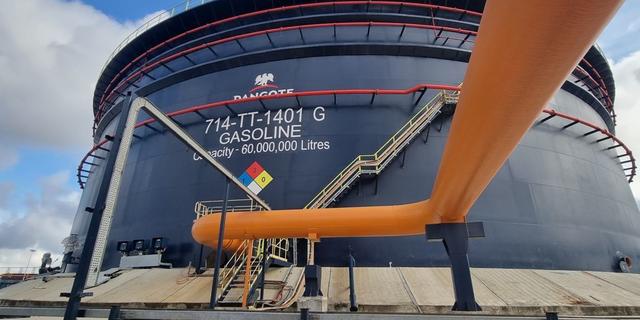
The Dangote Refinery equipped about 72.3 per cent of Nigeria’s complete home demand for petrol in March, however with consumption falling by roughly 16.9 per cent in the course of the interval into consideration from 56.9 million litres per day in February to 47.3 million litres final month.
Apart from, though nonetheless modest in comparison with final yr’s large importation, the share of petrol imports within the provide combine surged by 96.7 per cent month-on-month, rising from 3 million litres per day to five.9 million litres/day in the course of the interval.
Information from the March 2026 reality sheet on midstream and downstream petroleum operations supplied by the Nigerian Midstream and Downstream Petroleum Regulatory Authority (NMDPRA) on Tuesday, confirmed that the 47.3 million litres per day consumption for march fell beneath the nationwide common of fifty million litres per day.
Overrall, the info indicated that complete home petrol provide stood at 34.2 million litres per day in March. When measured towards complete consumption of 47.3 million litres per day, this positioned Dangote Refinery’s contribution at roughly 72.3 per cent of the home market, reaffirming its dominant position within the nation’s gas provide chain.
Nonetheless, the provision combine additionally mirrored a pointy enhance within the position of imports. The actual fact sheet confirmed that petrol import contribution rose from 3 million litres per day in February to five.9 million litres per day in March, equal to a 96.7 per cent soar in import share.
Nonetheless, this enhance in imported petrol between February and March was regardless of the downstream regulator’s insistence that it has halted the issuance of import licenses to grease entrepreneurs for months.
For over a yr, proprietor of the 650,000 barrels per day facility in Lagos, Aliko Dangote, has pushed to finish petrol imports with the intention to, in accordance with him, shield native refining and develop the financial system. Dangote’s refinery, which started production of petrol in 2024, has argued that Nigeria’s import licensing regime undermines native refining by permitting entrepreneurs to proceed bringing in petrol even when home provide is growing.
The corporate has maintained that beneath the Petroleum Business Act (PIA), imports ought to solely be permitted when there’s a clear provide shortfall, not as a parallel system competing with native production.
Alternatively, oil entrepreneurs and a cross part of Nigerians consider that leaving the market solely for Dangote, with none competitors from another refinery, particularly from NNPC’s defunct Port Harcourt and Warri refineries will result in a monopoly and inflated pump costs.
The NMDPRA reality sheet additional confirmed that different home refining sources contributed solely marginal volumes, particularly diesel refining. The three operational modular refineries: Walter Smith, Edo Refinery, and Aradel collectively equipped about 0.629 million litres per day of diesel in the course of the month.
Walter Smith refinery operated at a mean capability utilisation of 59.56 per cent, supplying 0.241 million litres per day. Edo Refinery recorded 64.69 per cent utilisation with 0.051 million litres per day, whereas Aradel posted 58.84 per cent utilisation, delivering 0.337 million litres per day.
Common diesel consumption in the course of the interval stood at 14.5 million litres day by day, barely above the 14 million litres per day nationwide benchmark, regardless of the rising costs on account of the Center East disaster, indicating sustained demand from industrial and business customers.
Equally, in March, aviation gas consumption remained decrease at 2.1 million litres per day in comparison with the three million litres per day benchmark for the nation and towards the two.9 million litres per day equipped in February.
In the entire gasoline market section, complete provide averaged 4.888 Billion Normal Cubic Ft Per Day (Bscf/d). Of this, 3.033 Bscf/d was equipped to the Nigeria LNG (NLNG), representing roughly 62 per cent of complete gasoline provide.
Home gasoline provide stood at 1.855 Bscf/d, with utilisation unfold throughout key sectors. Gasoline-to-power accounted for 0.485 Bscf/d, business consumption stood at 0.430 Bscf/d, and gas-based industries utilised 0.601 Bscf/d.
Within the Liquefied Petroleum Gasoline (LPG) section, the NMDPRA information indicated that demand outpaced provide in the course of the interval. Common day by day provide stood at 4,726 metric tonnes, whereas consumption reached 5,122 metric tonnes per day, leaving a shortfall of 396 metric tonnes day by day. Additionally, retail LPG costs ranged between N980 and N1,450 per kilogramme nationally.
Gasoline sufficiency information confirmed that petrol inventory ranges stood at 21 days, together with pumpable volumes on the Dangote Refinery, diesel sufficiency was 55 days, aviation gas stood at 109 days, and LPG at 14 days.
In the identical vein, the midstream and downstream regulator put the Ajaokuta-Kaduna-Kano (AKK) gasoline pipeline completion stage at 79.23 per cent; OB3 River Crossing at 59.50 per cent and the Odidi-Warri Growth Undertaking (OWEP) at 67.34 per cent completion price.
Emmanuel Addeh
Times Nigeria