

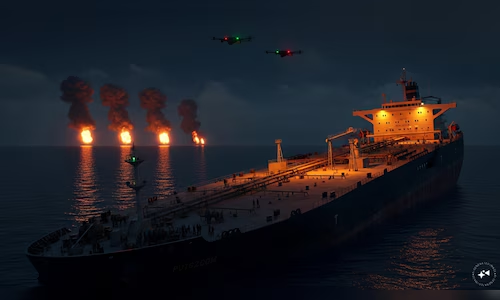
“The Strait of Hormuz has emerged as the centre of gravity in the ongoing conflict. The success of negotiations will depend largely on the status of the crucial chokepoint, which is the lifeline of global energy supply,” said Col (Retd) Rajeev Agrawal, West Asia expert and author of Between Tehran and Tel Aviv.
An Indian seafarer stationed near Iraqi waters told CNBC-TV18, “There is no food, no water and no fuel on our ship. Our entire crew is living in fear. A few days ago, two tankers transferring oil near us were attacked by an unknown boat. Missiles are fired in front of us—we don’t know what to do.”
The seafarer said that most of the crew was on their first or second voyage. Despite being positioned near an Iraqi port, crew members from Iraq abandoned the ship right after anchorage in the Iraqi waters.
Living through conflict at sea
Another seafarer, whose vessel was instructed to reroute away from the Strait, said India-flagged ships have an advantage over non-Indian vessels due to Iran’s conditions for safe passage. However, many Indian seafarers remain onboard ships registered in India but not flying the Indian flag.
As of April 20, 10 ships that transited the Strait and returned to India were Indian-flagged. At least one foreign-flagged vessel and another with an unconfirmed flag have also returned to Indian ports.
Yet another seafarer, who recently returned from the Strait after spending over a week in the region, described the experience as deeply harrowing.
“The whole crew was rationing food as supplies were limited. At night, we could see explosions on ships anchored near us. People from attacked vessels reached out over radio, but we couldn’t move to help—any movement would have made us a target,” the seafarer said.
There were also strict instructions from Indian authorities to maintain anchorage at designated coordinates, but that offered little reassurance.
“I would wake up at night as most attacks happened in the late hours. Some nights, it was the sound of distant strikes; on others, complete silence. Both were equally chilling—it felt like we could die any minute,” the seafarer said.
Catch Iran US War LIVE Updates hereAn under-counted workforce at sea
Indian nationals make up roughly 10-12% of the global seafaring workforce. Even before the West Asia crisis, thousands transited the Strait daily, with tens of thousands deployed across the Gulf.
Many are spread across vessel types, and even on foreign-registered ships, Indian crew often form a majority.
“Nearly 80% of Indian seafarers stuck in West Asia are working on foreign-flagged vessels. While International Maritime Organization norms count large vessels, there’s a significant presence of Indian seafarers even on offshore supply vessels and smaller ships that are not included. Many more lives are at stake than those officially counted,” said Manoj Kumar Yadav, general secretary of the Forward Seamen’s Union of India.
While US naval forces are active in the region, the country has relatively few seafarers in global commercial shipping. In contrast, several vessels linked to Iranian trade networks operate through intermediaries based in Dubai due to sanctions risks. This creates complex ownership structures spanning multiple jurisdictions, even as a significant share of crew members are Indian.
“If the conflict escalates, vessels linked to Iranian trade networks with Indian crew onboard will be exposed to attacks,” Yadav said.
The compensation gap
Since February 28, the waterway has not seen a stable operating cycle, oscillating between closure, partial access and brief reopenings that have not fully normalised traffic. More than 20 vessels have been attacked in the broader region, with at least 10 targeted in the Strait itself.
“The flow of ships and tankers through the Strait of Hormuz requires continuity in policy and action. It cannot function like a valve that is shut and reopened based on provocations,” Agrawal said.
The attack on Indian vessels on April 19 has raised concerns about financial risks for the shipping sector.
“A specific concern for Indian-flagged vessels servicing offshore fields near sensitive maritime boundaries is that insurers are inserting ‘Missile or Drone Endorsement’ exclusions. If a vessel is hit by a stray drone, standard protection may not apply unless additional war-risk cover is in place,” Shrikant Hathi, managing partner at Mumbai-based law firm Brus Chambers, said.
“The shipping and insurance sectors require stability and lasting assurances, not sudden policy shifts,” Agrawal added.
The seafarer who recently returned from the Strait also described how, despite emergency advisories from the Shipping Ministry, there was little clarity from charter operators. “Our vessel halted nearly 200 nautical miles from Hormuz after a drone strike hit a ship ahead of us. We eventually anchored at the coordinates suggested by authorities after receiving no clear response from the charter,” the seafarer said.
The route has also seen a disproportionately young workforce, with many seafarers between 21 and 35 years old.
“Indian manning agents cannot force seafarers to join vessels bound for Hormuz without a signed waiver and proof of war-risk insurance. We are seeing experienced officers opt for safer routes, even at lower pay, leading to shortages on key vessels,” Hathi said.
According to government briefings, over 2,400 Indian seafarers have been repatriated so far, but unions say many remain stranded.
“Mere crew change cannot be considered repatriation. Many are being replaced by other Indian seafarers and have not received any war-risk compensation,” Yadav said.