

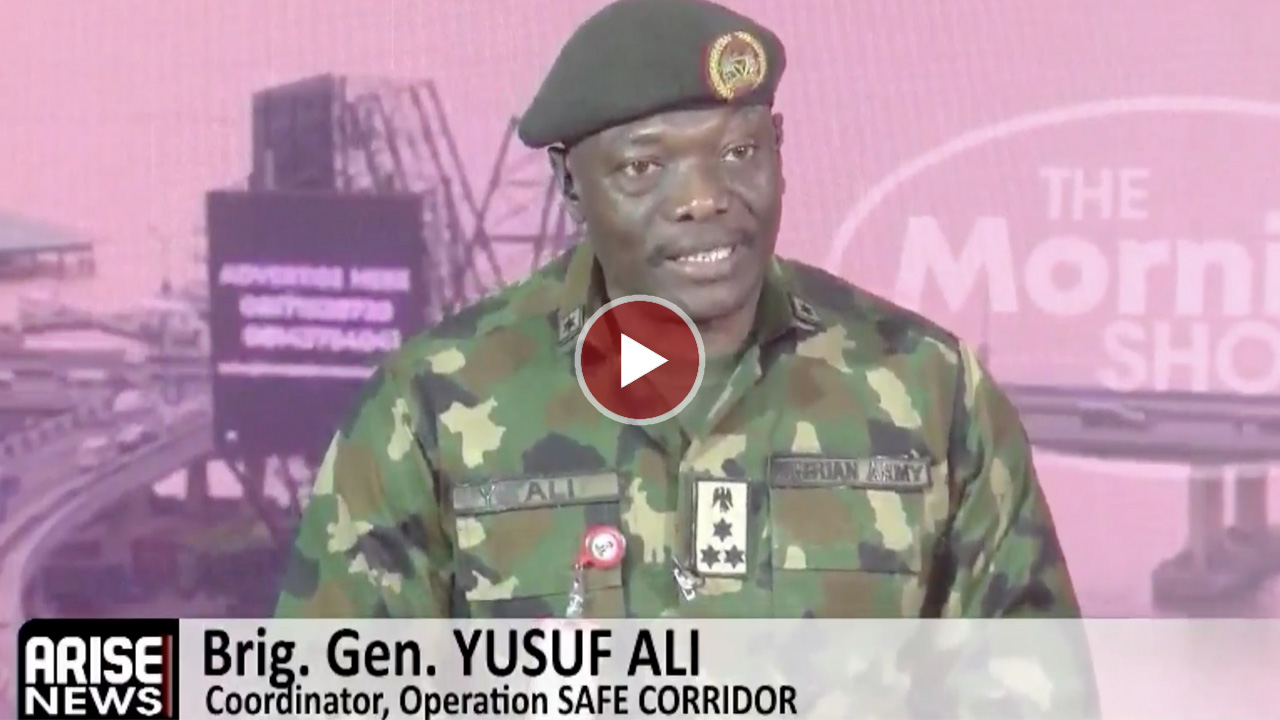
The Coordinator of Operation SAFE CORRIDOR, Brigadier Normal Yusuf Ali, has defended Nigeria’s deradicalisation and reintegration programme, insisting that there isn’t a proof that people who handed by means of the scheme have returned to prison or terrorist actions.
Talking in an interview with Wednesday throughout an interview on ARISE Information, Brig. Gen. Ali mentioned considerations that rehabilitated ex-insurgents have been rejoining violent {groups} “don’t mirror actuality on the bottom,” including that the programme stays structured, clear, and collectively supervised by a number of safety and civil establishments.
Responding to questions concerning the effectiveness of Operation SAFE CORRIDOR and allegations that reintegrated individuals generally relapse into crime, he mentioned:
“The fact on the bottom doesn’t help that assertion. Operation SAFE CORRIDOR is structured and a well-developed system of screening shoppers and offering psychosocial and different types of help we offer for them.
“On the finish of their coaching on the DDR camp, we don’t simply insert them into society like that. Their integration is even completed by the varied state governments. We solely present the atmosphere conducive for them to be reintegrated into their communities.”
He defined that reintegration shouldn’t be dealt with solely by the navy, however includes state governments, conventional rulers, native leaders, and safety businesses, who proceed monitoring members after launch.
“From there, the state governments, conventional rulers, and different key leaders, together with safety businesses on the native stage, proceed the monitoring of the shoppers, making certain that their behaviours are per the coaching they’ve imbibed at Operation Secure Hall,” he mentioned.
Brig. Gen. Ali additional maintained that, primarily based on accessible data, no confirmed case exists of a deradicalised participant returning to violent crime throughout Nigeria or neighbouring international locations.
“I’m daring to say that no member of shoppers which have left Operation Secure Hall has been discovered to foment bother of their numerous communities, reducing throughout Akwa Ibom within the south, Ebonyi within the southeast, all the way down to the north and different elements of the nation, together with our neighbouring international locations like Niger, Cameroon, Mali, Burkina Faso and others,” he acknowledged.
On requires extra structured monitoring and accountability, together with month-to-month experiences from communities and conventional rulers, Ali welcomed the suggestion, describing it as a constructive enchancment.
“I feel I might take this as a suggestion… Operation Secure Hall shouldn’t be a 100% foolproof, faultless entity. It’s a piece in progress. We’re clear, accountable, and open to options like this,” he mentioned.
He added that whereas formal month-to-month reporting techniques weren’t but in place because of the absence of hostile experiences, such proposals could be thought-about going ahead.
The dialogue additionally addressed considerations concerning the categorisation of surrendered people, significantly the excellence between “low-risk” and “high-risk” members.
Ali clarified that Operation SAFE CORRIDOR doesn’t routinely grant amnesty, stressing that the Ministry of Justice performs a central position in screening and classification.
“Operation Secure Hall doesn’t present amnesty simply since you give up. It includes 17 ministries, departments, and businesses, together with the Ministry of Justice. It’s the Ministry of Justice that screens and categorises people who give up… It’s these low dangers which can be handed over to Operation Secure Hall that we admit and administer deradicalisation and psychosocial remedy to,” he mentioned.
Addressing considerations that people concerned in violent crimes might nonetheless be labeled as low-risk, he famous that some members had indirectly participated in killings and, in some instances, have been victims of abduction and coercion.
“A few of them haven’t even seen any individual killed of their life. A few of them are kidnapped and made to run errands, fetching water, firewood and happening completely different messages,” he defined.
On broader considerations about rising terrorism in Nigeria and the effectiveness of the programme, Brig. Gen. Ali acknowledged the complexity of the problem, describing terrorism as a worldwide problem requiring each navy and non-military responses.
“Terrorism has been a worldwide phenomenon, and the causes are broad and plenty of. What Operation Secure Hall seeks to do is to cut back recruitment of gullible Nigerians who’re brainwashed and recruited into terrorism and different violent crimes,” he mentioned.
He argued that Nigeria’s present safety state of affairs displays mixed kinetic and non-kinetic interventions.
“Comparatively put collectively, what we’re at the moment having fun with, regardless of some few incidences right here and there, is the web product of the mixture of kinetic and non-kinetic operations,” he acknowledged.
Concluding, Brig. Gen. Ali urged Nigerians to help safety businesses in tackling terrorism collectively.
“Terrorism thrives the place there are numerous elements, and it takes the entire nation to defeat terrorism. I’ll urge Nigerians to hitch palms with the Chief of Defence Employees in order that each kinetic and non-kinetic operations can present the specified peace and safety that Nigeria rightly deserves,” he concluded.
Boluwatife Enome
Times Nigeria