

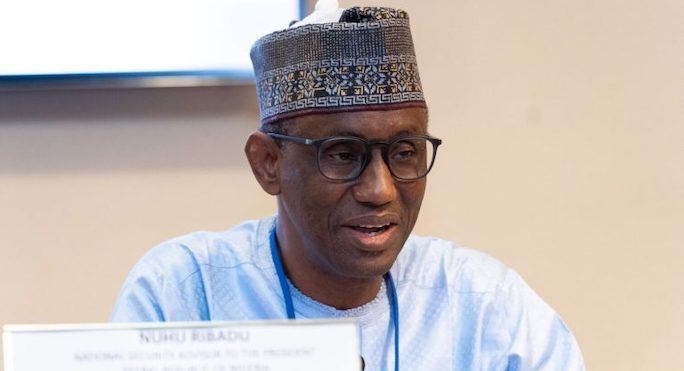
Nationwide Safety Adviser (NSA), Mallam Nuhu Ribadu, has underscored the vital function of strategic communication and girls’s empowerment in strengthening Nigeria’s nationwide safety structure, declaring that inclusive narratives are indispensable for fostering peace, resilience, and social cohesion.
Ribadu, represented by Nationwide Coordinator of the Nationwide Counter Terrorism Centre (NCTC), Main-Normal Adamu Laka, spoke at a high-level occasion on Monday in Abuja to commemorate Worldwide Ladies’s Day.
The occasion was organised in collaboration with Nigerian Institute of Public Relations (NIPR).
It was attended by Deputy Governor of Ogun State, Noimot Salako-Oyedele; Chairman, Nigeria Governors’ Wives Discussion board, Olufolake Abdulrazak; feminine ministers and heads of federal authorities ministries, departments and businesses, feminine envoys in Nigeria, growth companions, amongst others.
Ribadu mentioned Nigeria should transfer past conventional safety responses and embrace preventive, people-centred approaches rooted in efficient communication and gender inclusion.
Quoting the late poet Ntozake Shange — “The place there’s a girl, there’s magic” — Ribadu emphasised that the theme of the occasion, “Talk to Steadiness, Acquire Fairness, Empower Ladies,” mirrored the rising significance of narratives in shaping nationwide outcomes, significantly in an period of advanced safety challenges.
He warned that narratives, if poorly managed, may deepen divisions, however when strategically deployed, may construct belief, unity, and nationwide cohesion.
“The best way narratives are constructed and shared can both divide us or unite us. In right this moment’s safety setting, communication isn’t non-compulsory; it’s central to reaching sustainable peace,” he mentioned.
The NSA burdened that trendy safety threats, together with terrorism and violent extremism, required a shift from purely kinetic approaches to preventive frameworks that prioritised inclusivity, neighborhood engagement and gender stability.
He acknowledged, “For us on the NCTC, sustainable safety goes past power. It’s anchored on preventive methods embedded in our nationwide frameworks for countering violent extremism.”
He described ladies as vital actors in peace-building, early warning techniques, and neighborhood stabilisation efforts.
Ribadu mentioned, “Ladies aren’t simply caregivers; they’re leaders, mediators and educators whose affect cuts throughout generations. Their inclusion in governance and safety processes isn’t non-compulsory, it’s important.”
He acknowledged that collaboration with NIPR underscored the significance {of professional} communication in shaping public notion, combating misinformation, and strengthening belief between authorities and residents.
In her keynote deal with, Particular Adviser to the President on Coverage and Coordination, Hadiza Bala Usman, bolstered the argument that communication was the spine of efficient governance.
She warned that regardless of how well-designed, insurance policies couldn’t succeed with out correct dissemination and public understanding.
“A coverage doc gathering mud adjustments nothing. An excellent initiative that can’t be defined to the individuals has no worth past the paper it’s written on,” she mentioned.
Usman described communication as a transformative device able to dismantling systemic inequalities, significantly these affecting ladies.
Drawing a distinction between equality and fairness, she defined that whereas equality assumed uniform distribution, fairness addressed structural disadvantages.
“Equality offers everybody the identical shoe measurement; fairness ensures everybody will get a shoe that matches,” she acknowledged, stressing that poorly designed insurance policies typically exclude ladies.
Usman cited information indicating that Nigeria’s gender hole continued to hinder {economic} development, stating that closing the hole in workforce participation can improve the nation’s Gross Home Product by as much as 30 per cent.
“Ladies reinvest as a lot as 90 per cent of their earnings into their households and communities. Investing in ladies isn’t just social justice; it’s good economics,” she added.
Usman recognized obstacles, akin to restricted entry to finance, cultural constraints, and office insurance policies that disproportionately affected ladies, particularly throughout childbearing years, urging leaders to create enabling environments that assist ladies’s development.
She referred to as for a shift from symbolic gestures to concrete reforms that addressed systemic inequalities and emphasised the necessity for data-driven storytelling to spotlight the advantages of gender inclusion.
“Communication should not solely inform; it should diagnose and expose inequities to allow them to be addressed,” she mentioned.
President of NIPR, Ike Neliaku, urged a elementary shift in societal narratives about ladies, calling for an finish to portrayals rooted in sympathy and a transition to narratives that promote management and empowerment.
“Many years in the past, society advised ladies ‘don’t cry.’ Right now, we should inform ladies to guide, to rise and to reshape the long run,” he mentioned.
Neliaku highlighted the historic and up to date contributions of ladies to nationwide growth, stating that they’ve all the time been lively contributors in shaping society.
“Nigerian ladies have by no means been spectators; they’ve all the time been authors of our nationwide story,” he acknowledged.
He acknowledged persistent challenges, together with under-representation in management, wage disparities and restricted entry to alternatives, calling for deliberate and sustained efforts to handle them.
He mentioned, “As custodians of public belief and shapers of narratives, we should be sure that communication promotes inclusion fairly than exclusion.”
In his remarks, Governor of Taraba State, Agbu Kefas, reiterated the significance of ladies’s inclusion in governance, citing his administration’s resolution to nominate feminine commissioners regardless of preliminary resistance.
Kefas mentioned inclusive management strengthened governance outcomes and enhanced public belief.
Contributors on the occasion agreed that reaching nationwide stability and gender stability required a whole-of-society strategy, combining efficient communication, inclusive insurance policies and sustained collaboration amongst stakeholders.
The gathering concluded with a renewed dedication to leverage communication as a strategic device for advancing fairness, empowering ladies and strengthening Nigeria’s nationwide safety framework.
Sunday Aborisade
Times Nigeria