

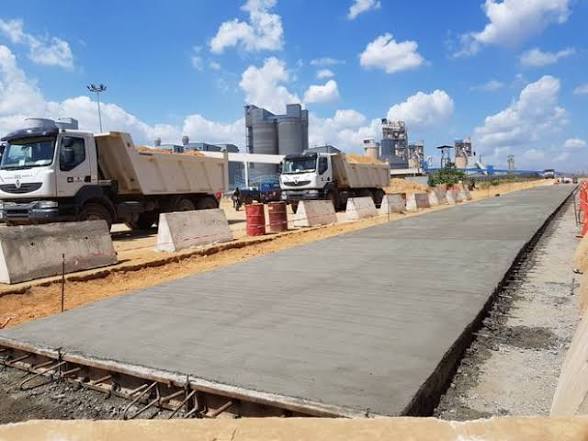
Lengthy roads, particularly highways and expressways, usually take a very long time to finish in Nigeria attributable to many causes and components. Probably the most distinguished amongst them is the gradual tempo of labor by contractors, which is typically compounded by funding challenges, variation in mission scope, inflation, and logistical constraints. These delays not solely improve mission prices but in addition lengthen hardship for street customers, gradual {economic} actions, and contribute to accidents and automobile upkeep prices.
On December 20, 2017, the federal authorities awarded the rehabilitation of the over 430 km Abuja–Kaduna–Zaria–Kano twin carriageway to Julius Berger Nigeria Plc. The contract was later terminated in November 2024 attributable to delays, value disputes, and points referring to efficiency. The federal authorities subsequently re-awarded the contract to Infoquest (Infouest) Nigeria Ltd, and work is now progressing at a sooner tempo, with seen enhancements in mobilisation, gear deployment, and manpower throughout a number of sections of the hall.
Equally, the rehabilitation/reconstruction of the 127 km Lagos–Ibadan Expressway was awarded in July 2013 by the federal authorities to Julius Berger Nigeria Plc and Reynolds Development Firm (RCC) at a price of about ₦167 billion. The mission was anticipated to considerably ease visitors congestion between Lagos and the remainder of the nation, given the strategic {economic} significance of the route.
Nevertheless, after about 13 years, the rehabilitation/reconstruction of the Lagos–Ibadan Expressway has nonetheless not been absolutely accomplished. Whereas Julius Berger accomplished its part, the remaining parts underneath the second section have continued to expertise delays, with some sections nonetheless unfinished. This has led to extended inconvenience for commuters and companies that rely closely on the hall for the motion of products and companies.
It seems that the rehabilitation, reconstruction, or development of lengthy roads in Nigeria consumes a substantial period of time. Nigeria ought to subsequently take into account adopting another method to dealing with long-distance street tasks. One sensible methodology is to divide such tasks into manageable segments and assign them to a number of contractors concurrently.
As an illustration, any development, reconstruction, or rehabilitation of lengthy roads might be divided into segments of about 25 km per development agency. A 100 km street, for instance, might be dealt with by 4 completely different contractors working on the similar time. This method would carry extra gear, elevated manpower, and sooner execution. It could additionally create wholesome competitors among the many firms, encouraging adherence to timelines and improved high quality of labor. Moreover, this methodology reduces the danger related to counting on a single contractor, as delays in a single phase wouldn’t essentially stall all the mission.
Moreover, segmenting tasks permits for higher monitoring and analysis by authorities businesses, improves accountability, and makes it simpler to implement efficiency benchmarks. It additionally offers alternatives for extra indigenous development firms to take part in main infrastructure growth, thereby strengthening native capability within the development sector.
Though this method has been utilized in some tasks, it isn’t but broadly adopted as a regular coverage. Institutionalising it might introduce a extra environment friendly and results-driven framework for street supply throughout the nation.
The federal and state governments ought to subsequently experiment with this methodology on main street tasks. If correctly applied, it could help Nigeria in constructing extra roads in document time, scale back development delays, enhance street high quality, and speed up {economic} progress throughout the nation.