

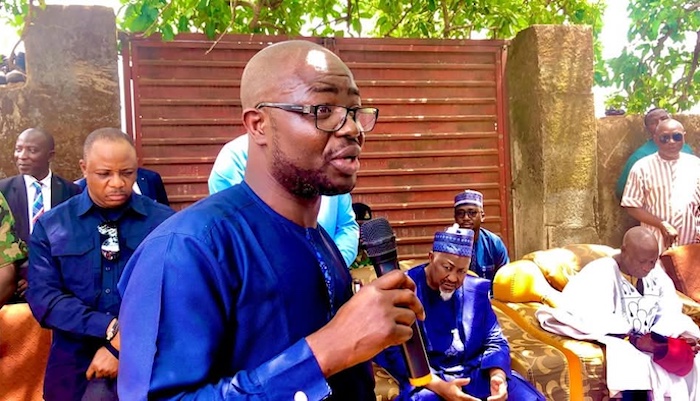
The federal authorities has unveiled a sweeping reform of Nigeria’s humanitarian and poverty discount structure, adopting a brand new unified framework aimed toward ending years of fragmented interventions and putting weak residents on a transparent path from survival to self-reliance.
On the shut of a four-day Nationwide Technical Workshop in Abuja, the Minister of Humanitarian Affairs and Poverty Discount, Dr. Bernard Doro, introduced the adoption of the One Humanitarian – One Poverty Response System (OHOPRS) because the nation’s new nationwide coordination framework for humanitarian motion, social safety, and poverty discount.
Talking throughout a press convention on the United Nations Home in Abuja, the minister mentioned the initiative represented a decisive shift in Nigeria’s strategy to addressing poverty and humanitarian challenges.
“At present marks a defining second in our journey in direction of reforming humanitarian interventions and decreasing poverty at scale,” Doro instructed journalists and improvement companions.
He defined that the workshop, convened by the ministry in collaboration with worldwide and native companions, was designed to deal with what he described as a elementary weak spot in Nigeria’s humanitarian ecosystem — the fragmentation of programmes and lack of coordination amongst establishments.
The minister illustrated the urgency for reform with a narrative shared by a area group working in Nigeria’s conflict-affected North-east.
In response to him, the group encountered a mom of 4 who had spent three years receiving intermittent humanitarian assist however remained trapped in poverty.
“She obtained sufficient meals to outlive the week, however by no means sufficient instruments to alter her life,” he mentioned.
Quoting the girl’s phrases, he added: “We’re all the time helped… however we’re by no means transferring ahead.”
Doro mentioned the story mirrored a broader systemic failure within the nation’s poverty response mechanisms.
“It isn’t that assist will not be reaching individuals,” he mentioned. “It’s that our techniques aren’t designed to maneuver individuals from survival to self-reliance.”
The minister warned that failure to reform the system would proceed to waste scarce assets and depart weak communities trapped in cycles of dependence.
“If a affected person arrives at a hospital and 10 completely different docs every deal with one symptom — with no shared notes, no shared analysis — that affected person might survive the day however won’t ever actually get better,” he mentioned.
“Nigeria’s poor have had many docs. What they haven’t had is a advisor who sees the entire individual.”
To handle these gaps, the federal government adopted the OHOPRS, which the minister described as a nationwide working system relatively than one other standalone programme.
“OHOPRS will not be one other programme,” he burdened. “It’s supposed as a nationwide working system.”
The framework is designed to unify humanitarian interventions, social safety programmes, and poverty discount initiatives below a single coordination platform.
In response to Doro, the brand new system will drive 5 main structural adjustments in how help is delivered nationwide.
These embody the transition from a number of coordination mechanisms to a single nationwide system, the mixing of a number of beneficiary databases into one nationwide registry structure, and the shift from project-based funding to a pooled financing construction with stronger accountability mechanisms.
He added that the brand new framework would additionally give attention to measurable outcomes of poverty exit relatively than mere intervention supply, whereas introducing real-time monitoring techniques to strengthen transparency.
Central to the reform is what the minister described as a “Ladder of Progress”, a structured pathway designed to trace the journey of each beneficiary from identification to {economic} resilience.
Underneath the system, weak residents will first be recognized by way of the Nationwide Social Register. Their interventions will then be tracked utilizing a Unified Beneficiary Register.
Beneficiaries will subsequently transfer by way of a Poverty Exit Pathway designed to information them in direction of {economic} independence, after which they are going to be monitored by way of a Development Register to make sure they continue to be resilient and don’t relapse into poverty.
Doro emphasised that the success of the initiative will depend upon the alignment of establishments throughout all ranges of presidency and improvement companions.
He known as on ministries, departments, and companies; state and native governments; improvement companions; the personal sector; civil society organisations; and non-governmental organisations to combine their interventions into the unified nationwide system.
“This reform requires collective dedication,” he mentioned.
The minister additionally framed poverty discount as a strategic nationwide precedence below President Bola Ahmed Tinubu, noting that addressing vulnerability is central to nationwide stability.
“Poverty discount will not be an act of charity; it’s a pillar of nationwide safety,” he mentioned.
“We’re now not content material with managing poverty. Our objective is to finish it.”
Michael Olugbode
Times Nigeria