

Politics
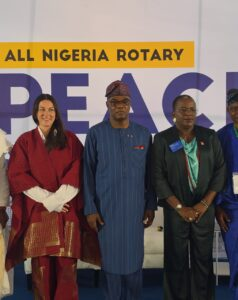
L-R: Lea Perekrests, Director of Partnerships at the Institute for Economics and Peace, Sydney, Australia; Rotary International President, Olayinka Babalola, and Ijeoma Okoro, Trustee, the Rotary Foundation; at the All Nigeria Rotary Peace Summit at Alausa, Ikeja, on Saturday
THE Rotary International has urged Nigerians to take collective responsibility for peacebuilding, saying sustainable peace cannot be left to security agencies and other government institutions alone.
The Rotary International President, Mr Olayinka Babalola, said this at the All Nigeria Rotary Peace Summit which took place on Saturday at Alausa, Ikeja.
The summit had the theme, “Good Governance, Justice and Equity: Foundations for Sustainable Peace”.
Babalola said peacebuilding was an integral part of leadership and required active participation of traditional rulers, business leaders, community organisations, political leaders and others.
According to him, sustaining peace is everybody’s responsibility irrespective of differences in language, religion, culture or social background.
“The question before us is how to come together, work together towards a shared national vision and achieve true and lasting peace,” he said.
Babalola said that Nigeria had demonstrated capacity for peacebuilding through its contributions to regional stability, particularly its interventions in Liberia and other African countries as well as participation in UN peacekeeping operations.
He urged Nigerians to channel the same commitment toward resolving conflicts and promoting peace within the country.

“We cannot impose peace. We must nurture it from the very roots of our society so it may grow into a tree that will feed and shelter all of us under its protective embrace,” he said.
The Rotary president said that peace extended beyond absence of violence or war, stressing the need to promote attitudes and build institutions and structures that would create and sustain peace.
He said that meaningful peace in Nigeria would require collaboration across all levels of the society to improve living conditions and address challenges fuelling insecurity and conflicts.
Babalola said Rotary International’s interventions in healthcare, water provision, sanitation, education, economic empowerment, environmental protection and disease prevention were all connected to its commitment to peacebuilding.
He cited the organisation’s “Together for Healthy Families in Nigeria” programme which was launched in 2022.
He said that the programme had improved access to prenatal care in three states and the Federal Capital Territory.
According to him, community health workers made nearly 60,000 home visits to expectant mothers and their families, while 158 health facilities received medicines and equipment.
He said that available data showed that maternal deaths had reduced by 77 per cent and newborn deaths by 45 per cent in the supported facilities.
Babalola said that such interventions contributed to peace by reducing emotional, social and economic burdens on families.
“A man, who lost a wife at childbirth and is confronted with raising a newborn without the mother, cannot have peace,” he said.
He recalled that Nigeria had been free from wild polio since 2020, adding that Rotary International had continued to collaborate with governments, World Health Organisation and other partners to sustain the achievement.
Babalola said the organisation had also partnered with Macpherson University in Uganda to establish the first Rotary Peace Centre in African with the aim of developing African-focused approaches to conflict resolution.
He disclosed that more than 75 Rotary Peace Fellows had emerged from Nigeria over the years.
Babalola narrated how insecurity undermined some economic empowerment initiatives, recalling an encounter with a woman who declined financial support for farming because armed men routinely robbed farmers of produce.
He said the experience demonstrated how insecurity could frustrate development programmes and discourage individuals from pursuing economic opportunities.
According to him, Rotary International has more than 20,000 members in Nigeria, whose collective networks could be mobilised to strengthen community relationships, public trust and peaceful coexistence.
He urged Nigerians to embrace positive change and build institutions that would serve everyone, irrespective of their background.
“We cannot continue to do what we have always done and expect our great dream of peace to magically sprout from the ground.
“We must nurture our country and ourselves with all our being,” he said.
Babalola also expressed concern over negative comments about Nigeria, including those coming from people expected to protect the country’s image.
He said that such attitudes must change.
He called on Nigerians to support security personnel by taking responsibility for peacebuilding within their respective communities.
In a keynote address, Lea Perekrests, Director of Partnerships at the Institute for Economics and Peace, Sydney, Australia, urged governments and communities to strengthen good governance, justice and equitable resource distribution.
The director said the strengthening would help to achieve sustainable peace and development.
Perekrests said that lasting peace would require functional institutions, respect for human rights, economic opportunities and structures that would promote fairness and inclusion.
She identified effective governance, accountability, transparency, equal access to justice and respect for the rights of others as essential pillars of peaceful societies.
She urged leaders to improve public service delivery, tackle corruption and ensure that citizens would be treated fairly irrespective of their backgrounds.
Perekrests called on individuals to take responsibility for promoting justice, fairness and peaceful coexistence in their daily activities.
The director said that the values should be promoted in homes, workplaces, Rotary clubs and communities.
She also called for stronger collaboration between governments, civil society organisations, security agencies and community groups to advance good governance, justice and sustainable peace.
Earlier in a goodwill message, Mrs Kunbi Wuraola, Founder, Women on a Mission, said sustainable peace could only be achieved through good governance, justice and equity.
She described good governance as responsible stewardship rather than exercise of power, urging leaders to be transparent, accountable and committed to managing public resources in the interest of the people.
She said justice must protect both the weak and the strong, while equity would require providing all individuals with opportunities and resources to thrive.
According to her, peace goes beyond the absence of war to include an environment where children can learn without fear and mothers can provide for their families with dignity.
She said that peace also required that young people could pursue their aspirations without losing faith in the system.
She said Rotary International’s interventions in water provision, scholarships, healthcare and skills development were not merely charitable activities but investments in the infrastructure of peace.
“You are not just doing charity. You are building infrastructure, and that infrastructure is that of peace,” she said.
Wuraola urged leaders to promote integrity, amplify voices of marginalised groups, ensure justice for women and create equal opportunities for all.
Mr Akinbode Abitogun of the Junior Chamber International (JCI) Nigeria said that peace was too important to be left to security institutions alone.
He described peace building as a collective responsibility requiring intentional leadership and active participation by all segments of society.
He emphasised the need for leadership of societies to translate visions into meaningful actions and lasting impacts.
According to him, building sustainable peace requires responsible leadership, justice, and amplifying voices of citizens.
He commended Rotary International for organising the summit and reaffirmed JCI Nigeria’s commitment to promoting peace.
The News Agency of Nigeria (NAN) reports that the summit also featured panel sessions examining governance, justice, national cohesion, security and inclusion.
NAN also reports that the summit brought together peacebuilding experts, policymakers, security specialists, academics and civil society leaders. (NAN)
A.I
Nov. 7, 2026
Tags: Ijeoma Okoro Olayinka Babalola