

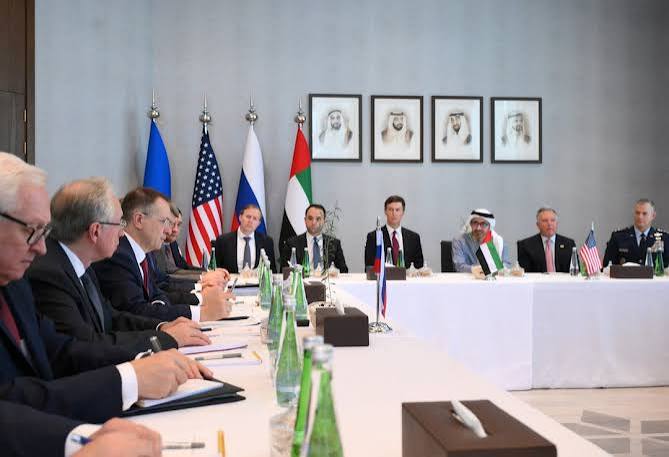
US-mediated peace talks between Russia and Ukraine have begun in Abu Dhabi, United Arab Emirates, with Washington pushing for a new European security framework aimed at ending the war and preventing future conflicts across the continent.
The two-day negotiations, which opened on Tuesday, November 10, 2026, bring together Russian, Ukrainian and American delegations for the first trilateral meeting since February.
The discussions are being led by US President Donald Trump’s special envoys, Steve Witkoff and Jared Kushner, as Washington intensifies efforts to broker a settlement to the conflict, which began with Russia’s full-scale invasion of Ukraine in February 2022.
According to the Associated Press, the talks will focus on security guarantees for the countries involved, particularly arrangements that could prevent further Russian aggression against Ukraine.
Speaking at the opening of the negotiations, Kushner said the United States wanted to develop a new framework by examining previous diplomatic arrangements and identifying what had worked and failed.
He said Washington hoped to establish an understanding capable of delivering lasting peace for decades or even centuries.
The proposed framework extends beyond the immediate conflict in Ukraine and could involve broader security arrangements between Russia and European countries.
US officials have indicated that any comprehensive settlement would require direct engagement between Moscow and European governments on issues affecting regional stability.
Last week, Trump described the proposed arrangement as a major agreement that could involve more than Ukraine and potentially cover the wider European continent.
Kushner also said that a lasting settlement would require direct discussions between Russia and European partners on broader security concerns.
Representatives from the United Kingdom, France, Germany, Italy, the European Union and NATO are also involved in consultations surrounding the negotiations.
Ukraine’s delegation, led by Rustem Umerov, began the day with discussions involving US representatives and European officials before moving into the trilateral format with Russia.
Umerov expressed hope that the negotiations would produce a lasting peace, thanking Washington for its efforts to end the war.
However, significant disagreements remain between Moscow and Kyiv, particularly over territorial control, Ukraine’s potential membership of NATO and the security guarantees required to prevent another invasion.
Russian President Vladimir Putin has maintained demands for Ukraine to withdraw from four regions claimed by Moscow, abandon its NATO membership ambitions and accept restrictions on its military.
Ukrainian President Volodymyr Zelenskyy has rejected territorial concessions and restrictions on the country’s military capabilities, insisting that credible security guarantees are essential to any peace agreement.
Kyiv has also argued that an immediate ceasefire should precede negotiations on a broader settlement, while Moscow has resisted a general halt in hostilities.
The negotiations are taking place amid continued military operations, with both countries reporting overnight drone and missile attacks.
Russia has also welcomed Washington’s broader approach to European security, although some European Union officials have expressed concerns that the proposed framework could accommodate Moscow’s demands at the expense of European security interests.
EU foreign policy chief Kaja Kallas has argued that Europe already has an established security framework based on international agreements, accusing Russia of failing to respect its obligations under those arrangements.
The outcome of the Abu Dhabi negotiations could therefore have implications beyond the Russia-Ukraine conflict, potentially shaping future relations between Moscow, Washington and European governments.
However, with both sides maintaining sharply contrasting positions on territory and security, it remains uncertain whether the latest diplomatic initiative will produce a breakthrough.