

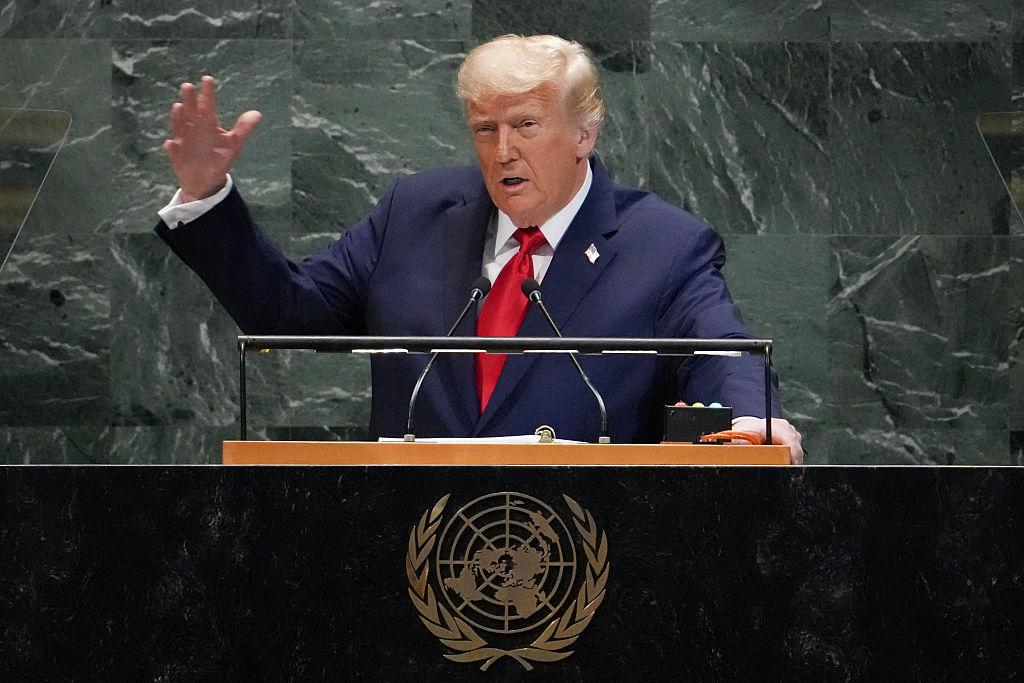
US President Donald Trump is continuing to push policies that have faced widespread opposition from voters, despite a major midterm election setback that handed Democrats control of both chambers of Congress.
Rather than adjusting his approach following the election, Trump has reaffirmed his support for tariffs, wealthy technology executives and controversial foreign leaders, while offering little concrete response to voters’ concerns about rising living costs.
The president’s stance has drawn attention to his unwillingness to follow the political tradition of adjusting policies after significant midterm losses.
This week, Trump backed the return of billionaire Jensen Huang to the leadership of Nvidia, amid voter concerns about economic inequality. An AP Voter Poll found that seven in 10 respondents believed the economy was tilted in favour of wealthy Americans.
Trump described Huang as happy to return to his position, saying on Thursday that the executive considered it his second term. Huang had previously been removed following an admission of an extramarital affair with Alice Huang, a woman linked to the Chinese government. Beijing has denied allegations that she was a spy.
Trump also announced a fresh round of tariffs on Wednesday targeting China and traditional trade partners, including Japan, South Korea and the European Union. However, polling indicated that about two-thirds of voters believed his import taxes had already harmed the economy, amid worsening inflation.
.
advertisement
The president has repeatedly praised tariffs, describing the term as one of his favourite words, but did not personally promote the latest tariff increases.
Trump shows little sign of changing course after election losses
Previous presidents have often responded to midterm election setbacks by adjusting their policies or seeking compromises with political opponents.
Democratic President Bill Clinton reworked welfare policies following his party’s losses in the 1994 elections, while Republican President George W. Bush increased troop deployments in Iraq after the 2006 midterms.
Former President Barack Obama also pursued a bipartisan deficit-reduction agreement following Democratic losses in 2010.
Matthew Dallek, a political historian and professor at George Washington University, said Trump’s apparent refusal to adapt could threaten his party’s political standing.
Dallek described the election outcome as a deeper rejection of Trump’s leadership, suggesting it could challenge long-held assumptions about the political divide between Republican-leaning and Democratic-leaning states.
The White House did not respond to questions about whether the election results had prompted a reassessment of its policies.
Although Trump has indicated a willingness to cooperate with Democrats, he has also posted a cartoon depicting himself as Vito Corleone, the fictional mafia boss from The Godfather, suggesting he would use his veto power against legislation from the opposition.
Speaking at his Mar-a-Lago estate in Florida on Thursday, Trump said he expected a bipartisan relationship with Democrats, arguing that his veto authority could influence their approach.
He said some Democrats had contacted him and pointed to the veto as a powerful tool, although he claimed he was not eager to use it.
Senator Tim Kaine, a Democrat from Virginia, criticised Trump’s response to the election, arguing that the president was continuing to pursue unpopular policies, including deportations, his relationship with wealthy technology executives and tariffs.
Kaine urged Trump to recognise the political message delivered by voters.
Cost-of-living concerns remain a major challenge
Affordability was among the key issues that influenced voters during the midterm elections, with many expecting the federal government to take steps to reduce the cost of essential goods and services.
However, Trump has yet to outline a comprehensive plan addressing those concerns.
On Wednesday, he avoided focusing on a government inflation report showing that the personal consumption expenditures price index, a key measure monitored by the Federal Reserve, had increased by 3.8 per cent over the previous 12 months.
Instead, Trump highlighted falling gasoline prices, suggesting they had been artificially elevated before the November 3 election.
Gasoline prices had initially risen following the president’s decision to launch the war with Iran in February.
The American Petroleum Institute, in a recent report, attributed some of the decline in fuel prices to seasonal factors, including reduced driving during colder weather, changes in refinery production and rebuilding fuel inventories.
Yuval Levin, a senior fellow at the American Enterprise Institute, said Trump had not developed a coordinated policy response to the election results and was unlikely to adopt a consistent strategy.
Levin said the president’s approach appeared reactive, with occasional signals about potential cooperation on healthcare access and immigration reform but no formal policy decisions to support those indications.
Trump questions economic data
Trump also criticised his own Commerce Department on Thanksgiving Day, accusing it of releasing inaccurate economic figures before the election.
The department had revised its estimate of third-quarter economic growth on Wednesday, raising the annualised rate to 4.3 per cent from an earlier estimate of 3.4 per cent released in late October.
The revision followed the standard process of updating economic data as additional information becomes available.
Trump, however, alleged without evidence that the earlier figure had been deliberately misreported and announced an investigation into the matter.
When asked by a reporter who would oversee the investigation, the president changed the subject.