

Politics
By Anthony Isibor
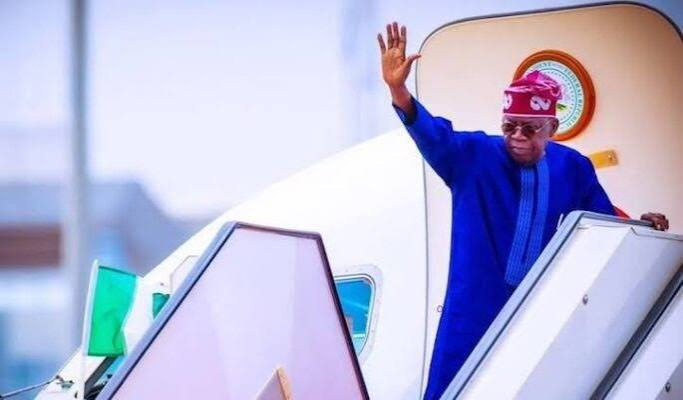
THE Omo Oduduwa Collective has called on President Bola Tinubu to account for the reported N37.64 billion spent on presidential travels between June 2023 and April 2026, questioning the necessity of his frequent foreign trips amid Nigeria’s economic and security challenges.
The group, in a statement signed by its convener, Professor Akinyemi Onigbinde, and six other members, also urged the National Assembly and relevant audit institutions to investigate the expenditure and ensure compliance with appropriation laws and financial regulations.
According to the group, reports published in August 2026, based on an analysis of GovSpend records, put presidential travel and related expenditure at approximately N37.64 billion within the period under review.
The reports also estimated that Tinubu had undertaken 52 foreign trips and spent about 261 days outside the country since assuming office in May 2023.
The group expressed concern that the expenditure came at a time when Nigerians were grappling with rising living costs, insecurity, inadequate healthcare, poor infrastructure and declining purchasing power.
It questioned the justification for the President’s latest foreign trip, reportedly undertaken for pilgrimage and prayers for Nigeria, arguing that the country’s challenges required more direct presidential attention.
The collective also questioned the President’s decision to limit his participation in the All Progressives Congress presidential campaign activities to one-third of the states, reportedly to give him more time to attend to governance.
It described the decision to embark on another foreign trip as inconsistent with the administration’s stated commitment to addressing the country’s challenges.
“Stripped of all forms of sugarcoat, the latest presidential trip is an exercise in wastage and idleness,” the group said.
It argued that prayers offered outside Nigeria could not substitute for sound economic policies, responsible management of public resources and effective governance.
Beyond the religious justification for the trip, the group accused Tinubu of increasingly distancing himself from Nigerians, citing his absence during major domestic crises, including security incidents in Benue and Jos.
It said the frequency of his foreign travels raised questions about his commitment to providing direct leadership at a time when the country required sustained executive attention.
The group, however, acknowledged that international engagements were part of the responsibilities of the President but insisted that such journeys must demonstrate clear economic, diplomatic or strategic benefits.
It said the reported N37.64 billion expenditure represented a significant allocation of public resources that could otherwise have been directed towards addressing critical national needs.
“The principle of opportunity cost is central to this assessment. Resources allocated to presidential travel cannot simultaneously be deployed elsewhere,” it said.
The collective stressed that its position was not that presidential travels were inherently wasteful or that the reported expenditure alone could resolve Nigeria’s socioeconomic problems.
Rather, it said the Presidency had a responsibility to explain why the expenditure was necessary, what it achieved and whether less expensive alternatives could have produced similar results.
It called for the publication of an itemised account of presidential travel costs, including aircraft operations, accommodation, security, logistics and expenses incurred by official delegations.
It also demanded that the government discloses the objectives of major foreign trips, agreements secured and the extent to which commitments made during such engagements had been implemented.
While acknowledging that security and diplomatic considerations could justify withholding certain information, the group said such considerations should not become a blanket exemption from financial accountability.
On the management of domestic affairs, the collective said Nigeria’s security challenges, including kidnappings, attacks on communities, displacement and destruction of livelihoods, required sustained presidential oversight and effective coordination of government institutions.
It also questioned whether the President’s remote handling of official duties while abroad was sufficient to address the country’s governance challenges.
The group cited the Presidency’s account that Tinubu continued to perform official duties while in France, including directing an investigation into the deaths of 37 suspected illegal miners in Minna.
However, it argued that isolated examples of remote intervention did not resolve the broader question of whether the administration demonstrated sufficient urgency and responsiveness to domestic challenges.
The collective also linked the controversy over presidential travel expenditure to the economic reforms introduced by the Tinubu administration, particularly the removal of petrol subsidy and the unification of the foreign exchange market.
It said the government’s justification for the reforms, which included addressing longstanding fiscal and structural weaknesses, must be matched by measurable improvements in the economy and responsible management of public expenditure.
According to the group, Nigerians who have been asked to endure rising food and transportation costs, higher business operating expenses and declining real incomes deserve evidence that the sacrifices demanded of them are producing results.
“For us as Omo Oduduwa Collective, the government cannot reasonably demand fiscal restraint from the population while providing inadequate explanations for its own discretionary commitments,” it said.
The group consequently urged the Presidency to publish an auditable breakdown of presidential travel expenditure, provide clear objectives for major foreign trips and disclose their measurable outcomes.
It also called for an explanation of why presidential attendance was necessary at certain international engagements when senior government officials could adequately represent the country.
The National Assembly and relevant audit institutions, it added, should scrutinise the expenditure to establish whether it complied with approved budgets and applicable financial regulations.
The collective further called for a clear protocol to guide executive coordination and public communication during major domestic emergencies when the President was outside the country.
It said greater transparency would help replace public speculation with verifiable information and provide a basis for determining whether international engagements justified their financial and administrative costs.
” Nigeria does not require a president permanently confined within its borders, but it requires one whose international engagements are purposeful, whose expenditure is defensible and whose attention to domestic governance is beyond reasonable doubt,” the group said.
The statement was also signed by Senator Babafemi Ojudu, Adeolu Oyekan, Sunkanmi Olapeju, Arinloye Samuel Adebisi and Kazeem Olasupo.
A.I
Nov. 7, 2026
Tags: APC Omo Oduduwa Collective Professor Akinyemi Onigbinde