

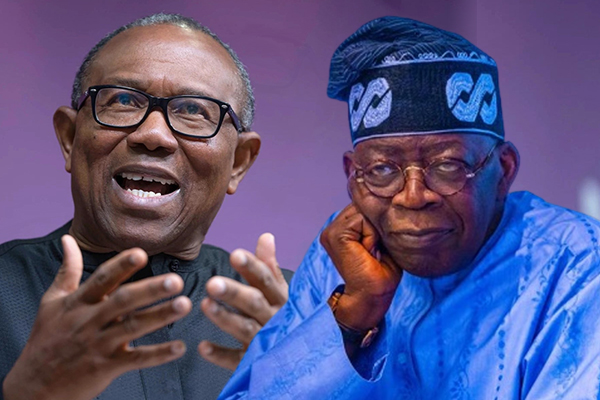
A fresh political face-off has erupted between former Labour Party presidential candidate, Peter Obi, and supporters of President Bola Tinubu over the ₦15.8 trillion saved from fuel subsidy removal, with Obi demanding an account of how the money was spent and the City Boy Movement insisting the funds were never sitting in government coffers for distribution.
The clash followed an open letter by Obi challenging Tinubu to justify the use of subsidy savings, over $100 billion in borrowings and increased government revenues, amid persistent poverty, insecurity, poor electricity supply and failing public services.
Obi, in the letter on Saturday, demanded concrete figures on Nigerians lifted out of poverty, out-of-school children returned to classrooms and functional primary healthcare centres built, insisting that citizens deserved measurable returns on the resources entrusted to the government.
But the City Boy Movement, through its National Director of Media Monitoring and Rapid Response, Bashir Ahmad, dismissed Obi’s position as a politically convenient narrative, arguing that subsidy savings and government borrowings must be assessed within the broader context of economic reforms and national expenditure.
Obi, who reacted to Tinubu’s recent overnight visit to Akwa Ibom State, urged the President to extend his visits to the remaining 33 states of the federation and engage directly with Nigerians on the impact of his administration’s economic policies.
The former Anambra governor questioned what the government had achieved with the resources available to it, demanding figures on the number of Nigerians lifted out of poverty, out-of-school children returned to classrooms and functional primary healthcare centres constructed.
He also challenged the administration to account for improvements in electricity supply and security, insisting that Nigerians deserved measurable evidence of how public resources had been deployed.
According to Obi, the government must explain what it had done with the ₦15.8 trillion in subsidy savings, the over $100 billion borrowed and additional revenues generated through increased taxation and improved government earnings.
“Nigerians deserve answers. They deserve to know what has been done with the resources entrusted to your government,” he declared.
He argued that accountability, transparency and measurable improvements in citizens’ living conditions must form the foundation of a new Nigeria.
Obi also recalled Tinubu’s promise that Nigerians should not vote for him if he failed to fix electricity, questioning how much progress had been made in the power sector.
He further expressed concern that Nigeria remained among the world’s most terrorised countries despite the government’s security efforts.
However, the City Boy Movement, through its National Director of Media Monitoring and Rapid Response, Bashir Ahmad, rejected what it described as a politically convenient interpretation of the subsidy savings and other government revenues.
In a response titled *“Good Day, Mr Peter Obi,”* Ahmad argued that the ₦15.8 trillion cited by Obi should not be presented as money sitting in a government account awaiting distribution.
He maintained that subsidy savings, borrowing and increased government revenue must be assessed within the broader context of the economic reforms and financial challenges confronting the country.
“The N15.8 trillion cited as subsidy savings, for instance, should not automatically be treated as money sitting in a government account waiting to be distributed,” Ahmad said.
He also defended government borrowing, arguing that it was not inherently evidence of failure, but should be judged by how responsibly the funds were utilised, the benefits of investments and the sustainability of the country’s debt.
On electricity, insecurity, education, healthcare and poverty, Ahmad acknowledged that Nigeria continued to face serious challenges but insisted that unfinished work should not be used to dismiss whatever progress had been recorded.
He accused Obi of applying selective criticism, arguing that accountability should extend beyond the Federal Government to state and local governments and other public institutions.
“Accountability must be a two-way street,” he declared, insisting that those demanding answers from the President should equally acknowledge the complexities of governing a diverse country such as Nigeria.
Ahmad, however, admitted that Tinubu’s administration had a responsibility to communicate its achievements, challenges and plans more effectively to Nigerians.
He called for a national conversation based on facts, fairness and constructive criticism rather than what he described as political score-settling.
“Nigeria needs constructive criticism, not selective outrage. We need facts, not exaggerations; solutions, not sensationalism; and accountability that serves the national interest rather than partisan convenience,” he said.
Both sides, however, agree on the need for accountability, although they differ sharply on how the government’s financial resources and performance should be assessed.