

Rhetoric of Insecurity and the Danger of Weaponised Communication
BY Yushau A. Shuaib
When does a message become a threat? At what point does information circulating during a security crisis become an instrument of fear, hatred or violence? More importantly, how can journalists, government spokespersons and security communicators prevent dangerous narratives from escalating into bloodshed?
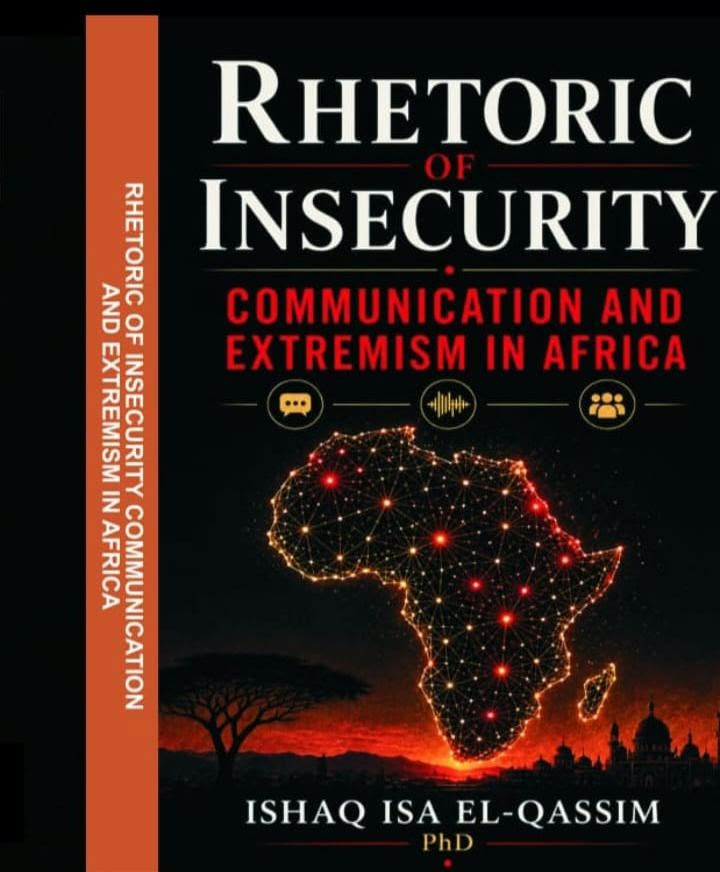
These questions have confronted me throughout my professional engagements in public communication, emergency management and national security. It was therefore an honour when an accomplished scholar, Dr. Ishaq Isa El-Qassim, invited me to review his latest intellectual contribution, “Rhetoric of Insecurity: Communication and Extremism in Africa.”
I must confess that I often approach invitations to review scholarly works with some hesitation, being more of a communication practitioner than an academic theorist. Nevertheless, I gladly accepted the opportunity to examine this thought-provoking book, published by Taraba State University Press in 2026. Its author, Dr. El-Qassim, teaches language and communication skills at the Federal University Wukari, Taraba State.
El-Qassim is a multidisciplinary scholar whose research interests span crisis and security communication, media studies, African literature, discourse analysis and emerging technologies. His previous publications explore artificial intelligence and virtual reality in African storytelling, the influence of Hausa-dubbed Indian films on youth communication, ethno-nationalism in digital media, and the relationship between film translation and gang violence. This diverse intellectual background enriches his understanding of how language, media and competing narratives shape identity, insecurity and conflict in contemporary Africa.
In Rhetoric of Insecurity, El-Qassim offers a compelling examination of how language shapes insecurity, influences public perception and sometimes legitimises violence. Although primarily an academic work, its insights are particularly relevant to practitioners navigating Nigeria’s increasingly complex security and digital information environments.
Having worked within government communication structures, especially at the National Emergency Management Agency (NEMA), the Office of the National Security Adviser (ONSA) as well as Chief Consultant to the Forum of Spokespersons of Security and Response Agencies (FOSSRA) and the Centre for Crisis Communication (CCC), I find the book especially valuable for connecting scholarly analysis with challenges practitioners encounter daily.
When Communication Becomes a Security Threat
El-Qassim’s central argument is that insecurity is not defined solely by violent incidents. It is also shaped by how people interpret threats, remember grievances, perceive exclusion and respond to competing narratives. Violence may be an event, but insecurity can persist long after an incident ends, sustained by fear, distrust, and unresolved grievances.
This distinction resonates with my experience. During security emergencies, official spokespersons and affected communities sometimes describe the same incident in fundamentally different ways. While government statements may emphasise operational success, communities may focus on casualties, displacement or unanswered questions.
The resulting communication gap can deepen suspicion and undermine public confidence.
El-Qassim explains this phenomenon through two complementary analytical tools: the Communicative Insecurity Framework (CIF) and the Rhetoric, Escalation, Mediation and Mobilisation (REMM) heuristic.
CIF examines the institutional and material conditions surrounding insecurity, while REMM explains how narratives influence perceptions, escalate tensions and mobilise collective action.
Together, they provide a framework for understanding why communication can either contain a crisis or aggravate it.
One of the book’s most illuminating contributions is what El-Qassim calls the grammar of fear.
He identifies eight recurring rhetorical operations: naming, enemy construction, victimhood, historical myth, existentialisation, moral obligation, dehumanisation and mobilisation. These processes explain how an isolated incident can become a wider narrative of collective persecution or existential threat.
Consider how quickly an unverified allegation can spread through social media. An alleged perpetrator is identified, an entire community is blamed, historical grievances are revived, and retaliation is presented as a moral obligation. Before investigators establish the facts, dangerous narratives may already have mobilised hostile reactions.
During my engagements with ONSA, FOSSRA and CCC, I repeatedly encountered these patterns, particularly when rumours circulated faster than official clarification. El-Qassim’s contribution lies in systematically identifying these rhetorical mechanisms, enabling communicators to recognise warning signs and develop preventive responses rather than merely reacting after tensions escalate.
Another important concept is communicative weaponisation: the deliberate use of communication to intensify perceived threats, discredit opponents or justify coercive action. This
Danger of Weaponised Communication is even being witnessed as we prepare for the general election, where fake news and deepfake tools are used to amplify hate speech.
Importantly, El-Qassim cautions against labelling every controversial statement as extremist propaganda. Political criticism, religious advocacy and emotionally charged expression do not automatically constitute dangerous communication. This distinction is particularly relevant in Nigeria, where public institutions sometimes dismiss uncomfortable narratives as misinformation without adequately examining their substance.
When government spokespersons treat legitimate criticism as hostility or dismiss community grievances as propaganda, they risk damaging institutional credibility. The author rightly applies the same evidentiary standards to state and non-state actors.
Government authority does not automatically guarantee public trust. Credibility depends on accuracy, transparency, accountability and consistency between official explanations and verifiable realities.
For crisis communicators, this is a fundamental lesson: effective communication cannot be sustained through denial, intimidation or selective presentation of facts.
The book examines six Nigerian cases involving Abubakar Shekau and Boko Haram; Nnamdi Kanu and IPOB; Hausa Zalla/Zallawa identity discourse; Sheikh Sani Yahaya Jingir; Reverend Ezekiel Dachomo; and the killing of Islamic schoolteacher Ummulkhairi Usman Aliyu in Kaduna State. El-Qassim carefully distinguishes violent extremism from separatist advocacy, religious persuasion and communal mobilisation. The Ummulkhairi tragedy particularly illustrates how unverified allegations, amplified by public reactions and institutional failures, can trigger fatal violence. It reinforces a principle I have consistently advocated: timely verification and credible communication are not merely public relations responsibilities but essential safeguards for public safety.
El-Qassim’s concept of communicative repair emphasises five principles: verification, community participation, institutional credibility, cultural sensitivity and responsible counter-communication to rebuild trust and counter harmful narratives. The principles emphasise rebuilding trust, correcting harmful narratives, and strengthening institutional responses.
However, effective communication cannot replace justice, security or good governance. This aligns with my research on AI and crisis communication, which informed IMPR’s 2026 IPRA Golden World Awards Grand Prix entry, and CCC’s proposed 24-hour, AI-enabled Crisis Communication Hub for misinformation detection, early warning and coordinated response. The book thus reinforces the need to integrate technology, institutional accountability and effective crisis management.
Meanwhile, despite its scholarly strengths, the book could offer more practical guidance on communicative repair, including measurable interventions and effective institutional responses. Greater attention to the roles of spokespersons, journalists and community intermediaries would also strengthen its relevance to practitioners. Furthermore, a deeper examination of Nigeria’s digital environment, particularly WhatsApp-driven misinformation, encrypted messaging and the challenge of countering harmful narratives while protecting freedom of expression, would enhance its practical value.
These observations do not diminish the book’s contribution. Rather, they identify opportunities for future research connecting academic theory with operational crisis management.
Rhetoric of Insecurity is recommended reading for security communicators, journalists, policymakers and scholars. El-Qassim offers a compelling African-centred framework on how communication shapes extremism, insecurity and crisis management.
As Nigeria approaches the 2027 general elections, the growing influence of social media and increasingly inflammatory political rhetoric should remind us that words can inflame crises, legitimise violence and erode public trust. Conversely, communication anchored in truth, responsibility and institutional credibility can defuse tensions, prevent conflict, protect lives and strengthen national stability.
That is why this book matters, and why it deserves to be read beyond academic circles.
Yushau A. Shuaib, FIPRA, is author of AI in Crisis Communication in Nigeria [email protected]