

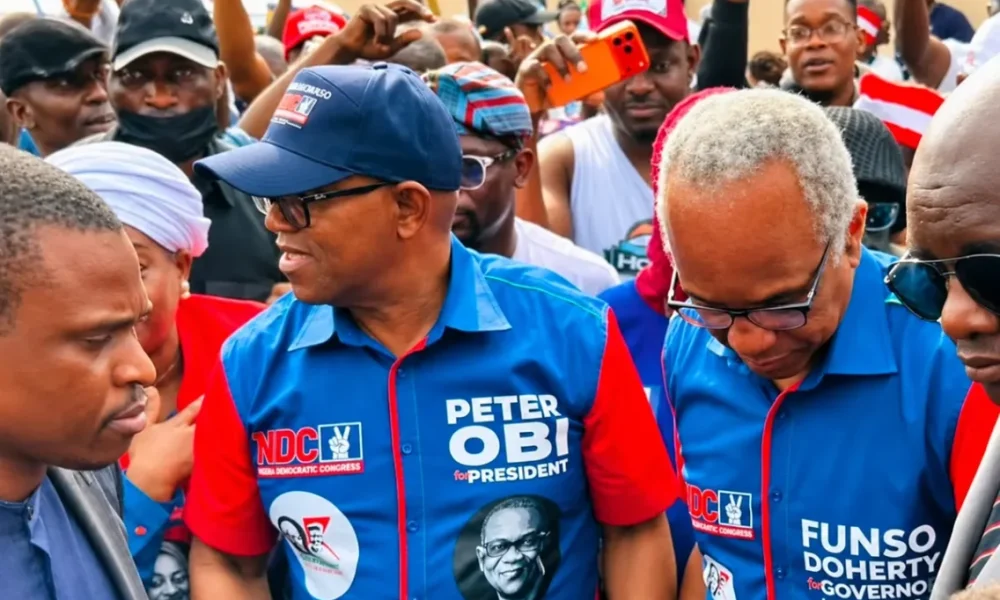
Peter Obi’s decision to remain seated during the rendition of Nigeria’s restored national anthem, Nigeria, We Hail Thee, at the Nigeria Democratic Congress (NDC) Town Hall Meeting in Oregun, Lagos, has triggered a debate over patriotism, national identity and the distinction between party loyalty and national responsibility.
The incident, which reportedly occurred on Thursday, November 12, 2026, saw Obi, the NDC’s presidential candidate for the 2027 general election, and some party supporters remain seated when the current national anthem was introduced.
However, when the event anchor switched to the former national anthem, Arise, O Compatriots, Obi stood up and joined in singing. During the rendition, he was also seen raising two fingers on both hands in a gesture associated with the NDC’s party symbol.
The sequence has drawn criticism from some political observers and government officials, who have questioned why a presidential aspirant would participate in the rendition of a former anthem while appearing to withhold recognition from the country’s legally adopted national anthem.
In a commentary examining the incident, lawyer, political scientist and public administrator, Osifo Osa Washington, argued that Obi’s conduct raises fundamental questions about the relationship between political allegiance and national identity.
Osifo examined the development from four perspectives: legal, political, social and administrative, arguing that national symbols should remain above partisan interests.
READ ALSO; Police arrest suspect as attack on Peter Obi supporters sparks political tension in Lagos
National Anthem Act and the Legal Argument
At the centre of the controversy is the National Anthem Act 2024, which restored Nigeria, We Hail Thee as the country’s official national anthem, replacing Arise, O Compatriots, which had been in use since 1978.
President Bola Tinubu assented to the legislation on May 29, 2024, following its passage by the National Assembly.
Osifo argued that irrespective of disagreements surrounding the process that led to the restoration of the former anthem, the legislation remains the applicable law.
He maintained that a presidential aspirant seeking to lead the country should demonstrate respect for its constitutional and legal institutions, including legislation establishing national symbols.
Although Minister of Aviation and Aerospace Development, Festus Keyamo, reportedly acknowledged that the legislation does not prescribe a specific penalty for refusing to sing the anthem, Osifo argued that the absence of a penalty does not eliminate the broader expectation of respect for national institutions.
The lawyer also distinguished between the right to express personal preference for the former anthem and the responsibility to recognise the legally established national anthem at official public functions.
In his view, political disagreement with the government or the National Assembly should not automatically translate into rejection of national symbols.
Party Loyalty Versus National Identity
Beyond the legal argument, Osifo questioned the political implications of the incident, particularly given Obi’s ambition to become Nigeria’s president in 2027.
He argued that presidential aspirants are expected to demonstrate an ability to rise above partisan considerations and identify with the country as a whole.
The decision to stand for the former anthem after remaining seated during the current one, coupled with the reported party-associated hand gesture, has raised questions about the message conveyed to Nigerians.
Osifo described the development as an instance in which party identity appeared to take precedence over national symbolism.
He also recalled the 2023 presidential election in Lagos, where Obi polled 582,354 votes against Tinubu’s 572,606, arguing that the former Anambra governor benefited from the country’s democratic institutions and electoral framework.
The commentary further referenced Federal Capital Territory Minister Nyesom Wike, who questioned Obi’s decision to remain seated during the current anthem but stand for the former one.
The controversy, Osifo argued, could become a recurring issue in the build-up to the 2027 election, particularly when Obi speaks about national unity and his commitment to bringing Nigerians together.
READ ALSO; Peter Obi unveils 2027 agenda, pledges to tackle insecurity, reunite Nigeria
Concerns Over National Values and Social Responsibility
Osifo also examined the incident from a social perspective, warning that the conduct of political leaders can influence how younger Nigerians relate to national institutions and symbols.
He noted that Nigeria’s diversity, comprising different ethnic groups, religions and cultural identities, makes shared national symbols important instruments of cohesion.
According to him, the national anthem, flag, Constitution and other symbols provide a common identity that transcends political affiliations.
He argued that political leaders must be conscious of the influence their public conduct has on young people, particularly supporters who may interpret their actions as examples to emulate.
The commentary maintained that citizens have the right to question government policies, challenge legislation and express disagreement with political decisions. However, such disagreements should be distinguished from the country’s broader national identity.
Osifo stressed that opposition to the policies of an administration should not necessarily translate into opposition to the symbols of the Nigerian state.
The Question of Leadership and Administrative Responsibility
The fourth dimension of Osifo’s criticism centred on leadership, protocol and the distinction between party activities and official state responsibilities.
He argued that as the principal political figure at the town hall meeting, Obi had an opportunity to establish a clear distinction between the country’s national anthem and any song or symbol adopted by his political party.
According to the lawyer, a political gathering can accommodate party songs, campaign slogans and other expressions of political identity, but these should not be confused with national symbols.
He suggested that the organisers could have recognised the current national anthem before proceeding with any rendition of the former anthem as part of their political programme.
For Osifo, the incident raises a broader question about how political leaders manage the relationship between partisan loyalty and national responsibility.
He maintained that the presidency requires an understanding of the distinction between party interests and the responsibilities of governing a diverse federation.
Debate Over the Restoration of the Anthem
While criticising Obi’s reported conduct, Osifo acknowledged that Nigerians are entitled to disagree with the restoration of Nigeria, We Hail Thee.
He noted that many citizens grew up singing Arise, O Compatriots and remain emotionally attached to its lyrics and historical significance.
He also recognised that the process through which the former anthem was restored has generated public debate.
However, he argued that disagreement with the decision should be pursued through democratic and lawful channels rather than through actions that could be interpreted as rejecting the country’s established national symbols.
The controversy has therefore reopened discussions about patriotism, freedom of expression, political symbolism and the responsibilities of public figures.
As the 2027 election approaches, the incident is likely to remain part of the wider conversation about political conduct, national unity and the responsibilities that accompany the ambition to govern Nigeria.