

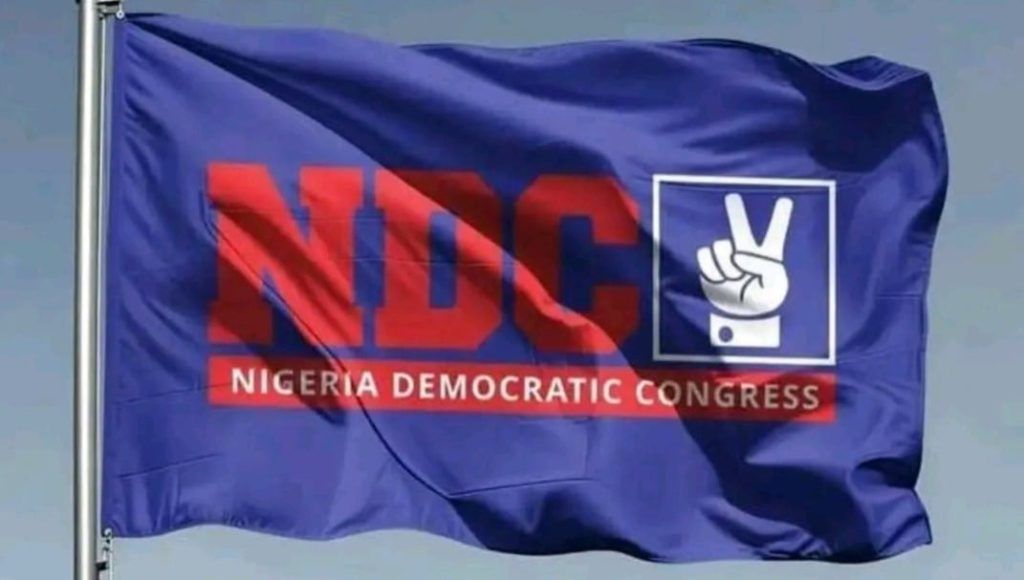
The Nigeria Democratic Congress (NDC) has denied allegations by the All Progressives Congress (APC) that it is recruiting thugs to disrupt political activities ahead of the 2027 general elections, describing the claims as false and misleading.
The denial came barely 24 hours after the APC accused the African Democratic Congress (ADC) and NDC of sponsoring violence, spreading misinformation and recruiting young Nigerians to disrupt its presidential campaign activities ahead of the elections.
The NDC, however, accused supporters of the ruling APC of orchestrating attacks and intimidation against its members across the country, citing alleged incidents in Enugu, Lagos, Benue and other states.
The party, in a statement signed by its National Campaign Council Deputy Spokesperson 2, Sam Omale, on Wednesday, described the APC’s allegations as an attempt by the perpetrators of political violence to portray themselves as victims.
It alleged that its members and supporters had endured a year-long campaign of intimidation and targeted attacks by thugs loyal to the ruling party.
The NDC cited an incident on July 18, 2025, when Edo State Governor, Monday Okpebholo, allegedly threatened its presidential candidate, Peter Obi, warning him against entering the state without prior clearance during a political rally in Uromi.
It also referenced a viral video allegedly showing Senator Francis Fadahunsi, representing Osun East Senatorial District, instructing APC supporters in Yoruba to seek out and kill members of the rival Accord Party ahead of an election in Ilesa, Osun State.
“Senator Francis Adenigba Fadahunsi, representing Osun East Senatorial District, was caught on a viral video in Ilesa instructing APC supporters in Yoruba to “seek out and kill” members of the rival Accord Party before the election.
“To date, he has faced no real accountability, proving that violence is tolerated and rewarded within the APC,” the statement reads.
The NDC further alleged that armed men invaded its campaign office in Enugu on October 10, 2026, fatally shooting one of its members, Ifeanyi Nwolie.
It also claimed that hoodlums attacked a peaceful town hall meeting organised by the party in Oregun, Lagos, on November 12, 2026, leaving several supporters injured.
Additionally, the party accused Benue State Governor, Hyacinth Alia, of deploying thugs to block and disrupt Obi’s condolence visit to Yelewata following the massacre of residents in the community.
It also alleged that Obi and his campaign entourage had repeatedly been targeted by hoodlums in Calabar, Delta and Edo states, while the campaign team of its vice-presidential candidate, Rabiu Musa Kwankwaso, was also attacked in Kano.
Reacting to the APC’s allegations, the NDC urged its spokesperson, Dele Alake, to direct his call for peaceful political conduct to President Bola Tinubu, whom it accused of promoting a culture of political violence.
The party recalled Tinubu’s widely publicised political remarks, including his statement that power was not served à la carte and his instruction to supporters to “grab it, snatch it, and run away with it.”
It argued that such remarks contributed to a political environment where the pursuit of power was associated with intimidation and force.
On the growing popularity of the NDC and its presidential ticket of Obi and Kwankwaso, the party maintained that its support was organic and driven by Nigerians’ dissatisfaction with the APC administration.
According to the NDC, economic hardship, hunger, multidimensional poverty and rising insecurity have increased public frustration with the government, making it unnecessary for the opposition to sponsor disruptions at political rallies.
It maintained that the reactions witnessed at APC campaign activities reflected Nigerians’ spontaneous rejection of the ruling party rather than organised political attacks.
The party also accused the APC of exploiting vulnerable youths for political violence, insisting that its own movement was built on ideas, competence, education and employment opportunities.
The NDC further alleged that the ruling party was laying the groundwork for a crackdown on opposition activities and possible disqualification of opposition parties ahead of the 2027 elections.
It claimed that opposition parties had faced restrictions on displaying campaign posters and billboards and accessing public facilities for political rallies, describing such actions as attempts to turn Nigeria into a one-party state.
The party challenged the APC to rein in its supporters and campaign on its performance record rather than resort to what it described as propaganda.
It reaffirmed its commitment to participating in the 2027 elections, insisting that intimidation would not deter its efforts to challenge the ruling party.
The NDC also urged Nigerians to support its candidates in 2027, promising that an NDC-led government would promote transparency, reduce unnecessary government expenditure, improve governance and restore Nigeria’s international reputation.