

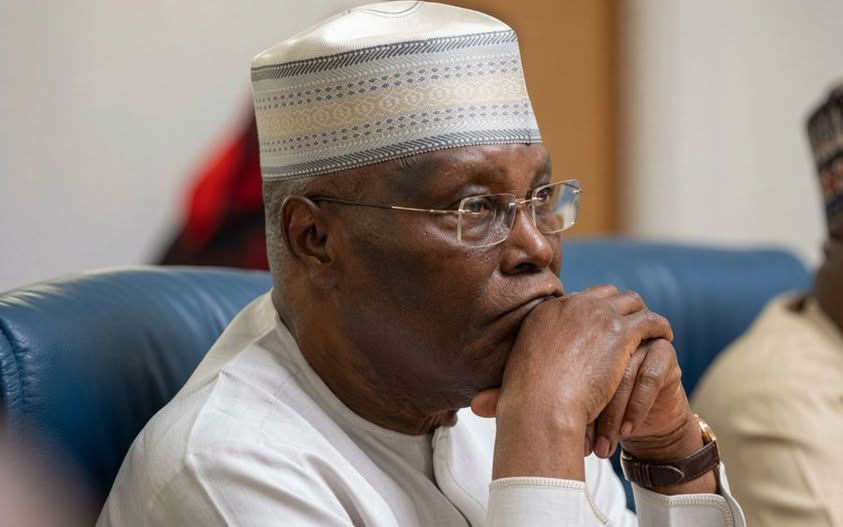
What began as a disagreement over who should take charge of the African Democratic Congress (ADC) following the departure of its former National Chairman, Ralph Nwosu, has developed into a major legal battle, culminating in a Federal High Court judgment that threatens the party’s leadership structure and former Vice-President Atiku Abubakar’s presidential ambition for the 2027 general elections.
The judgment, delivered on November 5, 2026, by Justice Peter Lifu of the Federal High Court in Abuja, nullified the leadership of the party under former Senate President David Mark and invalidated decisions taken under its authority, including the presidential primary that produced Atiku as the ADC’s flag bearer.
The ruling followed a suit filed by Nafiu Bala Gombe, a former Deputy National Chairman of the ADC, who challenged the legitimacy of the leadership transition that brought Mark and former Osun State Governor Rauf Aregbesola into the party’s national leadership.
Beyond the immediate implications for Atiku, the dispute has exposed divisions within the opposition party, raised questions about internal democracy and party succession, and placed the ADC’s preparations for the 2027 elections under renewed legal uncertainty.
The disagreement dates back to 2025, when Nwosu stepped down as the ADC’s National Chairman following discussions about repositioning the party as a political platform for opposition figures seeking an alternative to the ruling All Progressives Congress (APC).
Following his departure, a caretaker leadership structure emerged, with Mark assuming the position of National Chairman and Aregbesola becoming National Secretary.
The arrangement attracted prominent opposition politicians, including Atiku and other political figures seeking to build a coalition ahead of the 2027 elections.
However, Bala, who had served as the party’s Deputy National Chairman for the North-East, challenged the leadership transition.
He argued that the ADC constitution entitled him to succeed Nwosu as National Chairman following the latter’s resignation.
Bala maintained that the emergence of Mark and other members of the caretaker committee did not follow the procedures prescribed by the party’s constitution.
He subsequently approached the Federal High Court in Abuja, seeking to invalidate the leadership structure and restrain Mark and Aregbesola from presenting themselves as the party’s National Chairman and National Secretary.
The suit, marked FHC/ABJ/CS/1819/2025, listed the ADC, the Independent National Electoral Commission (INEC), Mark, Aregbesola and Nwosu as defendants.
The ADC’s position, however, differed. In a letter to INEC dated July 21, 2025, the party stated that Bala had resigned from his position on May 17, 2025, and that the resignation had been accepted. The supporting resignation document was not available for independent examination in a subsequent review by Premium Times.
This disagreement over Bala’s status and the interpretation of the party’s constitution became central to the legal battle.
As the disagreement intensified, the dispute moved from internal party discussions to the courts, with different legal proceedings producing decisions that affected the recognition of the competing leadership structures.
In September 2025, the Federal High Court, presided over by Justice Emeka Nwite, declined to grant the immediate injunctive reliefs Bala sought in an ex parte application.
The matter subsequently generated further proceedings at the Court of Appeal, where the parties contested decisions relating to the leadership dispute and the status quo pending determination of the substantive case.
The Mark-led faction challenged aspects of the appellate proceedings at the Supreme Court.
On April 30, 2026, the Supreme Court set aside the Court of Appeal’s order directing the parties to maintain the status quo and returned the matter to the Federal High Court for an expeditious determination.
Importantly, the Supreme Court did not determine whether Bala or Mark was entitled to lead the ADC. Its intervention concerned the handling of the proceedings, leaving the substantive leadership question for the trial court.
The distinction became important because both factions continued to rely on different court decisions to support their claims to the party’s leadership.
While Bala’s case was pending, another legal challenge emerged involving Leke Abejide, a member of the House of Representatives and an ADC politician.
Abejide filed a separate suit challenging the process through which Mark and Aregbesola assumed their respective positions in the party.
On July 2, 2026, Justice Musa Liman of the Federal High Court in Abuja dismissed the suit.
The Mark-led faction subsequently relied on the decision as part of its argument that its leadership arrangement had judicial backing.
However, the Abejide case and Bala’s suit were separate proceedings involving different claimants. The dismissal of Abejide’s case did not automatically resolve the substantive questions raised by Bala.
The party also faced another legal setback over its state congresses. On July 13, 2026, the Court of Appeal upheld restrictions relating to the recognition of certain congresses organised under committees appointed by the Mark-led leadership.
These developments further complicated the party’s efforts to establish a nationally recognised leadership structure ahead of the elections.
By October 2026, Bala’s substantive case remained one of the outstanding legal questions surrounding the ADC. Justice Lifu had reserved judgment after lawyers adopted their final written addresses.
The leadership dispute took on greater political significance after Atiku emerged as the ADC’s presidential candidate in May 2026.
The former Vice-President, who served between 1999 and 2007, joined the ADC as part of efforts to consolidate opposition forces ahead of the 2027 presidential election.
His emergence followed his involvement in discussions among opposition politicians seeking to challenge President Bola Tinubu and the APC.
Atiku’s political history also added weight to the development. He was the runner-up in the 2023 presidential election, while Peter Obi finished third.
His move to the ADC and subsequent emergence as its presidential candidate positioned the party as one of the major opposition platforms ahead of the next election.
However, the unresolved leadership dispute meant that the authority of the structure responsible for conducting the party’s presidential primary remained subject to judicial scrutiny.
That question became central to Bala’s case: if the Mark-led leadership was not lawfully constituted, could decisions taken under its authority, including the process that produced Atiku, stand?
The court’s eventual answer on November 5 was to invalidate the disputed leadership structure and the decisions taken under it.
Justice Lifu’s judgment represented a major setback for the Mark-led faction.
The court held that the emergence of the caretaker leadership violated the ADC constitution, relevant provisions of the Electoral Act and the 1999 Constitution.
It consequently nullified the Mark-led leadership, including Aregbesola’s emergence as National Secretary and the appointments of other national officers.
The court also directed INEC not to recognise or act on decisions taken at the party’s 99th National Executive Committee meeting held on July 27, 2025.
The consequences extended beyond the leadership dispute.
The judgment invalidated the presidential primary that produced Atiku as the ADC’s candidate and affected the nominations of other candidates presented by the party for the 2027 elections.
Bala’s legal team welcomed the outcome. His lawyer, Lukman Fagbemi, a Senior Advocate of Nigeria, said the judgment nullified actions taken by the disputed leadership from July 2025.
Bala also praised the court, describing its handling of the politically sensitive dispute as independent and impartial.
His reaction reflected his long-standing position that the party’s leadership transition had violated its constitution and that the courts should determine who was legally entitled to lead the organisation.
The judgment was immediately rejected by the Mark-led ADC leadership, which accused the ruling All Progressives Congress of attempting to weaken the opposition ahead of the 2027 elections.
In a statement issued by its National Publicity Secretary, Bolaji Abdullahi, the party described the decision as politically motivated and announced plans to challenge it through the appellate courts.
The ADC also questioned the relationship between the November 5 judgment and an earlier ruling delivered by Justice Liman in the separate case filed by Abejide.
It argued that a Federal High Court judge could not sit on appeal over or invalidate a subsisting judgment delivered by another court of coordinate jurisdiction.
However, the two cases involved different claimants, and the precise legal implications of the competing decisions will remain subject to further judicial consideration.
Atiku also condemned the ruling, describing it as an attempt to frustrate his presidential ambition and weaken the opposition.
The former Vice-President maintained that he would pursue available legal options, while the ADC said it was awaiting the Certified True Copy of the judgment to determine its next steps.
Reuters reported that the party intended to appeal the decision, although the immediate status of any filed appeal or application for a stay of execution had not been confirmed at the time of reporting.
The immediate implication of the ruling is uncertainty over the ADC’s ability to retain its existing leadership structure and the validity of candidates nominated under that structure.
If upheld by the higher courts, the judgment could leave the party without recognised candidates for the presidential, governorship, National Assembly and state assembly elections.
For Atiku, the decision puts his ADC nomination in jeopardy because the court invalidated the process through which he emerged as the party’s presidential candidate.
However, the ruling does not automatically amount to a permanent ban on Atiku contesting the presidential election. Its final effect will depend on the outcome of any appeal, further judicial orders and the applicable electoral requirements.
The ADC has also faced a separate legal challenge over its continued registration. In June 2026, a Federal High Court ordered INEC to deregister the party and four others over alleged failure to meet constitutional electoral requirements. That decision was subsequently overturned by an appellate court, allowing the ADC to remain registered.
The separate deregistration dispute illustrates the legal difficulties confronting the party as it prepares for the 2027 elections.
Beyond the immediate contest between Bala and Mark, the ADC leadership crisis raises broader questions about internal democracy, constitutional compliance and the management of political party succession in Nigeria.
For the opposition, the dispute comes at a critical time when political parties are expected to consolidate their structures and prepare candidates for the next general elections.
The ADC had attracted politicians seeking a common platform to challenge the APC, but the prolonged disagreement over its leadership has created uncertainty around that project.
The latest judgment has therefore transformed what began as an internal disagreement over succession into a significant legal battle with consequences for the party’s electoral ambitions.
Whether Atiku retains the ADC ticket, whether Mark’s leadership survives and whether the party can resolve its internal divisions will ultimately depend on the next stages of the judicial process.
For now, the Federal High Court ruling has placed the ADC’s leadership and its 2027 electoral preparations under renewed uncertainty, leaving the opposition party facing another major challenge ahead of the general elections.