

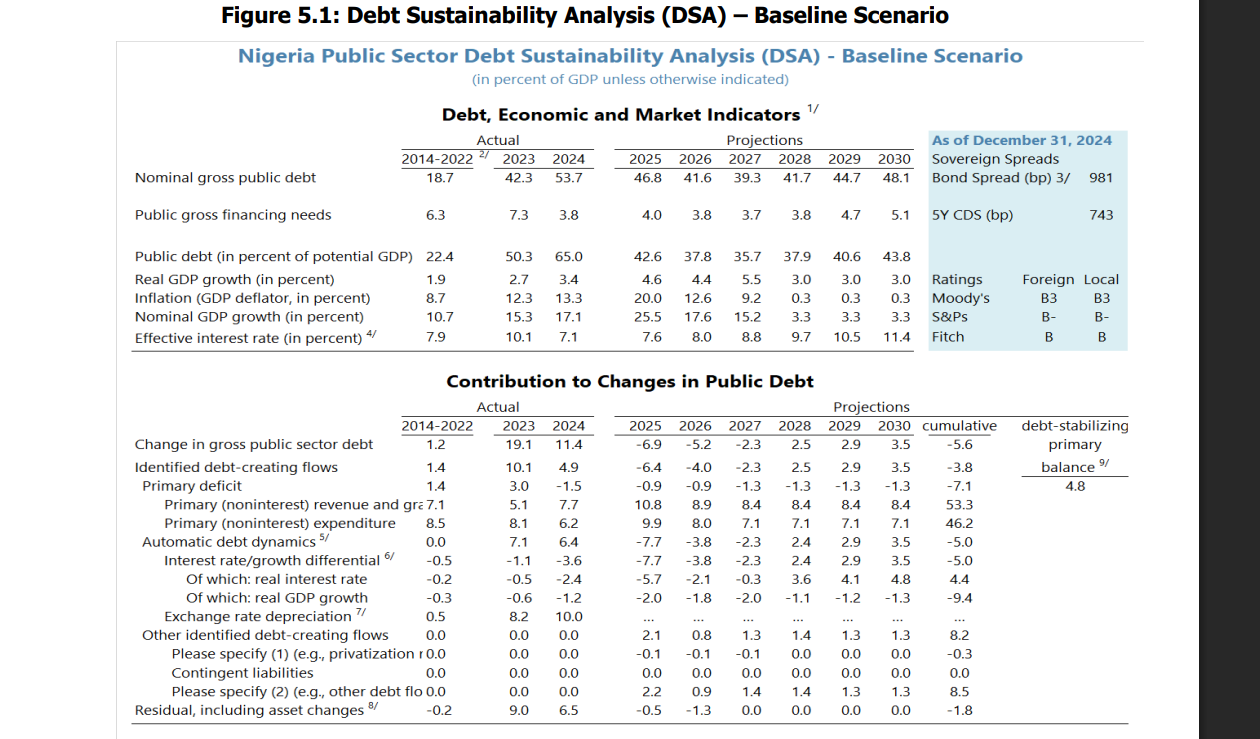
Nigeria’s debt service-to-revenue ratio is projected to rise to 71.7 per cent by 2030, raising concerns over the Federal Government’s ability to meet its debt obligations while providing funds for critical infrastructure and essential public services.
The Debt Management Office (DMO), in its 2024 Debt Sustainability Analysis (DSA) report, warned that the country’s debt burden could worsen if revenue generation, economic growth and exchange rate stability fall short of projections.
According to the report shared via website on Monday, the debt service-to-revenue ratio, which stood at 60.6 per cent in 2024, is expected to decline to 44.9 per cent in 2025 before rising to 51 per cent in 2026 and 57.1 per cent in 2027. It is subsequently projected to reach 71.7 per cent by 2030 under the baseline scenario.
The projection suggests that the Federal Government could spend more than 71 kobo out of every naira generated on debt servicing by the end of the decade, leaving limited resources for capital projects, healthcare, education and other public expenditure.
The DMO, however, warned that the situation could deteriorate further under an adverse economic scenario, with the ratio projected to climb to 97.3 per cent by 2030.
Under this scenario, which assumes a 30 per cent depreciation of the naira, a two per cent decline in real Gross Domestic Product (GDP) growth and a reduction in government revenue, nearly all the Federal Government’s earnings would be consumed by debt servicing.
The report also assessed the implications of contingent liabilities, including government guarantees estimated at ₦5.63 trillion as of December 2024, becoming actual obligations and being added to the country’s public debt stock.
It warned that if these liabilities crystallise, debt service obligations could exceed the Federal Government’s total revenue before the end of the decade, further worsening the country’s fiscal position.
The DMO attributed the projected increase in the debt service burden to debt servicing obligations growing faster than government revenue, thereby limiting the fiscal space available for development spending.
“This ratio is high and the fiscal space available to the Government is limited,” the report stated, warning that both the baseline and shock scenarios highlighted growing threats to debt sustainability.
The projected ratio also exceeds Nigeria’s self-imposed debt service-to-revenue threshold of 50 per cent under its debt sustainability framework. Although the Market Access Country framework does not prescribe a specific benchmark for the indicator, Nigeria adopted the 50 per cent limit in its DSA, which the country is expected to breach again from 2026.
The growing pressure comes amid a significant expansion in Nigeria’s public debt stock, which covers the Federal Government, the 36 states and the Federal Capital Territory. Total public debt rose from ₦27.40 trillion in 2019 to ₦144.67 trillion at the end of 2024, representing an increase in the debt-to-GDP ratio from 19 per cent to 53.72 per cent.
The Federal Government spent ₦12.62 trillion on debt servicing in 2024 out of total revenue of ₦20.84 trillion, representing 60.55 per cent of its earnings.
Although this was an improvement from the 64.14 per cent recorded in 2023, it remained significantly higher than the 23 to 27 per cent range recorded between 2019 and 2021.
The DMO attributed the improvement in revenue performance partly to the removal of the petrol subsidy, the unification of exchange rates, improved tax administration and increased remittances from government-owned agencies.
Meanwhile, the securitisation of ₦7.3 trillion in Ways and Means advances from the Central Bank of Nigeria contributed to the expansion of the debt stock, despite a reduction in the fiscal deficit from 4.6 per cent of GDP in 2023 to 3.9 per cent in 2024.
Despite the rising debt servicing burden, the DMO presented a mixed assessment of Nigeria’s overall debt sustainability, projecting that the public debt-to-GDP ratio would remain below Nigeria’s proposed 60 per cent ceiling under the Medium-Term Debt Management Strategy (MTDS) 2024–2027 and the 70 per cent benchmark for emerging market economies through 2030.
However, the report identified significant vulnerabilities in the country’s debt structure, particularly financing costs and refinancing obligations.
It classified Nigeria’s financing risk as high, noting that the average Eurobond spread stood at 976 basis points between October and December 2024, significantly above the 600-basis-point threshold.
Refinancing risk was also classified as high, with the annual change in the share of short-term debt recorded at 1.8, above the threshold of 1.0. The DMO linked this to increased issuances of Nigerian Treasury Bills, which could expose the government to frequent refinancing pressures.
The report warned that further naira depreciation, weaker economic growth and revenue shortfalls could worsen the country’s debt profile and push debt servicing obligations closer to the adverse scenario.
To contain the risks, the DMO urged the Federal Government to sustain the removal of the petrol subsidy and maintain the unified and flexible foreign exchange regime.
It also recommended stronger revenue mobilisation through tax reforms aimed at broadening the tax base, improving compliance and strengthening tax administration.
The office further called for improved public spending efficiency, reduced reliance on fresh borrowing and greater use of public-private partnerships to finance infrastructure projects.
It emphasised the need for compliance with the Fiscal Responsibility Act 2007, as amended, and the Central Bank of Nigeria Act 2007, particularly provisions governing Ways and Means advances.
The DMO also recommended the privatisation or sale of selected government assets and increased reliance on concessional financing to reduce borrowing costs.