
Bature Begins Official Engagement at TimesNG as CCC, IMPR Host AI, Crisis Communication Training

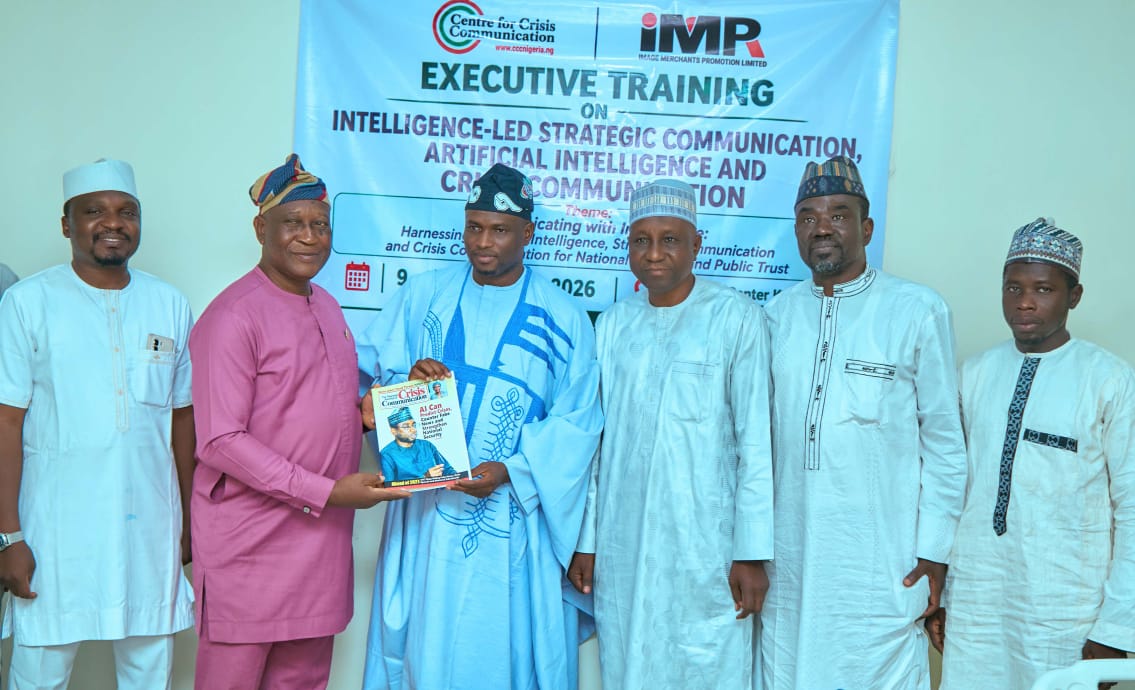
Bature Begins Official Engagement at TimesNG as CCC, IMPR Host AI, Crisis Communication Training
Newly appointed Kano State Commissioner for Information and Internal Affairs, Sanusi Bature Dawakin Tofa, has begun his official engagements with a call on communication professionals to embrace artificial intelligence and continuous training to remain effective in an increasingly complex information environment.
Bature, who also serves as Special Spokesperson to Governor Abba Kabir Yusuf, spoke as Special Guest of Honour while declaring open an executive training programme on Artificial Intelligence, strategic communication and crisis communication at the TimesNG Centre in Kano.
The programme, themed “Communicating with Intelligence: Harnessing Artificial Intelligence, Strategic Communication and Crisis Communication for National Security and Public Trust,” brought together professionals from government, security and regulatory institutions.
It was organised by the Centre for Crisis Communication (CCC) in partnership with Image Merchants Promotion Limited (IMPR), publishers of TimesNG and Economic Confidential.
Welcoming the Commissioner, IMPR Managing Director and Chief Executive Officer, Yushau A. Shuaib, congratulated him on his appointment, describing the position as a major responsibility requiring effective communication of government policies while remaining sensitive to the interests of Kano residents irrespective of their political affiliations or orientations.
Shuaib traced Bature’s progression in public communication from Press Secretary to Director-General of Media and Public Relations and, eventually, Commissioner for Information and Internal Affairs, while continuing as Special Spokesperson to Governor Yusuf.
He said the appointment deserved celebration as well as prayers for wisdom, guidance and safety, particularly given Nigeria’s increasingly charged political environment.
Shuaib, who said he had known Bature for more than a decade as a journalist, social worker and contributor to the mentorship of younger communication professionals, urged him to see his new responsibility as extending beyond government messaging to building trust with the wider Kano public.
He expressed confidence that Bature’s professional background would prove valuable in an era when public institutions must contend with misinformation, rapid digital communication and growing demands for transparency.
Chairman of the Centre for Crisis Communication, Major General Chris Olukolade (rtd.), said the executive programme was designed to equip participants with practical skills for deploying emerging technologies in organisational communication, information verification, crisis management and public engagement.
Olukolade warned that the spread of fake news, hate speech and AI-manipulated content posed increasing risks as political activities intensify ahead of the 2027 elections.
He announced that the Crisis Communication Hub (CCH) would be formally activated on 1 December 2026 to strengthen the detection of misinformation and disinformation and provide appropriate advisories to relevant regulatory authorities, particularly where harmful information could contribute to electoral violence or other threats.
According to him, the Hub, developed in partnership with the National Information Technology Development Agency (NITDA), incorporates representation from security institutions, the media and civil society to support balanced assessment and advisory processes.
Delivering the keynote address, Chairman of the IMPR Board and Professor of Strategic Communication, Sule Ya’u Sule, examined the growing role of artificial intelligence in strategic communication.
He described AI as a powerful tool for improving productivity and access to information but warned professionals against treating machine-generated content as inherently accurate.
Citing a video reportedly generated using AI following the collapse of the Nasarawa Bridge, Sule warned that manipulated digital content could mislead both the public and security authorities.
“One mistake can ignite trouble in the country,” he cautioned.
The communication scholar urged participants to develop practical competence in AI-assisted communication strategy, organisational messaging, social-media fact-checking and crisis management while recognising the technology’s limitations and maintaining human oversight.
He also called for similar capacity-building programmes for political actors ahead of the 2027 elections.
Sule stressed that communication professionals must remain alert, open-minded and proactive in receiving information, assessing rapidly evolving situations and developing practical responses to emerging challenges.
In his remarks, Commissioner Bature described public relations practitioners as professional problem-solvers who are often expected to manage institutional challenges even when they played no role in creating them.
“Most of the time, we are not the people who create the problems within our organisations. Rather, we are the people expected to solve them,” he said.
He argued that communication professionals must be willing to make sacrifices to protect their institutions, stakeholders and relationships while continually updating their professional skills.
“Whoever is not exposed to training like this will soon be not only outdated but a problem to communication,” Bature said, adding that contemporary institutions required leaders capable of “communicating with intelligence” rather than merely speaking.
The Commissioner also paid tribute to Professor Sule and Shuaib, describing them as important professional mentors whose support had contributed significantly to his career development even before his emergence as spokesperson to the Kano State Government.
The executive training forms part of the continuing efforts by CCC and IMPR to strengthen institutional communication capacity, encourage responsible adoption of emerging technologies and improve crisis preparedness, information verification and public trust.
By TimesNG