

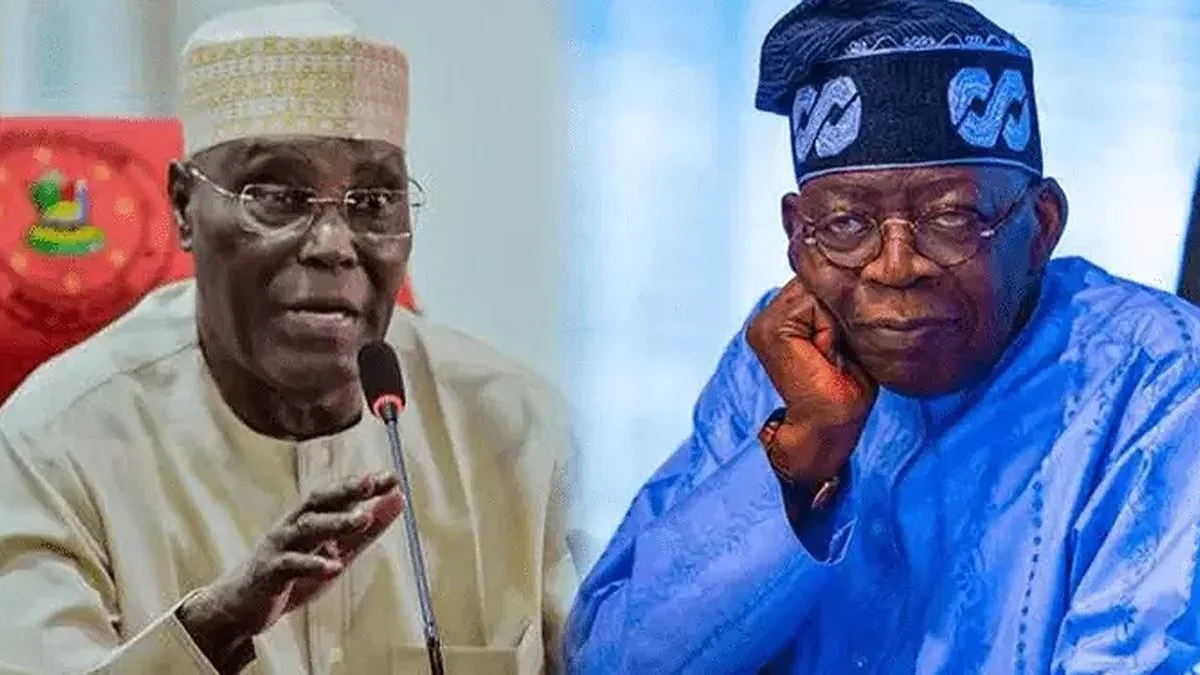
African Democratic Congress (ADC) presidential candidate and former Vice-President Atiku Abubakar has criticised President Bola Tinubu over reports that 638 people were killed in insecurity-related incidents in October, while nearly 64,000 Nigerians fled to neighbouring Niger Republic.
Atiku, in a statement issued by Phrank Shaibu, Director of Strategic Communication of the ADC Presidential Campaign Council, said the figures exposed the alleged failure of the Tinubu administration to protect Nigerians.
He noted that behind the statistics were grieving families and communities forced to abandon their homes in search of safety outside the country.
According to Atiku, a report by the Foundation for Investigative Journalism, citing the Centre for Democracy and Development’s October tracker, showed that 638 people were killed in broader insecurity incidents during the month, with the North-East accounting for 409 deaths.
“Across all security incidents, the tracker recorded 640 deaths, up from 396 in September. The United Nations also reported that nearly 64,000 people fled violence in northern Nigeria for Niger since the start of 2026, while several hundred more fled to Benin.
“These figures are a devastating indictment of the security situation in our country. Behind every number is a Nigerian whose life has been lost, a family in mourning or a community forced to abandon its home. Nigerians should not have to flee across our borders to find safety,” he said.
The former vice-president called on the Tinubu administration to prioritise the protection of lives and communities, strengthen security in affected areas and provide support for displaced families.
He also urged the government to collaborate with neighbouring countries and humanitarian agencies to assist Nigerians who had fled violence.
“A government that cannot protect its people has failed in its most basic duty. President Tinubu must stop offering excuses and take responsibility for this worsening crisis. Nigerians need safety now, not another promise,” Atiku added.
Similarly, Governor Seyi Makinde of Oyo State, the presidential candidate of the Allied Peoples Movement (APM), also criticised Tinubu over the removal of petrol subsidy, accusing his administration of failing to put adequate measures in place to cushion the resulting economic hardship.
Makinde argued that Tinubu should have used the transition period before assuming office in May 2023 to develop interventions that would protect Nigerians from the effects of the policy.
The governor made the remarks in a newsletter explaining his decision to challenge Tinubu in the 2027 presidential election.
He maintained that Tinubu could not claim ignorance of the hardship an abrupt subsidy removal would cause, recalling his opposition to former President Goodluck Jonathan’s attempt to remove the policy in 2012.
“After all, President Tinubu cannot honestly say he did not know what the consequences would be. Back in 2012, when President Goodluck Jonathan attempted to remove petrol subsidy, he publicly opposed the abrupt removal, arguing against the hardship it would impose on Nigerians,” Makinde said.
He also recalled that Tinubu witnessed the economic difficulties Nigerians experienced before the 2023 presidential election, particularly the petrol and naira scarcity crises.
“Nor can he claim he did not understand the hardship Nigerians were already experiencing. He witnessed the petrol and naira scarcity crises leading up to the 2023 elections and spoke publicly about their effects on Nigerians,” he added.
Makinde said he would have convened the National Economic Council during the transition period to develop a coordinated response involving state governors before implementing the subsidy removal.
According to him, the meeting would have identified necessary interventions, their funding sources and how the federal, state and local governments would collaborate to implement them.
He added that the process would have enabled Nigerians to monitor government spending and identify beneficiaries of the interventions.
The governor contrasted the Federal Government’s approach with the measures his administration introduced in Oyo State following the announcement of subsidy removal in May 2023.
He said his government immediately began consultations with organised labour and introduced measures to reduce transportation costs for residents.
“Within eleven days, we had announced the deployment of additional Omituntun buses, maintained existing fares and introduced half-price travel for students and senior citizens,” he said.
Makinde added that his administration subsequently launched the Sustainable Actions for Economic Recovery (SAfER) programme in August 2023.
According to him, the programme provided food relief to 200,000 vulnerable households, subsidised public transportation and supported small businesses and farmers through loans and agricultural inputs.
“Our approach was simple: provide immediate relief while developing measures to help people earn a living,” he said.
The governor maintained that economic policies should be accompanied by interventions to protect citizens from their consequences.
“Good leadership requires more than making economically sound decisions. It requires understanding how those decisions will affect the people you have been elected to serve,” he said.
“Nigerians deserved better preparation and better protection.”