

By Olabode Opeseitan
In the long, often winding arc of Nigerian academia, few figures have managed to combine intellectual rigour, administrative steel and an instinctive feel for human complexity quite like Professor Ibiyemi Ibilola Olatunji-Bello. Her tour of duty as Vice-Chancellor of Lagos State University, which ended this month, was not merely a tenure. It was a demonstration of what happens when preparation meets purpose and purpose meets an unflinching will. She arrived at the office with the calm of a seasoned physiologist and the quiet certainty of someone who had spent decades studying systems, pressure points and the delicate balance required to keep organisms alive. She left the university several notches higher than she met it, having quietly but decisively reshaped its systems, culture and ambitions.
Her story begins in Surulere, where she attended Anglican Girls’ Primary School between 1970 and 1974. Her rise was not accidental but anchored in steady, deliberate steps. From Ibadan to the University of Lagos, from a research fellowship in Texas to a PhD earned through grit, she built a career that was both linear and luminous. By 2007, LASU appointed her Professor of Physiology, and in January 2026, the Senate conferred on her the rare honour of Distinguished Professor.
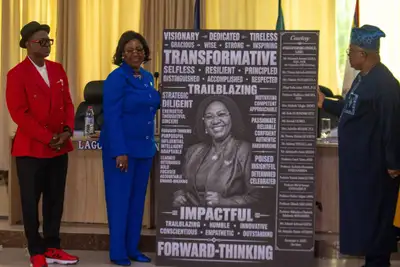
Her leadership style was unmistakable. It is what historians would describe as “performance-driven, data-conscious and intolerant of bureaucratic lethargy.” Biographers would linger on the subtler textures: the way she listened more than she spoke, the way she insisted on clarity before action, the way she carried herself with a pastoral gentleness that belied her administrative ferocity. Those who worked with her often said she possessed a rare duality. The Pro-Chancellor, Babatunde Ogala San, captured it best at her valedictory session: “She is a go-getter and a teacher of teachers,” he said, praising her grace, professionalism and ability to manage the demands of leadership with unusual calm.
Her achievements read like the output of an institution twice LASU’s size. She inherited thirty-seven programmes due for accreditation and secured full accreditation for thirty-one of them in her first year, an unprecedented 96 percent success rate. “All professional programmes received full accreditation,” the record notes, a feat that would become a recurring theme of her administration. Under her watch, LASU became the most subscribed university in Nigeria in 2025 and again in 2026, attracting over eighty-five thousand admission applications. It emerged the Best University in West Africa in the UI Greenmetrics Rankings four years in a row and the Best State University in Nigeria in multiple independent assessments.
Yet numbers alone cannot capture the scale of her transformation. She supervised the boldest infrastructural revolution in the university’s forty-two-year history, with over fifty projects receiving her midas touch. From the Babajide Sanwo-Olu Library Complex to the six-storey Academic Resource Centre, from hostels that finally made LASU a residential university to the multi-billion naira Tunji Bello Auditorium in Epe, she reshaped the physical and intellectual landscape of the institution. Her digital revolution was equally sweeping. LASU became one of Nigeria’s most digitalised universities, earning a three-billion-naira Centre of Excellence for Artificial Intelligence, Robotics and Cyber Security from TETFund in 2026.
What made her unique was not simply the volume of her achievements but the philosophy beneath them. She governed with six strategic goals that acted as a compass: accreditation, research, infrastructure, revenue, welfare and sports. Each goal was pursued with a clarity that made even sceptics concede her administrative discipline. She expanded faculties, created new schools, established specialised centres and opened new frontiers of knowledge. She strengthened research culture, instituted grants, attracted external funding and positioned LASU within global academic networks. She improved staff welfare, cleared arrears, expanded career structures and ensured promotions were timely. She championed student welfare, introduced scholarships, expanded foundation programmes and created work-study opportunities.
Her tenure also had its moments of symbolism. When LASU co-hosted the 11th All-Africa University Games with the University of Lagos in 2024, the university emerged the best in Nigeria and second overall in Africa. It was a statement of ambition, a declaration that LASU had stepped onto the continental stage. When she represented all African Vice-Chancellors at the United Nations High-Level Political Forum on the SDGs in 2025, it was a recognition of her intellectual stature and administrative credibility.
Her legacy is not merely infrastructural or statistical. It is cultural. She restored discipline, strengthened institutional governance, and reintroduced a sense of collective pride. She made LASU beautiful, functional and globally competitive. She made it a university that could dream without apology. In her valedictory remarks, she said, “Offices and titles are temporary, but the relationships built and the institutional impact achieved endure beyond tenure.” It was a line that sounded like a closing chapter but felt more like a thesis on leadership.
What LASU will remember her for is simple: she took a university with strong potential and turned it into a continental contender. She proved that Nigerian universities can be well-run, forward-looking and globally relevant. She demonstrated that excellence is not an aspiration but a discipline. And she left behind a blueprint that future Vice-Chancellors will study, imitate and, perhaps, attempt to surpass.
In the end, her story is a reminder that leadership in academia is not about occupying an office. It is about bending an institution toward its highest possibilities. Professor Ibiyemi Olatunji-Bello did exactly that. And in doing so, she joined the small, distinguished company of Nigerian university leaders whose legacies will outlive their titles.