

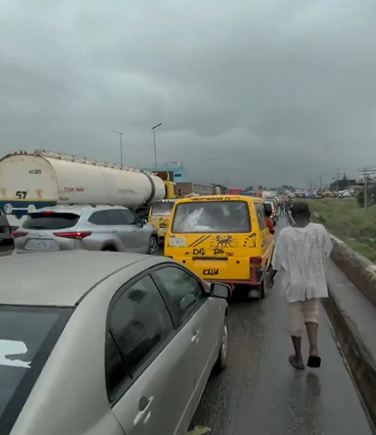
Four days into the repair of the damaged expansion joints on Kara Bridge, commuters and motorists along the Lagos-Ibadan Expressway are already grappling with severe traffic congestion, longer travel times and increased transport fares.
The repairs have particularly affected residents travelling between Berger, Akute, Alagbole and other parts of Lagos and Ogun states, with many commuters spending hours on the road and struggling to find commercial buses willing to navigate the affected routes.
The gridlock stretches from the Kara axis in Ogun State to 7Up Junction, Toll Gate and Secretariat Bus Stop in Lagos, leaving hundreds of vehicles trapped in hours-long traffic and disrupting the daily activities of residents and businesses along the corridor.
It was learnt that the situation has also forced some residents who work around Ikeja and neighbouring areas to adjust their daily routines, with some now leaving home much earlier and leaving work early to beat the worsening traffic.
A commuter, Barakat, who spoke to The Guild on Friday about her experience around Berger, said the traffic had made it increasingly difficult to find commercial buses, as many drivers had diverted to alternative routes to avoid spending several hours in the gridlock.
According to her, commuters now spend between one and two hours trying to secure a bus from Ikeja Under Bridge, while the fare to Berger has risen from about N700 to as much as N1,500.
“The traffic has been so hectic, and it is also difficult to get a bus because no driver wants to follow the route. The fare has doubled because of the repair works,” she said.
“Getting a bus from Ikeja Under Bridge now takes at least one to two hours because most of the drivers have changed their routes due to the traffic.”
Another commuter, Cynthia Seun, who lives around Akute, said the repairs had significantly increased both her travelling time and daily transportation expenses.
She explained that she previously spent between N700 and N1,000 to get home but now spends between N2,000 and N2,500 for the same journey.
Cynthia said the traffic situation had also forced her to adjust her daily routine, as she now wakes up as early as 4am to prepare for work in Ikeja and leave home early enough to beat the morning gridlock.
She added that she also leaves work earlier than usual to avoid getting caught in the heavy traffic on her way home, noting that the longer travel time has made her daily commute increasingly stressful.
“On a normal day, we get home within one hour, but now we spend about three to four hours on the road because of the traffic,” she said.
For another commuter travelling to Alagbole, the difficulty starts with finding a vehicle amid the rush and limited availability of buses.
She said commuters were now forced to struggle for the few available vehicles, while some transport operators had taken advantage of the situation to increase fares.
“Everyone was struggling to enter the only available vehicle. I also struggled with all the strength I had, only to hear ‘N1,500 Berger,’ as opposed to the N500 to N700 I normally pay,” she said.
She added that she eventually had to alight and take another vehicle to Alagbole for N2,000, compared with the usual fare of between N1,200 and N1,300.
The experiences of the commuters highlight the wider impact of the Kara Bridge repairs, with the traffic situation affecting not only movement along the busy corridor but also the cost and availability of public transportation.
Workers, traders, students and other daily travellers are having to contend with longer journeys and higher transport expenses, while businesses along the affected routes are also facing reduced movement and fewer customers.
The repair work on the expansion joints entered its fourth day on Friday, with construction activities ongoing at both ends of the bridge.
Workers from the contractor, CBC, are intensifying efforts to meet the two-week completion deadline, with the rehabilitation expected to continue until September 22.
Until the work is completed, commuters and motorists are expected to continue adjusting to the temporary traffic arrangements around the Kara axis.