
From Ifangni to Ilasamaja: How a 10-year-old “tiling apprentice” ended up mixing cement instead of going to school

Key points
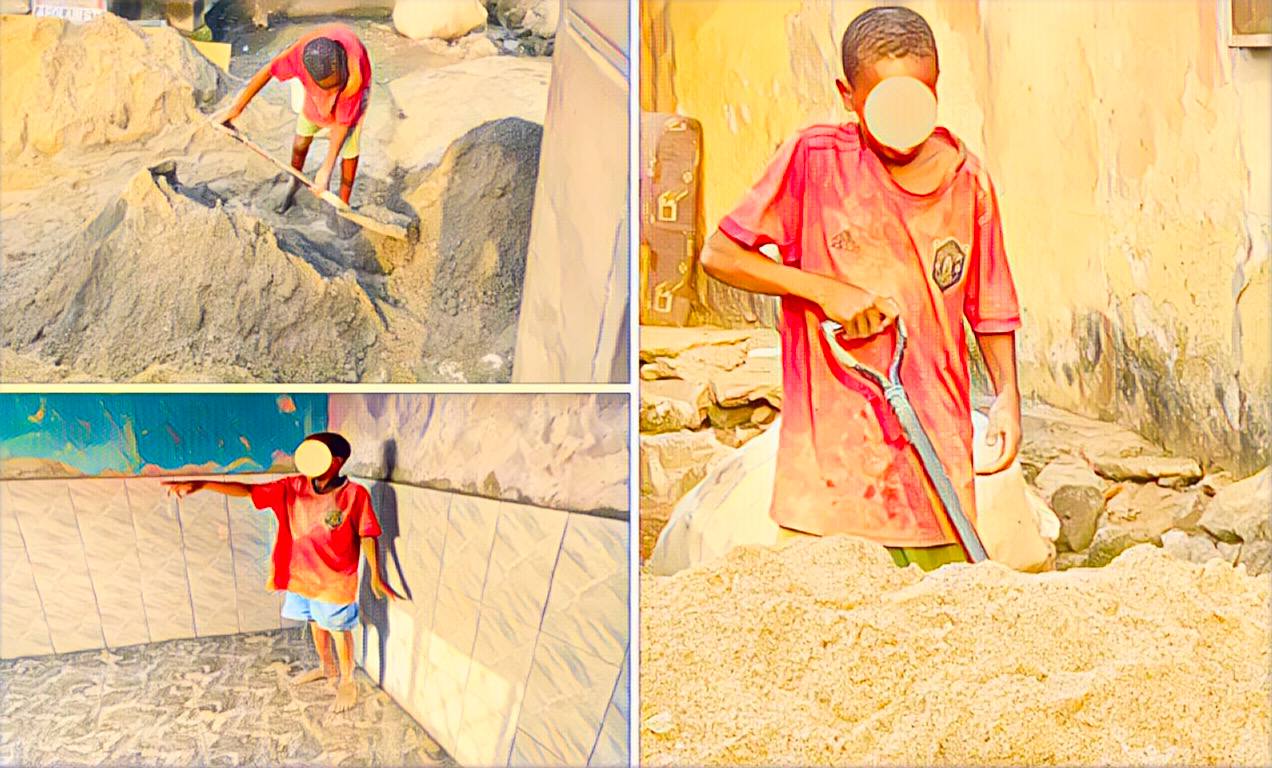
- Ibukun, 10, was brought from Ifangni in Benin to Lagos as a tiling “apprentice” but carries materials, mixes mortar and sleeps at the site.
- Nigeria’s 2022 National Child Labour Survey estimated 24.7 million children in child labor, 14.39 million of them in hazardous work.
- Nigeria validated a new National Child Labour Policy and 2026-2030 action plan in June, but enforcement in informal workplaces remains weak.
In Ilasamaja, a low-income neighborhood in Lagos, a 10-year-old boy named Ibukun starts his day pushing a shovel almost as tall as he is through wet sand and cement. He does not go to school.
When the work ends, he sleeps on a piece of cardboard in an empty room of the same unfinished building, with no mattress, mosquito net or electricity.
Ibukun came to Lagos from Ifangni in southeastern Benin Republic with Kilamuwaye Alexandre, a tiler from the same town who describes the boy as his apprentice. According to Alexandre, Ibukun preferred learning a trade to school, and his parents agreed.
“Instead of allowing the boy to stay home and become a nuisance, the parents agreed to work with me,” he told The PUNCH. He also admitted the boy is too young for a construction site.
That admission sits at the center of the story. Nigeria has a long tradition of informal apprenticeship, most famously the Igbo Igba-Boi system, which has built businesses across the southeast.
However, the International Labour Organization defines child labor as work that harms a child’s development, interferes with education or involves children too young to do it. A boy who mixes cement all day and sleeps at the workplace is not simply observing a master.
A route, not a one-off
Ibukun’s journey ran through the Seme border on the Lagos-Badagry road. As ECOWAS citizens, Beninese nationals can enter Nigeria visa-free for up to 90 days, and cross-border work is routine.
Olabisi Akande, a Beninese vulcanizer who has lived in Lagos for 15 years, said he travels home through Idiroko every two weeks without difficulty.
Consequently, the same mobility that gives adults opportunity can make children invisible. Koku Tosin, a Togolese tiler with a decade in Lagos, said Ibukun is not an isolated case. “Small boys from Benin Republic come to Lagos to do these jobs,” he said. “Economic necessity shapes it.”
Jamiu Ibrahim, an engineer who noticed Ibukun at the site, put it plainly: “He should be in school.”
Laws on paper, gaps on the ground
Nigeria’s Child Rights Act of 2003 bars exploitative and hazardous child labor and work that keeps children out of school. The Labour Act restricts industrial work for children under 15 and sets 12 as the minimum age for apprenticeship.
The 2022 National Child Labour Survey counted 24.7 million children in child labor, 14.39 million in hazardous work, with construction among the hazardous sectors.
In June, the National Steering Committee validated a third National Child Labour Policy and a 2026-2030 action plan, developed with the ILO and ECOWAS support.
ILO country director Vanessa Phala said the policy must translate into real change, with sustained financing and monitoring.
Meanwhile, globally, the ILO and UNICEF estimate 138 million children remain in child labor, 87 million of them in sub-Saharan Africa. Experts warn that removing a child from a site without easing household poverty often sends him straight back. Ibukun, for now, wakes each morning to the same shovel.