
AFSF 2026: Bank of Agriculture Charts New Path for Youth Financing as Africa Demands Shift Beyond Conventional Collateral

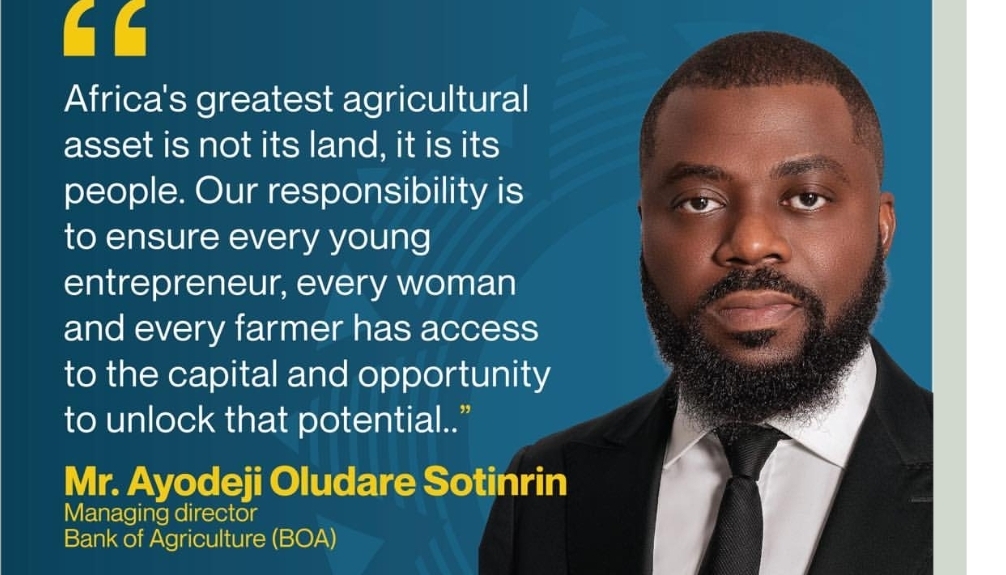
At the high-level Youth Dome session during the ongoing Africa Food Systems Forum (AFSF) 2026, the long-standing conversation around funding Africa’s young farmers finally confronted the hard reality in the room: conventional banking architecture is simply not working for Africa’s youth, and public development finance institutions must urgently step in to rewrite the rules.
Speaking during the framing segment of the session titled “Special Investment Programs for Youth and Women in Agrifood Systems,” the Managing Director and Chief Executive Officer of the Bank of Agriculture (BOA) Nigeria, Ayodeji Oludare Sotinrin, threw down a clear challenge to development financiers and institutional lenders.
For years, young African agriprenuers have been crippled by impossible balance-sheet metrics—from prohibitive double-digit interest rates hovering well above 25% to commercial banks demanding landed property and fixed physical assets before disbursing credit. Sotinrin insisted that state agricultural banks cannot afford to run on that obsolete playbook if Africa is to meet its post-Malabo CAADP 2026–2035 targets.
“We must fundamentally re-engineer how agricultural credit treats our young people,” Sotinrin said as he rounded off his intervention in Kigali. “You cannot expect a 26-year-old innovator or a young woman aggregator fresh out of school to produce a certificate of occupancy in downtown Lagos or Abuja just to access working capital for mechanized farming. If our public development finance institutions operate with the same commercial mindset that shuts young producers out, we will fail our national food security targets.”
Sotinrin maintained that the mandate of institutions like the Bank of Agriculture must focus on deliberate, structured de-risking. By pairing single-digit concessionary capital with credit-guarantee schemes and anchor-borrower mechanisms, development banks can unlock liquidity for youth who have outgrown microfinance institutions but remain locked out of traditional commercial banking.
“Our role as development banks is not to act like traditional risk-averse commercial lenders,” Sotinrin argued. “Our business is to de-risk the ecosystem. We must meet our youth halfway with tailored, patient capital, single-digit lending windows, and structured cluster facilities that recognize their business models, not just their physical collateral.”
The session—which brought together continental agriculture leaders, including the Mastercard Foundation and AGRA—mirrored the raw realities shared on the panel by young African agripreneurs. Beneficiaries of programs like AGRA’s Youth Entrepreneurship for the Future of Food and Agriculture (YEFFA) took to the stage to outline the systemic hurdles choking their growth, openly calling on financial institutions to align repayment moratoriums with biological crop seasons rather than rigid monthly accounting calendars.
Sotinrin tied his call to action to Nigeria’s broader macroeconomic push to achieve domestic food sovereignty, noting that state capability and institutional financing must converge to scale agrifood enterprises from subsistence patches into viable commercial champions.
“The youth on this continent are not charity cases looking for hand-outs; they are the future boardroom executives and private-sector drivers of our food value chains,” Sotinrin stated. “When we back their enterprises with viable credit guarantees, accessible interest rates, and structured access to mechanization hubs, we are not just supporting young people—we are insulating our food economies against external global shocks.”
As continental policymakers continue discussions in Kigali on mobilizing blended investment under the CAADP Kampala Declaration framework, the clear takeaway from Nigeria’s agricultural financing chief is unmistakable: without radical public bank de-risking and concessionary youth windows, Africa’s agri-food transformation will remain stalled in policy memos.