

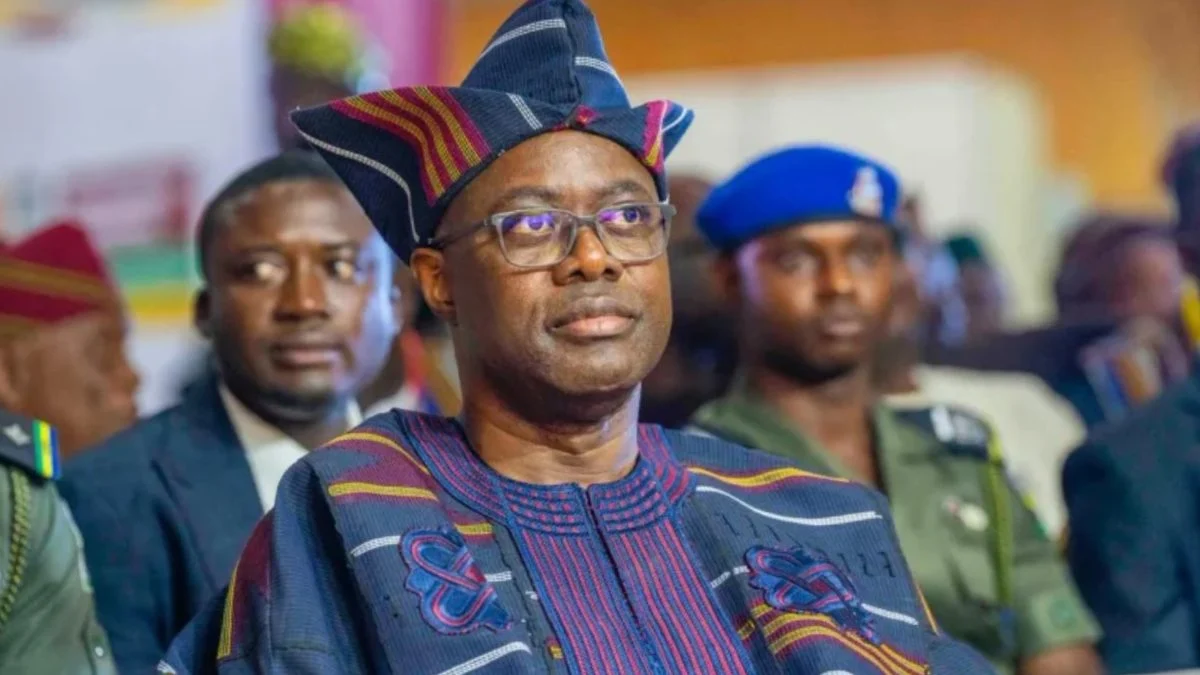
The Oyo State chapter of the All Progressives Congress (APC) has dismissed Governor Seyi Makinde’s presidential ambition ahead of the 2027 election.
It described him as a “noise maker” who lacks the political strength to challenge President Bola Tinubu.
The party also threatened to recover any public funds allegedly deployed by the governor’s administration to promote his presidential bid under the platform of Allied People’s Movement (APM)
Oyo APC Publicity Secretary, Olawale Sadare, stated this in a statement issued at the weekend and made available to journalists in Ibadan.
Sadare was reacting to remarks by Makinde after the governor was installed as the Aare Asoludero of Ibarapaland by the Eleruwa of Eruwa.
Makinde had said he would remain available to receive more chieftaincy titles after leaving office in May 2027, when he would be free to pursue other interests.
Sadare alleged that Makinde was using the reported ambition to generate publicity and divert attention from issues concerning his administration.
“It is important for us to reiterate that Gov. Makinde does not possess the wherewithal to slug it out with President Bola Tinubu in 2027 but he (Makinde) is only out to make some noise and distract the global community,” he said.
The APC spokesman further stated that campaign posters and billboards promoting Makinde’s ambition had surfaced in parts of Oyo and Bauchi states.
He warned that the party would monitor the governor’s political activities and demand accountability for any state resources allegedly used to finance his political project.
“Makinde is being monitored as he embarks on a political journey that has failed before its commencement while he would be made to cough out all the public funds he wasted on it,” Sadare said.
The party also accused the governor of attempting to intimidate traditional rulers and religious leaders over their interactions with APC members and candidates, warning him against such alleged actions.
Sadare maintained that President Tinubu remained the APC’s preferred candidate for the 2027 presidential election, arguing that Makinde lacked the political structure and strategy required to defeat the President.
He also predicted that the presidency could return to the North after Tinubu’s possible second term.
The APC’s attack came amid Makinde’s increasing focus on national issues, particularly petroleum pricing, governance and institutional reforms.
In his latest newsletter, The Business of Governance, the APM presidential candidate called for a fundamental review of Nigeria’s petroleum pricing framework, arguing that the debate should go beyond whether fuel subsidy should be restored or abolished.
Makinde said the key question should be whether Nigeria, as an oil-producing country, operates a pricing system that is transparent, fair and capable of ensuring that citizens benefit from the nation’s natural resources.
He called for greater transparency in the factors used to determine petrol prices, including crude oil benchmarks, refining costs and margins, exchange-rate assumptions, logistics, distribution costs, taxes and levies.
The governor also rejected the argument that Nigerians should pay higher petrol prices to discourage smuggling into neighbouring countries.
According to him, securing the nation’s borders is the responsibility of the government, and citizens should not be made to bear the financial consequences of inadequate border control.
Makinde disclosed that he would unveil an alternative approach to petroleum pricing in the coming weeks, urging Nigerians to assess the proposal based on its merits.
The governor said his broader “Reset Nigeria” initiative would address not only petroleum pricing but also the economy, security, education, institutions and the country’s political and social order.
He argued that replacing individuals in government would not be enough to solve Nigeria’s challenges without reforming the systems and institutions responsible for repeatedly producing poor outcomes.
Makinde said a national reset would require accountable leadership and sustained participation by Nigerians, stressing that rebuilding the country could not be left to one individual.