

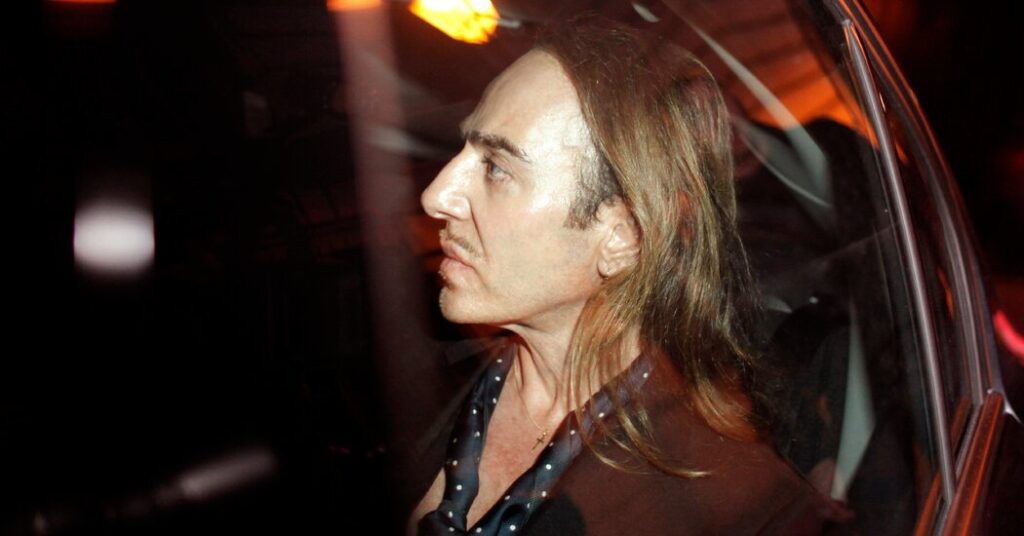
Thirty years ago this fall, a young, brash British fashion designer named John Galliano, known as much around Paris for his partying ways as for his gorgeous, outlandish creations, was hired by the august couture house Christian Dior to be its new creative director. For his first Dior haute couture show, staged at the Le Grand Hotel in January 1997, he presented a mash-up of Edwardian dressing, 19th-century Japonism and Maasai tribal wear, including bustled gowns, cinched corsets draped with tiny yellow and orange ceramic beads, and an opium-den-like sheath in chartreuse satin trimmed with mink — a look Nicole Kidman wore to the Oscars two months later.
“I was sitting in a row with Madame Chirac and Madame Pompidou and they looked like they had been hit in the face with a cold dead fish,” the New York socialite and longtime Dior client Nan Kempner told me after the show. “They couldn’t believe what they were looking at: this conservative house where they’ve all bought their clothes for years. How much was there that Madame Chirac or Madame Pompidou could wear?”
Nothing really. Mr. Galliano wasn’t thinking about clients’ needs or desires. As he had told me during an interview two years earlier, during a short-lived stint at Givenchy, “I don’t intend to please them.” Sixteen years later, his tenure at Dior came to an abrupt end, following a drunken antisemitic tirade in a Paris cafe. But while he held that vaunted position, he seemed to be designing with one thing in mind: a future museum retrospective.
Last week, he got it: the Metropolitan Museum of Art announced that Mr. Galliano would be the subject of the Costume Institute’s next exhibition, scheduled to open May 9. It is an exceptional honor. Only two other living designers have been so celebrated by the Met: Yves Saint Laurent in 1983 and Rei Kawakubo of Comme des Garçons in 2017.
This show, titled “John Galliano: Horizons,” promises to enshrine him among fashion’s greatest couturiers. But his fame will always have an asterisk attached. As the museum noted in its announcement: “Alongside Galliano’s extraordinary creative accomplishments, the exhibition will address the derogatory conduct that fundamentally altered his career and public reception. In doing so, the exhibition will consider how artistic achievement should be understood alongside ethical accountability.”
In other words, unlike most fashion retrospectives, which invite visitors to admire opulent gowns made for the rich and famous, with “John Galliano: Horizons,” the Met is attempting to tackle questions regarding cultural memory, accountability, rehabilitation and reputation. In the process, it is asserting the ability of powerful cultural institutions to decide when achievements of talent outweigh failures of morality.
Our culture offers endless examples of artists who behave disgracefully and are revered nonetheless, and high fashion — to some degree an explicit celebration of wealth inequality — has never been the place to look for lessons on virtue. Even so, Mr. Galliano’s rehabilitation, indeed his coronation, is a remarkable turn of events. As Mr. Galliano’s biographer, I think it is a terrible idea.
His infamous antisemitic rants were not an aberration. From his early days as a struggling designer in London and Paris through his time at the heights of the fashion industry, Mr. Galliano was known to be verbally abusive to employees, friends and strangers alike. He “talked trash” about everyone in his sphere, Jacqui Duclos, head of the John Galliano brand in the early 1990s, once told me. “No one escaped him.”
The fashion business has long been known to tolerate bad behavior; addiction, provocation, and eccentricity are seen as normal, and at times necessary, elements of the creative process. Mr. Galliano’s comportment went way beyond all that. He had a habit of being extravagantly careless with appointments, even with people (like Madonna) who could have had a big impact on his company’s sales. In 1996 he made headlines in the industry press for shunting aside his close friend and creative partner Amanda Harlech when he went to Dior, and then publicly cutting her out of his life. At some point in the mid-2000s he reportedly spent several hours naked in the elevator of the Ritz hotel in London, growling at guests who tried to enter and telling them he was a lion; he was subsequently ejected from the hotel.
I experienced his erratic behavior myself: When I arrived at his tiny Passage du Cheval Blanc studio in Paris in 1994 for our first interview, his staff told me he was nowhere to be found. When he showed up, he was glassy-eyed, strangely euphoric, not really there.
A reputation like that might be enough to give any curator pause. Choosing this moment to glorify the life’s work of someone who was convicted of making antisemitic remarks, however, is downright bizarre.
An independent curator told me in 2021 that he had spent years proposing a Galliano exhibition to museums across the United States and Europe. The answer, he said, was always the same: no. So was the reason: antisemitism. None of the museums wanted to take the risk of tarnishing themselves.
The Met and Anna Wintour — Vogue’s global editorial director, a Met trustee and Mr. Galliano’s greatest champion — apparently understand those concerns. At the museum in May, Mr. Galliano, Ms. Wintour and the Costume Institute’s chief curator, Andrew Bolton, met with some of New York City’s most influential rabbis and Jewish leaders to get a reading on the situation. In fact, a Galliano exhibition was originally scheduled for 2024 and was postponed following the Oct. 7 attacks in Israel. Yet the subject of antisemitism is no less charged today than it was then; reported incidents have increased; debates about it have roiled state and local elections; and the Trump administration has placed it front and center in its effort to slash university research funding.
Public discussions continue to rage over how to define antisemitism, but there is no definition narrow enough to exclude Mr. Galliano’s infamous outburst, in which he praised Hitler and told fellow cafe patrons their ancestors would have been gassed.
Already, outrage and condemnation have flooded social media since the museum’s announcement on Friday night, and the backlash is likely to grow in the months leading up to the Met Gala on May 3. The glittering event has become a regular site of protest for less polarizing issues: The 2023 exhibition, “Karl Lagerfeld: A Line of Beauty,” drew demonstrators condemning the designer’s attitudes toward women, and this year’s “Costume Art” celebration, which was co-sponsored and co-chaired by Jeff Bezos and Lauren Sánchez Bezos, brought anti-billionaire picketers near the museum’s Fifth Avenue entrance. The black-tie ball for “John Galliano: Horizons” which will run through Jan. 9, 2028, is likely to provoke a more vehement — and prolonged — response.
Despite all this, The Met and Ms. Wintour appear to believe they can transcend the controversy, and confer upon Mr. Galliano a place in the cultural canon without irretrievably harming their own reputations. Sadly, they might be right.
Coco Chanel was a virulent antisemite, but that didn’t stop the Met from mounting a major Chanel exhibition in 2005 and that attracted more than 460,000 visitors. Dolce & Gabbana was briefly ostracized in the late 2010s following a series of racist ads and homophobic and fat-phobic statements; today, the incidents have been largely forgotten and the brand is widely beloved. Balenciaga faced opprobrium in 2022 for ads featuring inappropriate sexual imagery of children, but within a matter of months the incident had blown over.
Mr. Galliano himself was never truly canceled. Two years after his firing, he completed a highly publicized residency at Oscar de la Renta in New York, reportedly with Ms. Wintour’s support. One year later, he was appointed creative director of Maison Martin Margiela, owned by the Italian entrepreneur Renzo Rosso, another longtime Wintour ally. In 2024, he was the subject of Oscar-winning director Kevin Macdonald’s well-regarded documentary, “High & Low: John Galliano,” produced in association with Condé Nast Entertainment, the film and television division of Vogue’s publisher.
More recently, celebrities including Zendaya and Kylie Jenner, as well as Lauren Sánchez Bezos, have been wearing vintage Galliano pieces, which has substantially increased their value. And last March, the Spanish fast-fashion giant Zara announced that it had enlisted the designer — whose mother was Andalusian — to “re-author” designs from its archives, introducing his work to a new generation of consumers. The first collection arrives in stores next month. Industry insiders are already speculating that Zara may sponsor the Met’s exhibition and gala. It seems, at least in some circles, that Mr. Galliano is considered a timeless classic.
Not all great creators deserve a retrospective, and someone as incendiary as Mr. Galliano certainly shouldn’t be the subject of one during his lifetime, when he stands to profit from the honor personally. With “John Galliano: Horizons,” the Met and Ms. Wintour are selling the idea that they can tell the rest of us how to think about a difficult and divisive figure. Maybe they didn’t notice that idea has gone badly out of fashion.
Dana Thomas is the author of “Gods and Kings: The Rise and Fall of Alexander McQueen and John Galliano.” She writes the newsletter The Style File.
The Times is committed to publishing a diversity of letters to the editor. We’d like to hear what you think about this or any of our articles. Here are some tips. And here’s our email: [email protected].
Follow the New York Times Opinion section on Facebook, Instagram, TikTok, Bluesky, WhatsApp and Threads.