

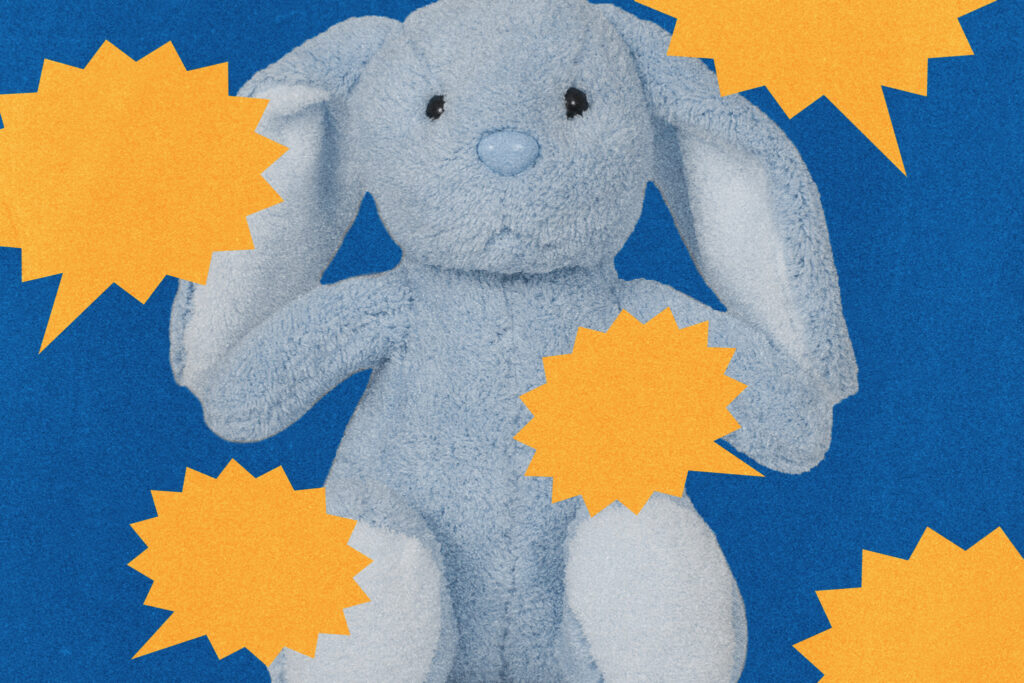
Until now, the mom in Pennsylvania had never heard of Rep. Max Miller or the “little blue bunny.” But she knew all about Buddy.
Her 10-year-old daughter would not sleep without that pink blanket attached to a teddy bear’s head. Long missing an eyebrow, the plushie looked forever quizzical.
“He’s the most precious thing in the world to her,” said Beth Tyson, a 47-year-old family therapist.
Though she rarely had time to stay on top of politics, let alone a House race in Ohio, Tyson kept reading about what she suspected was another little girl’s most precious thing in the world. All over the country, parents on social media seemed equally invested in the saga of a stuffed animal that turned a MAGA firebrand’s reelection campaign into a national news frenzy.
Miller, 37, has faced domestic violence and physical abuse allegations for years, most recently from his ex-wife, the mother of his 2-year-old daughter. But no detail has broken through quite like the “little blue bunny.” Conservative colleagues who previously had avoided commenting on Miller’s personal life called this week for his resignation after his former father-in-law, another powerful Ohio Republican, accused the second-term congressman of holding his granddaughter’s stuffy “hostage” for 48 hours.
“This girl is crying at night because she can’t sleep without her little blue bunny, and his answer is, ‘I’m just not going to give it to you,’” Sen. Bernie Moreno told reporters Tuesday.
Miller, who has denied all claims of abuse, posted screenshots on X the next day that he said exonerated him. His ex-wife’s team had sent the wrong “conduit” to fetch the bunny, he said, according to the text messages between the two, which delayed the handoff by 14 hours — not 48.
She asked him to please just leave it in the mailbox, according to the exchange, which racked up 2.3 million views. CNN’s Jake Tapper asked the question on so many minds, “Did you hold this doll hostage?”
“No, Mr. Tapper,” Miller replied, asserting that doing so would be “incredibly disturbing.”
On this, the internet agreed.
“What kind of father wouldn’t deliver the bunny himself, knowing that it helps his little girl sleep at night?” one commenter asked.
“This does not make you look better,” added a reporter for Gateway Pundit, a far-right news site.
“There are literally thousands of fathers reading those tweets and thinking: ‘When my daughter lost her favorite toy, I led a search party as if for a downed NATO nuclear warhead. And when that failed, I paid $300 for a replica on eBay,” posted David Frum, a former speechwriter for President George W. Bush.
Suddenly, the standoff over a toy in Ohio had sparked passionate chatter nationwide.
“Everybody gets it, no matter which side of the aisle they are on,” said Jon Krosnick, director of the Political Psychology Research Group at Stanford University. The little blue bunny, he added, “communicates so powerfully to all of us.”
Perhaps everyone has loved their own snuggle buddy or knows someone who does. Parents posted about the little blue bunnies in their homes (and the secret replacements in their closets). Tales of lost comfort items read like horror stories.
“We have six back-up monkeys,” said Danielle Baumann, a 35-year-old mother of twin toddlers following the Ohio tale from Los Angeles.
Her daughter is especially attached to what she believes is the sole Punch, always trying to feed him dinner.
“I can’t even imagine her losing him for one night,” Baumann said.
The image of a child separated from a beloved pal cuts to our emotional cores, said Eve Ng, an associate professor at Ohio University who studies mass communication. It also resonates in a world that consumes information in snippets.
“This visual is particularly powerful,” she said, “because it manages to sum everything up in one symbol.”
Tyson, the family therapist, didn’t want to pass judgment or wade into politics. She doesn’t have much of a stomach for America’s us-versus-them clashes, anyway. But she often speaks to the power of stuffies. Adults, she believes, should handle them carefully.
Buddy has been her daughter’s companion since she was a baby. The girl still grasps it in her fingers at night. Him — not it. They used human pronouns for Buddy. Kids tend to be magical thinkers, Tyson said, so that thing is real.
From her work, she knew a stuffy can soothe a young nervous system. Getting super attached to one, she added, is a healthy sign that a child can form a secure bond.
“It can be something to tell secrets to,” she said, “or something that helps you cope, or something that makes you feel safe.”
Randi Jaffe, 39, wondered if anyone had posted a picture of the little blue bunny. As the founder of the Lost Stuffy Project, she has replaced synthetic critters lost in the California wildfires or Texas floods.
Now she wanted to source a duplicate for an embattled congressman’s kid. “She could keep one at mom’s and one at dad’s,” Jaffe said, working through a possible solution to the impasse.
Of course, those parents might have to make sure the second bunny had the same degree of wear and tear as the first. A pristine replacement can register to a tiny person as a stranger. But not always. She thought of one survivor of the Los Angeles blaze, a girl who had lost her purple rabbit named Bubbles.
“WANTED,” Jaffe had posted to her Instagram followers with a photo of the out-of-production Squishmallow.
Someone in Canada replied that she had a Bubbles to spare, and where could she ship it?
Later, Jaffe received a tender email.
“Since the fire there have been so many things that felt impossible to replace,” the girl’s mother wrote, expressing her gratitude. Her daughter had lost so much, she added, “and Bubbles somehow became the symbol of it all.”