

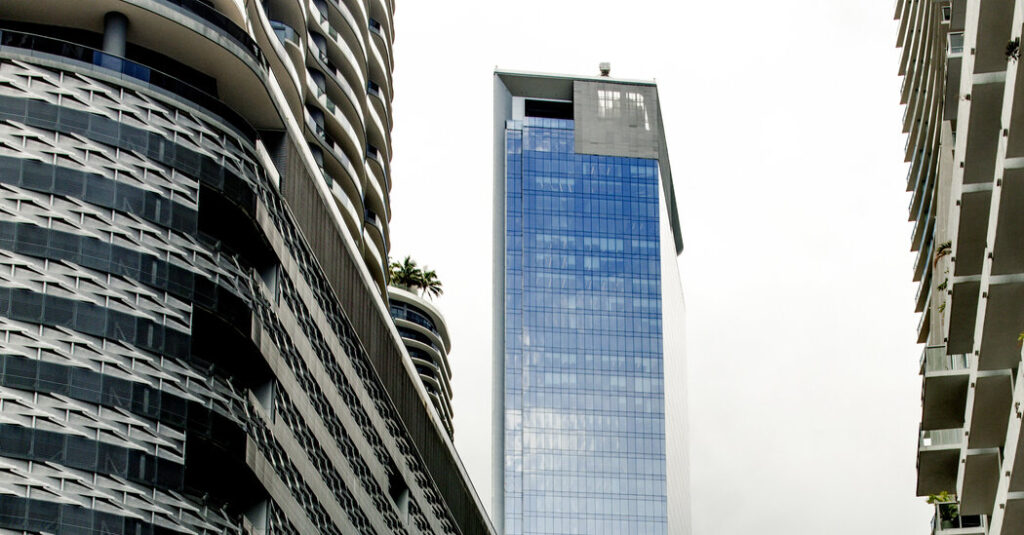
The billionaire investor Peter Thiel broke rental records in June when he leased space in Miami’s Brickell neighborhood for $250 a square foot for his family office. The same month, the billionaire Mohamed Mansour of Man Capital signed a family office lease in the Well, a new complex in upscale Coconut Grove. The Super Bowl champion Tom Brady is getting ready to move his family office, TEB Capital Management, into the same building.
Those moves and others like them have begun to change Miami’s office landscape, part of a growing wave of firms opening there to manage an individual’s wealth and private affairs. As more high-net-worth individuals have migrated to Miami since the Covid-19 pandemic, the need for these private firms there has increased, too.
Single-family offices, tracing their roots back to the Rockefellers in the 19th century, have grown substantially this decade. In 2024, there were more than 8,000 single-family offices globally, up about 30 percent from just over 6,000 in 2019, according to the latest report on family offices by Deloitte. That number is expected to exceed 10,000 by 2030, or roughly 75 percent growth over 10 years.
The rise comes from the rapid increase in the concentration of wealth. In 2024, the total estimated wealth of families with family offices was more than $5 trillion, compared with a little over $3 trillion in 2019, according to Deloitte. More money leads to more complex holdings, and accountants, tax experts and other firms have emerged to fill the gaps.
In Miami, brokers have had to move unusually fast to keep up with the pace of requests recently for family office space. During the second quarter of 2026, 15 percent of new leasing activity in Miami was tied to financial service expansions, which include family offices, according to a report from Blanca Commercial Real Estate, an independent brokerage and advisory firm.
The average assets under management of family offices was $2 billion in 2023, according to the Deloitte survey of 354 single-family offices around the world, including those of prominent families. More than 120 are already set up in the Miami area, with median assets under management of $350 million, according to research from Altss, which tracks family office data.
Now, more families outside the ultrahigh-net-worth tier are requesting office space.
“Twenty years ago, it was the uber wealthy and it was very investment focused,” said Lee-ford Tritt, a professor at the University of Florida’s Levin College of Law who focuses on estate planning. “Now they’ve become very much management vehicles for families with very complex holdings.”
The rising demand in office space has led to higher, more competitive leasing prices, analysts and real estate leaders said. Between 2020 and 2025, average asking rents for office space in Miami-Dade County increased more than 50 percent, according to data from Blanca and JLL, a real estate services firm.
During that period, according to the report, comparable markets did not see such steep growth. Austin, Texas, rents increased by almost 18 percent, Dallas by 13 percent and Raleigh, N.C., by 8 percent. New York City and San Francisco experienced declines, with average asking rents falling 10 percent and 15 percent.
“In New York, one building gets filled up and it’s a big deal, but it’s not a market changer,” said Brian Gale, the vice chairman of Cushman and Wakefield in Florida. “In Miami, because our market is so much smaller than New York or Chicago or Northern California, our rents went up two to three times” what they were before a huge wave of people moved to Miami during the pandemic, he said.
Miami, West Palm Beach and Boca Raton already have the lowest rates of office vacancies among the largest national markets — even though Miami has the highest rates of office construction in the United States, according to the Miami Association of Realtors.
More high-net-worth individuals have migrated to Miami in recent years partly because there is no state income tax, at a time when California, New York and Washington State — the traditional hubs for the tech and finance industries — are proposing new levies on the ultrawealthy.
Ken Griffin moved his personal residence and the global headquarters of his hedge fund, Citadel, to Miami from Chicago in 2022. (He bought an entire city block in the Brickell financial district.) Mark Zuckerberg, Jeff Bezos and Mr. Brady have also all made Florida their home base. With these moves comes the need for family offices nearby. Mr. Brady’s family office, for example, is a roughly 15-minute drive from his home in Indian Creek Village, a neighborhood known as “Billionaire Bunker” in Miami-Dade County.
Family offices vary in size, but they can often be lean operations with just one or two family members working out of the space. On average, 15 employees work in a family office, according to Deloitte’s report, but larger firms can have a staff of more than 20 people.
Accounting firms, law offices and other white-collar firms that service family offices have taken notice and begun to open satellite branches around Miami to meet the demand.
“The talent pool in Miami has grown significantly,” said Ricardo Gonzalez, an international director of wealth management at UBS who is based in Miami. “The influx of experienced private bankers, investment professionals, tax experts, attorneys have made it very attractive for family offices.”
Developers have been changing their tactics to attract attention. Some new projects, including the Well, are focused on distinct identities such as wellness or art. And some buildings are created for multiple family offices.
“They all have a unique identity like you would find in New York City — SoHo is different than Midtown,” said Tere Blanca, the chief executive of Blanca, which represented the landlord and developer at the Well for several of the building’s signings. “Everyone decides what makes sense based on how aligned their brand is with that neighborhood,” she added.
Even with the momentum, those paying attention to the real estate market in Miami don’t think the city will become the next Wall Street or Silicon Valley.
“I don’t think Miami will ever compete with New York financial, I think they complement,” Mr. Tritt said. “Most of the families who live in California and New York that also live in Florida, I think they’re going to bifurcate.”
As for Miami’s current injection of fortune, Mr. Tritt said: “Wealth attracts wealth.”