

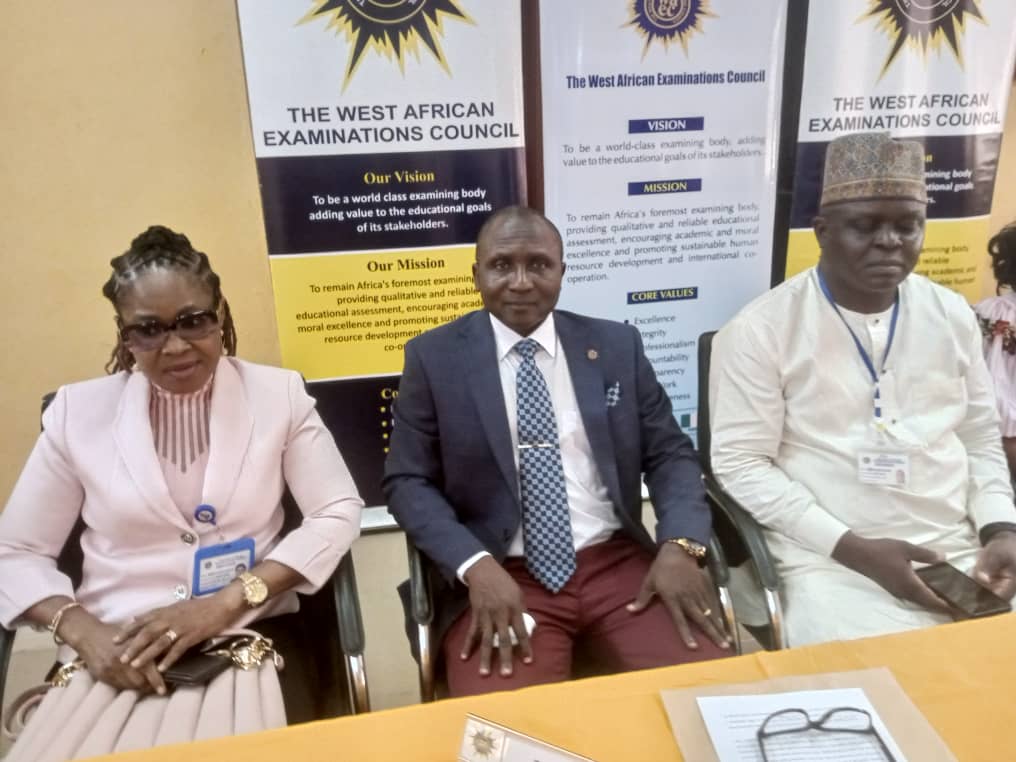
The West African Examinations Council (WAEC) on Wednesday, announced the results of the 2026 Computer-Based West African Senior School Certificate Examination (CB-WASSCE) for school candidates, with 1,200,514 candidates, representing 61.54 per cent obtaining credits in at least five subjects, including English Language and Mathematics.
Briefing journalists in Lagos, the Head of the Nigeria National Office (HNO), Dr. Amos Josiah Dangut, stated the figure represents a 1.42 percentage-point decline compared to the 2025 performance.
He disclosed that 1,950,726 candidates sat the examination out of the 1,959,668 who registered from 24,207 schools across Nigeria, as well as selected schools in Benin Republic, Côte d’Ivoire and Equatorial Guinea operating the Nigerian curriculum.
The analysis of candidates’ performance showed that 1,687,378 candidates, representing 86.50 per cent, obtained credit passes in at least five subjects, with or without English Language and Mathematics.
According to Dangut, 1,834,695 candidates, representing 94.05 per cent, have had their results fully processed and released, while the results of 116,031 candidates (5.95 per cent) are still being processed due to issues that are being resolved.
He assured affected candidates that efforts were underway to conclude the process within a few days.
The HNO also disclosed that the results of 167,486 candidates, representing 8.59 per cent of those who sat the examination, had been withheld over alleged involvement in examination malpractice.
He noted that the figure is lower than the 9.7 per cent recorded in 2025, indicating a reduction in malpractice cases.
He attributed the improvement to the council’s sustained anti-malpractice measures, including the expansion of computer-based examinations, serialisation of question papers and the introduction of the Digital Examiner Marking System (DEMS), which has accelerated result processing and enhanced service delivery.
“The council has consistently devised means of combating examination malpractice. The adoption of computer-based examinations and other innovations has significantly strengthened the integrity of the examination process,” he stated.
Dangut whose tenure as Head of the Nigeria National Office ends with the release of the 2026 results described the council’s transition to computer-based examinations as a landmark achievement, saying WAEC had become the first examining body in Africa and among the first globally to conduct achievement tests using the computer-based mode.
He noted that for the second consecutive year, school candidates were allowed to choose between computer-based testing and the traditional pen-and-paper format.
The WAEC boss however stated that the conduct of the examination was not without challenges, citing logistics, late registration by schools, inflation-driven operational costs and the activities of rogue websites promoting fake examination materials.
He condemned the activities of fraudulent online operators who exploit students and parents by peddling fake examination questions and spreading misinformation in the council’s name.
According to him, “the council, working with security agencies, arrested some of the perpetrators, while supervisors and invigilators found aiding examination malpractice would face sanctions through the Nigeria Examinations Committee (NRC) and relevant state ministries of education.”
Dangut also revealed that 1,213 candidates with special needs registered for the examination and were adequately catered for.
They included visually impaired, hearing-impaired, physically challenged and other candidates with disabilities, whose results have been released alongside those of other candidates.
As part of efforts to improve access to results, he announced that WAEC had discontinued the issuance of printed smart identity cards containing result checker PINs.
Instead, candidates can now generate their result-checking e-PINs directly through the council’s digital platform using their National Identification Number (NIN), while digital certificates will be available within 48 hours of result release. Hard-copy certificates, he added, will be ready within 90 days.
He called on governments and school proprietors to invest in digital infrastructure by equipping schools with functional computer laboratories and reliable power supply to support computer-based learning and assessment.
“Strengthening school infrastructure will not only facilitate a seamless transition to digital examinations but also improve teaching and learning outcomes in line with global best practices.
Dangut also urged candidates sponsored by states indebted to the council to prevail on their governments to settle outstanding obligations to enable the release of their results.
Funmi Ogundare
Follow us on: