

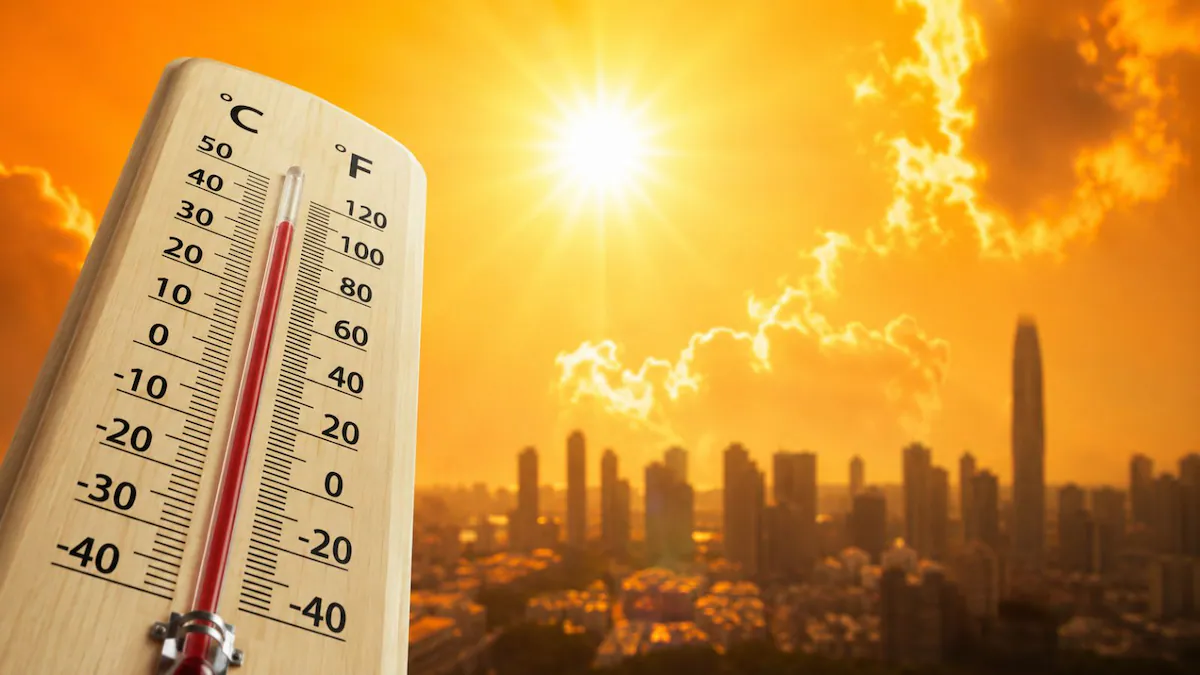
July averaged 76.89 degrees Fahrenheit (24.94 degrees Celsius) across the Lower 48 states, eclipsing the Dust Bowl’s July 1936 by an eighth of a degree. Records go back to 1895.
“It’s not good when you’re breaking records from the Dust Bowl, which we are in this case,” said meteorologist Jeff Masters of Yale Climate Connections. “And that was a crazy sort of situation where you put tens of millions of people in motion. You had this great migration because of the drought and the heat that hit the centre of the US — just a cataclysmic event in US history. If we’re exceeding records from the Dust Bowl, that says that we’re in deep trouble.”
Although it was unusually cool in Alaska, hotter-than-normal conditions blanketed the Lower 48, with the most extreme heat recorded in the Mountain West, Southwest, Northern Plains and Southeast. The heat was so widespread that every one of the Lower 48 states was at least 1 degree Fahrenheit (nearly 0.6 degrees Celsius) warmer than the 20th-century average, said Russ Vose, chief of monitoring at NOAA’s National Centers for Environmental Information.
The heat during the Dust Bowl years was more concentrated in parts of the Midwest and was aggravated by agricultural practices at the time, Vose said.
What is happening now is driven by the burning of coal, oil and gas, scientists said.
“Extremely high temperatures across the continental US this summer, along with intense drought and fire conditions, are absolutely consistent with the climate change signal,” said Katharine Jacobs, a climate scientist at the University of Arizona.
The biggest driver of the record heat was nighttime temperatures, which smashed the previous record for the hottest minimum temperatures by 0.7 degrees, NOAA said. Hotter nights are a classic sign of human-caused climate change, according to scientists and several studies published in peer-reviewed literature. NOAA’s calculation is based on the average temperature over 24 hours, rather than just the highs or lows.“If you’re talking heat waves, that nighttime low is incredibly important for determining total heat stress,” Masters said. “So if it doesn’t cool off at night, your body doesn’t have time to readjust to all the heat.”
As nighttime temperatures increase, more people die and lose sleep, studies show.
The years 2021 and 1936 are tied for America’s hottest summer, which runs from June through August. Through July, 2026 is slightly cooler than 2021, which was driven by record heat in June.
Because of climate change, Masters said, “this may be one of the coolest years we’re gonna experience for the rest of our lives.”
What is needed, Masters said, is “to stop burning so many fossil fuels. We also need to be spending money to adapt to the new climate that we’ve put in place.”