
Trump’s tariffs were supposed to boost American manufacturing, but the new levies are actually pushing some companies back to China


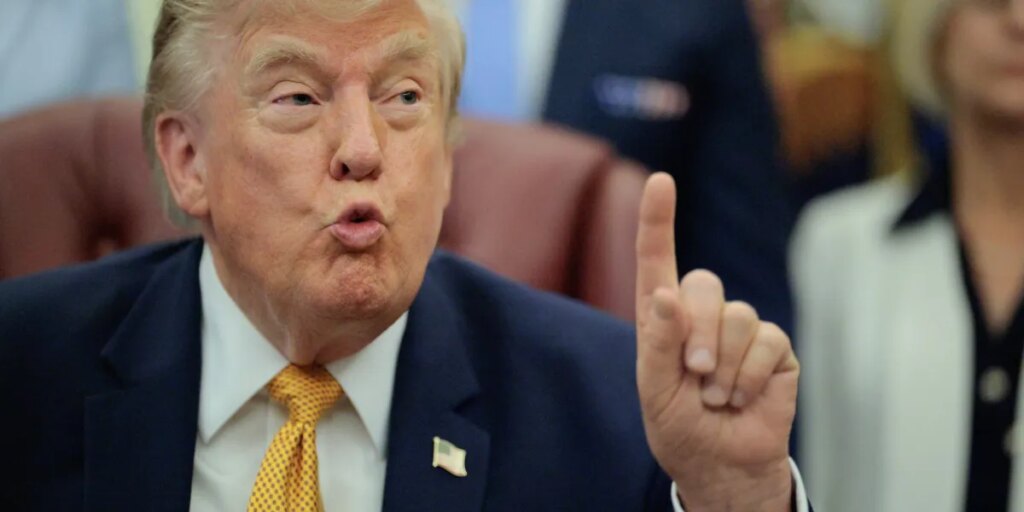
In both of his administrations, President Donald Trump has wielded tariffs as a means of discouraging trade relationships with China, as well as incentivizing American reshoring, but this strategy may be backfiring. As Trump’s import tax plan continues to fluctuate, some U.S. companies who initially moved away from China are now reinvesting in suppliers there.
Alliance Consumer Group, a Texas-based flashlight company, encouraged its Chinese manufacturer to build a factory for its products in Thailand when U.S. tariffs on China ballooned last year, making it financially challenging to import manufactured goods from there. But now that the levies on Chinese goods have fallen to similar levels as other areas of southeast Asia such as Vietnam and Thailand, Alliance Consumer Group is reconsidering where it manufactures its flashlights.
“Have we pulled back to China? Yes, we have,” Phil Laster, chief operations officer of Alliance Consumer Group, told the New York Times.
According to Mary Lovely, an economist at the Peterson Institute for International Economics (PIIE), there’s other anecdotes like this one. There’s not yet quantitative data on how many U.S. companies are returning to Chinese suppliers as a result of tariffs, but a trend in this direction “does make sense, given that the tariff differential between China and other countries has come down because of the invalidation of the Liberation Day tariffs,” she told Fortune.
The U.S. still has levies imposed on Chinese goods, but the magnitude of the taxes have fallen from the 145% imposed on Liberation Daylast April. Under Trump’s recent Section 301 tariffs, China and Vietnam face a similar 12.5% tariff rate, and Cambodia, Indonesia, and Malaysia have a 10% rate.
While Trump’s new batch of levies has effectively neutralized the advantage other countries have over China in exporting cheaper goods to U.S. companies, there have long been signs the tariffs have done little to curb America’s reliance on China for key products like consumer goods. Moreover, the trickle of U.S. companies returning to China for those goods may be indicative of a larger phenomenon economists say is unlikely to resolve anytime soon: The U.S. is tethered to China when it comes to trade, and it means Trump’s reshoring efforts will likely remain a fantasy.
“The story that it is bringing back manufacturing is really not the story,” Lovely said. “Manufacturing is not coming back.”
Tariffs have done little to curb Chinese imports
Indeed, between April and November of last year, the U.S. saw 59,000 fewer manufacturing jobs. While Trump’s tariffs on China beginning in 2018 have correlated with lower rates of Chinese imports, that data point doesn’t tell the whole story, Lovely argued. According to data collected by PIIE and published on Tuesday, the share of China’s imports to the U.S. fell from nearly 18% in 2018 to about 11% today, but China’s share of total value added in U.S. imports has remained at about 15% over the same time period.
The likelihood of the U.S. shrinking its share of Chinese imports in less than a decade is unrealistic, according to Lovely. For example, she explained, a tech company may expand manufacturing in India in order to dodge tariffs on China, but that facility in India may still source its components from China.
“It’s kind of hard to believe, and in fact, it is stupid to believe because what was happening…is that a lot of these inputs just went through third countries,” she said. “There has been a lot less decoupling than the top-line numbers indicate.”
Why the U.S. can’t decouple from China
Even if the U.S. were to take more drastic action to decouple from China, economists warn the costs to do so would be prohibitive. EY-Parthenon calculated the U.S. would have to invest $13.7 trillion over the next 25 years in order to effectively stop its reliance on China for key goods. Those costs would include infrastructure build-outs, as well as research and development, transportation networks, and workforce training.
This reliance developed as a natural result of globalization, but has grown more intense as U.S. companies continue to rely on China thanks to cheaper labor and manufacturing costs.
“You have this dynamic, this dialect between these two forces, which has always been there for many hundreds of years in one way or another, but which is now so pronounced,” Mats Persson, EY-Parthenon UK macro and geostrategy leader, previously told Fortune.
The U.S. has made strides beyond tariffs to try to cut its reliance on China—including expanding rare earth refiners domestically and floating legislation that would increase transparency about foreign influence in Big Pharma—but there are some products, including industrial supplies, where the U.S. will continue to buy from China, Lovely said.
It’s here where the U.S. is in a tough spot, she suggested. While the Trump administration can carve out exemptions for tariffs and impose levies to address certain products that can be manufactured in the U.S., reshoring efforts will also likely have to include subsidies like a Biden administration-era CHIPS Act, which is unlikely given the mounting U.S. debt.
“Tariffs would probably be part of any serious policy package,” Lovely said. “But it can’t be the only one.”