

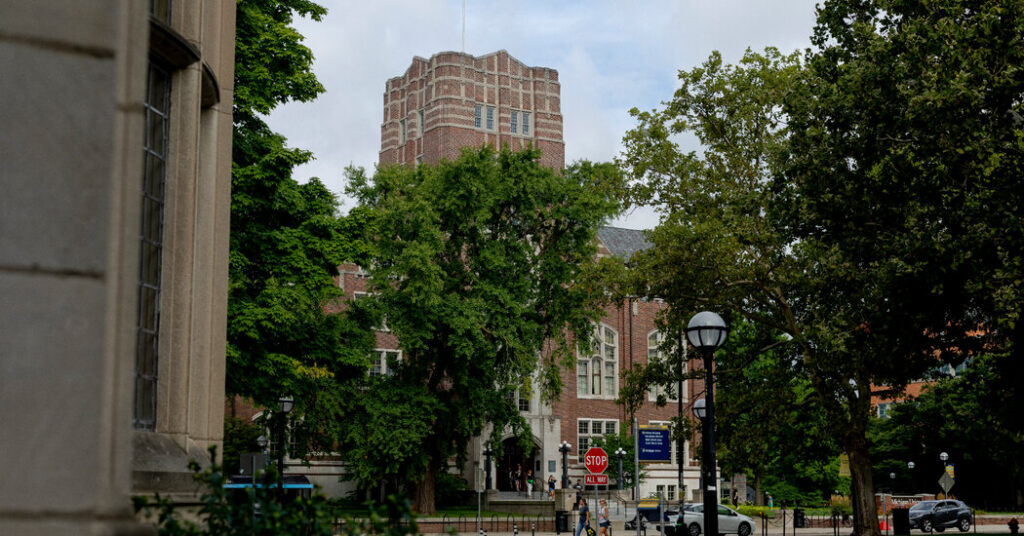
The University of Michigan will replace traditional letter grades for some first-semester freshmen with a pass/fail-style grade, to more gently ease new students into academic life.
The plan will go into effect in the fall of 2027 at the university’s College of Literature, Science and the Arts. It is intended to relieve pressure on freshmen and help them “start strong and curb the mental health crisis unfolding among college-aged individuals,” the university said in a statement.
Under the plan, first semester letter grades will still be recorded internally by the school for things like compliance reporting and eligibility for academic honors, the university said. Student transcripts, however, will reflect either “pass” for each course or “no credit.” First-semester grades will not factor into grade-point averages.
The new grading plan, reported earlier by The Chronicle of Higher Education, is similar to how the Massachusetts Institute of Technology records grades. First-semester freshman grades at M.I.T. are reported as either pass or no record, to allow students time to get accustomed to an increased college workload and different teaching methods, the M.I.T. Registrar’s Office explains on its website.
In many courses at Brown University, a student may choose between two grading options, according to the university’s Office of the Registrar. One is a grade of A, B, C or no credit. The other is a grade of satisfactory or no credit.
The University of Michigan said the point of the change “is to help first-year students acclimate to the demands of college,” and to allow students to set their early academic path with less grade pressure. “For example, they can explore a subject that may not come easily to them or take a course in a new field without the fear that a low grade may have long-term consequences,” the school said in its statement.
The College of Literature, Science, and the Arts, the university’s largest college, has about 3,500 first-year students, according to the university. The total number of university freshmen is about 8,000.
Summit Louth, study body president at the university, called the grading change “an incredible thing” and said that students he had heard from have overwhelmingly supported the new policy.
“It will do a lot to help get students into a routine that is healthy and sustainable for the time they are here,” he said.
Mr. Louth, 20, a junior, said that such a policy would have helped him when he was a freshman arriving on campus. “You’re just figuring out how to be an adult and live on your own,” he said. “It gets extremely stressful having to balance that with also wanting to be a straight-A student.”
The policy faced immediate criticism from people who have argued that making academics easier for students does not ultimately help them. Rick Hess, a senior fellow and director of education policy studies at the American Enterprise Institute, said the policy is “exactly the wrong diagnosis.”
“It turns out that swaddling college students does not actually improve their mental health,” he said. “It creates entitlement. It creates a lack of productive tension.”
Mr. Hess urges the opposite approach. He called for “ratcheting up rigor” in coursework and “ratcheting up expectations” on students, with things like robust minimum reading requirements and curbs on cellphone use on campus.
Jonathan Alpert, a psychotherapist and author, agreed that getting a bad grade can feel awful and make students anxious. “But feeling bad isn’t the same thing as being unwell,” he said. “I worry that therapists and institutions have blurred that distinction.”
“College should be one of the places where young people learn that evaluation isn’t always pleasant,” he said. Students might get a C or worse, hear criticism from a professor or fail to get the internship they wanted. “Those experiences can hurt, but learning that you can tolerate them and move forward prepares you for adulthood,” he added.
Chris Hulleman, a professor of education and public policy at the University of Virginia, said it was a positive sign that “institutions are thinking about grading and doing it differently.”
Research suggests that pass/fail grading helps reduce burnout in students, and that “from a motivational perspective, grades that compare students with each other tend to increase anxiety,” he said.
Other prominent schools, such as Harvard University, have taken the opposite tack with grades — making them more competitive. The Harvard Faculty of Arts and Sciences voted overwhelmingly in May to restrict the number of A-grades professors may award in undergraduate classes. The school capped A’s at roughly 20 percent of the grades in a class after extensive study and debate over how to address grade inflation.