

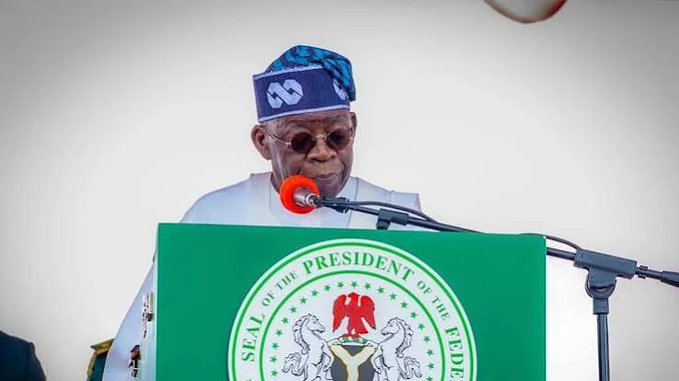
(President Bola Tinubu. Photo by Guardian Nigerian News)
President Tinubu has ordered the Economic and Financial Crimes Commission to immediately petition the court to set aside the order restricting bank accounts belonging to the Osun State Government.
The President expressed embarrassment over the timing of the EFCC’s action, particularly given that the state’s gubernatorial election is scheduled to occur within days.
The directive came in response to widespread controversy surrounding the commission’s decision to freeze the state government’s accounts shortly before the electoral contest.
The President subsequently contacted Governor Adeleke by telephone to notify him of the instruction issued to the EFCC to lift the court-imposed restriction on the state’s account.
In its response to the presidential directive, the Osun State Government praised the President’s intervention as a triumph for constitutional governance and the rule of law.
Governor Adeleke has initiated legal action by filing a ₦2 billion lawsuit against the EFCC, contesting what he characterizes as the unlawful restriction of the state’s Federal Statutory Allocation Account.
The suit seeks a court declaration that the defendants’ actions were unconstitutional and without legal foundation.
The Governor has requested the court award ₦2 billion in exemplary and aggravated damages for the unlawful interference with public resources, along with an order requiring the defendants to bear litigation costs.
The Osun State Government has refuted the EFCC’s allegation that the account freeze stemmed from suspected diversion of approximately ₦11 billion in ecological and intervention funds.
Officials maintained that the commission’s action was politically motivated, asserting that the true purpose was to prevent payment of palliatives promised to workers.
They contended that the state has already fulfilled these commitments following worker negotiations and stressed that government resources are directed toward public goods, services, and infrastructural development rather than illicit appropriation.
Former Vice-President Atiku Abubakar characterised the EFCC’s timing as constituting an assault on democratic principles, arguing that freezing a state’s operational account before an election risks disrupting governance, delaying salary disbursements, and undermining public service delivery.
He warned that anti-corruption agencies must not be deployed as political instruments against opposition governments and called on democratic actors to resist what he described as systematic weaponisation of state institutions.
The African Democratic Congress similarly challenged the President’s claim that he had directed the EFCC, arguing that his intervention contradicted assertions of the agency’s operational independence from the Presidency.
The party questioned whether the President possessed authority to reverse court proceedings for political considerations and contended that such interventions expose institutional dependence on presidential discretion.
An ADC legislative candidate disputed the existence of a court order authorising the EFCC to vacate its restriction, emphasising that only competent courts possess the authority to vary or nullify their own orders.
The candidate criticised the presidency’s narrative as legally indefensible and called for adherence to the rule of law rather than public relations management.
An EFCC spokesperson defended the agency’s action during a television programme, explaining that the restriction targeted suspicious activities within a single account over a one-week period involving multiple fund transfers.
The spokesperson clarified that the restriction did not constitute a blanket freeze of all state accounts and that the measure was temporary, lasting up to 72 hours before court authorisation becomes necessary.
The spokesperson cited provisions of the EFCC Act and Money Laundering legislation as conferring authority for such temporary restrictions and stressed that the state retained access to other accounts for governance operations and monthly salary payments.