
Tinubu Leaves Primary, Secondary School Qualification Fields Blank In 2027 INEC Nomination Form

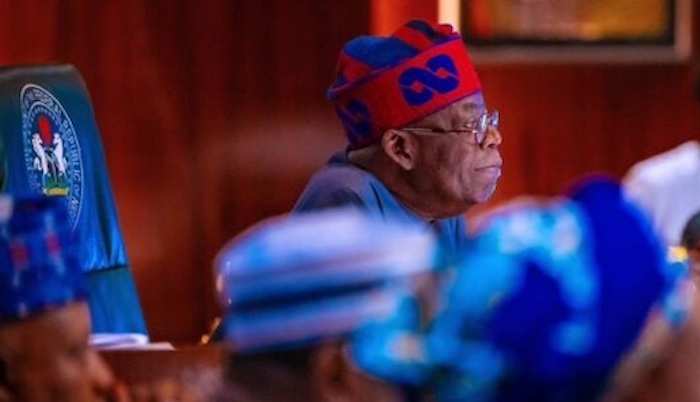
The personal particulars and academic credentials submitted by President Bola Ahmed Tinubu for the 2027 presidential election indicated that he listed only his University qualification in the educational qualifications section of his EC9 Nomination Form, leaving the spaces provided for his primary and secondary school qualifications blank.
The documents, published on Saturday by the Independent National Electoral Commission (INEC) is in line with its revised Timetable and Schedule of Activities for the 2027 General Election, and form part of the nomination papers filed by candidates seeking to contest the January 16, 2027 presidential election.
The commission also published documents of the Vice Presidential candidates of the political parties.
A review of Tinubu’s EC9 Form indicates that under the section for educational qualifications, the President listed a Bachelor of Science (B.Sc.) in Business Administration obtained from Chicago State University, United States, in 1979.
The spaces provided for primary and secondary school qualifications on the summary page of the form were left blank.
However, Tinubu attached copies of his Bachelor of Science degree certificate and his National Youth Service Corps (NYSC) certificate as part of the supporting documents accompanying his nomination papers.
The President stated that he was born on March 29, 1952, in Lagos and listed his occupation as “Politician.”
He also outlined his employment history, indicating that he worked at Mobil Nigeria Limited between 1983 and 1992 before serving as Governor of Lagos State from 1999 to 2007.
Tinubu listed his current employment as the Federal Government of Nigeria from 2023 to date and declared that he had never been dismissed from the public service.
Obi in the document he submitted to INEC described himself as a “Public Servant”, even as the documents show his complete educational history from primary school to the University.
He also stated that he was born on July 19, 1961, in Onitsha, Anambra State.
Obi provided his educational progression beginning from primary school.
He said that he attended St. Augustine’s Primary School, Anambra, where he completed his primary education in 1973, before proceeding to Christ the King College (CKC), Onitsha, where he obtained the West African School Certificate (WASC) in 1978.
He also declared that he obtained a Bachelor of Arts (B.A.) in Philosophy from the University of Nigeria, Nsukka, in 1984.
The University degree certificate attached to his nomination papers further shows that he graduated with Second Class Honours (Lower Division).
Obi also attached his NYSC certificate, indicating that he completed the mandatory national service between May 1985 and March 1986.
However, the section provided for previous working experience in his EC9 Form was left blank.
He also declared that he had never been dismissed from the public service.
Former Vice President Atiku Abubakar stated that he was born on November 25, 1946, in Jada, Adamawa State, and listed his occupation as “Businessman.”
The documents also show that Atiku listed his educational qualifications beginning with the First School Leaving Certificate (FSLC) obtained in 1954, the West African School Certificate (WASC) obtained in 1961, and a Master of Arts (M.A.) in International Relations, which he indicated was obtained in 2020.
He stated that he served in the Nigerian Customs Service from 1969 to 1989, leaving through voluntary retirement.
He also listed the Presidential Villa, Abuja, as his place of employment from 1999 to 2007, indicating that he left office after two terms elapsed.
The former Vice President also declared that he had never been dismissed from the public service.
The publication of the documents marks the commencement of the statutory period for public scrutiny of candidates’ personal particulars and supporting documents.
Under Section 33 of the Electoral Act, any person who believes that information contained in the affidavit or documents submitted by a candidate is false may institute an action in court with evidence challenging the declaration.
INEC had fixed August 1 for the publication of the personal particulars and credentials of presidential candidates following the conclusion of party primaries and the submission of nomination forms for the 2027 general election.
The presidential election is scheduled for January 16, 2027, while campaigns for presidential and National Assembly elections are expected to commence later this month in accordance with the Commission’s revised timetable.
Friday Olokor
Follow us on: