

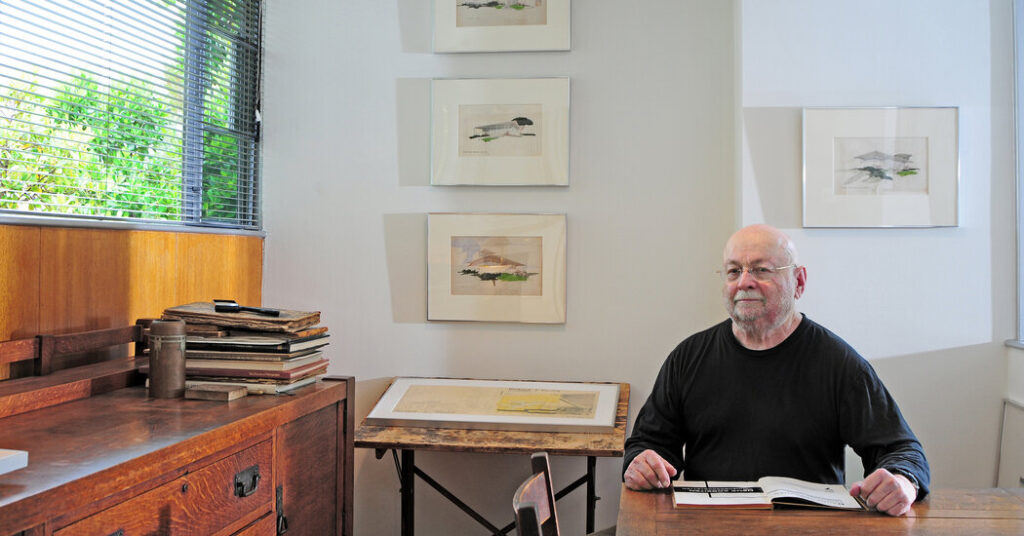
Thomas S. Hines, an architectural historian whose thorough research, crystalline writing and unending passion for the urban landscape of Los Angeles did much to cement the region’s reputation as a global center for modernist design in the 20th century, died on July 26 in Santa Monica, Calif. He was 89.
His son, Taylor Hines, said the death, at a hospital, was from complications of pneumonia.
Born in the South and educated in the Midwest, Professor Hines came to Southern California as a young academic to teach at the University of California, Los Angeles, and never left. Although his first book was a biography of the Chicago architect and planner Daniel H. Burnham, he spent the rest of his long career enmeshed in the human landscape of his adopted city.
Professor Hines’s achievement was twofold: He not only demonstrated that the modernist architecture of midcentury Southern California was worthy of systematic historical attention, but he did so by expanding the scope of his field to include economic, social and cultural history.
Rather than seeing the architecture of Los Angeles as an outlier to European and New York modernism — or the region as merely a refuge for European architects fleeing fascism — he showed that California modernism had its own history and dynamics.
“Since the early 20th century, Southern California has evolved as a unique laboratory of modernism,” he said in a 2010 speech at the Hammer Museum in Los Angeles, “inspired by a kind of ballet of adventurous architects and sympathetic clients and builders, and by social and economic forces sympathetic and otherwise, in a physical and psychological climate that has always seemed to encourage experimentation and innovation.”
In his own writing and that of his students, he insisted on clarity and accessibility, based on the belief that the work should speak to readers outside the academic world. He wrote extensively for general-interest publications, including The New York Times, and in his spare time gave walking tours around the U.C.L.A. campus in Westwood.
“He was always interested in reaching a broad audience and moving beyond the confines of what can sometimes be narrow architectural history filled with insider language or jargon,” Christopher Hawthorne, a former architecture critic for The Los Angeles Times who now teaches at Yale, said in an interview.
In 1982, Professor Hines published the first significant biography of Richard Neutra, the Austrian-born architect whose work in Southern California is considered foundational to the region’s modernist aesthetic. He loved Neutra’s work so much that he later lived in an apartment building that Neutra designed.
On the strength of that book, “Richard Neutra and the Search for Modern Architecture,” Professor Hines was invited to join Arthur Drexler, director of the department of architecture and design at the Museum of Modern Art in New York, in curating a major exhibition on Neutra’s work. When it opened at MoMA in 1982, the show established Neutra as one of the leading modernist designers of the 20th century.
Professor Hines followed his Neutra book with another groundbreaking biography, “Irving Gill and the Architecture of Reform” (2000).
Like his other work, this book showed how Mr. Gill, working largely outside the influence of European modernism, had developed a stripped-down, rational aesthetic that served the social and cultural needs of Los Angeles as it grew rapidly in the early 20th century.
Thomas Spight Hines Jr. was born on Oct. 28, 1936, in Oxford, Miss. His parents, Thomas Spight Hines Sr. and Polly (Moore) Hines, were teachers, and his father later became the dean of student life at the University of Mississippi.
Among his jobs as a teenager was running errands for William Faulkner’s mother, Maud.
After receiving his bachelor’s degree in history from the University of Mississippi in 1958, he enrolled in the graduate history program at the University of Wisconsin.
While working on his dissertation, he accepted a teaching position at U.C.L.A. He arrived in 1968 and received his doctorate in 1971. His dissertation, on Burnham, the Chicago architect, became his first book.
His marriage to Dorothy Taylor ended in divorce. Along with his son, he is survived by a daughter, Tracy Woodford; three grandchildren; and a sister, Sally Hines.
Professor Hines never lost his Southern drawl, nor his connection to Mississippi and Faulkner. In 1996, he published “William Faulkner and the Tangible Past: The Architecture of Yoknapatawpha,” an examination of how the Nobel Prize-winning writer had incorporated buildings into his work.
“Architecture in the Sun: Los Angeles Modernism 1900-1970,” published in 2010, was Professor Hines’s last major work. At more than 700 pages, it is the definitive history of modern design in Los Angeles.
In the book’s introduction, he explained why a boy from the Deep South would fall in love with the automotive chaos of Southern California.
“One of the most compelling things about L.A.,” he wrote, “is the way it has seemed — perhaps more than any other city — to teeter so beguilingly on the edge between the comic and the tragic, the latter becoming especially poignant when contrasted with, and illuminated by, that almost constant sunshine.”